Heat Treating, general discussion
Annealing, Hardening, Heat Treating, Tempering
541 topics in this forum
-
I am relatively new to blacksmithing but have gotten far enough to know when something is not getting hard. I use Canola oil as my quenching medium & have succesfully hardend two chisles, & two punches from old coilspring. But I have recently purchased some 4140 & have made some more tools out of it but it seems unable to harden. If anyone has any suggestions I will accept them gratefully.
-
- 17 replies
- 5.2k views
-
-
OK.. So I've heard that people make disposable (or limited use) tools out of mild steel, maybe a drift or something I guess. And I've heard people talk about hardening mild steel with things like SuperQuench. But my understanding was that in order to really harden metal, it takes carbon. And mild steel just doesn't have much carbon. I always wrote it off. Earlier I made a few tools from what I assume was mild hex bar. They bent or deformed when used on the one project I used them form. I may have let them get too hot without quenching (I honestly don't recall how much I quenched them while using) but to me, I wrote it off to them being made out of mild steel. Now…
-
- 61 replies
- 75.6k views
- 2 followers
-
-
First i need to say this is my first time doing this or attemptiong it, hence all the questions. I was asked at work to harden EN24t its a part for a rolling mashine that another worker milled out . there is 6x in total they were using these already but decided they want to get them harder, so they can last longer. Could you give me advice how to harden it? (I am using a gas forge for this) from topic (problem with forge. Welding temp) I would heat the steel to 820/850°C how long i should keep in in the forge for? do i just quench in any oil? or sould i use something specific then the tempering : what temperature sould i temper it? or should…
-
- 17 replies
- 5.6k views
-
-
Backstory: an old college friend (whose name happens to be same as that represented by the "J" and the first "C" of my username) is cleaning out his late father's gunsmithing shop and has offered me the tabletop muffle furnace therefrom. It's a Neycraft JFF2000, which has a temperature range of 300F - 2000F and an interior space of 9" wide x 9" deep x 6.5" high. The controls are manual; there's a knob for adjusting the temperature and a pyrometer for displaying it (there's apparently an automatic model that can be programmed for stepping the temperature up and down over specific time periods, but this ain't one, alas.) These retail for about $1400 new, but he's offering m…
-
- 5 replies
- 2.1k views
- 1 follower
-
-
Hello everybody! I made a leaf touchmark from a 12mm annealed drill bit, my question is how should i harden and temper it? Is it possible to harden it in sunflower oil? Thanks is advance.
-
- 7 replies
- 2.1k views
-
-
Finally got around to chabging from used motor oil as my quench oil to canola oil. First time i used it today. I have to admit, it smells a whole lot better than used motor oil. And i didnt feel like i had smoked 3 dozen packs of smokes in one breath. Oh, and i made a hook today as well! Since people are gonna think this: no, i didnt quench the hook in the oil. Im making a chefs knife and quenched the blade in the oil.
-
- 16 replies
- 3.1k views
-
-
I have a old telco heat treat oven. oven and elements work fine.the controller doesn’t work. Can I replace the controller with a digital one? can anyone recommend one? thank y’all
-
- 0 replies
- 895 views
-
-
Hello. How does one reduce grain growth in steel or iron? I know that one can shock it by heating it for a few seconds than dipping it in oil to shock it into contracting. is this the way it is done? I have only seen it done in a hot gas forge though. would it work to stick it in the coals for a few secs and then shock-dip-quenchy thingy it the same way a few times? Thanks, Archie
-
- 49 replies
- 10.8k views
-
-
-
Watching Animal planet, there is a show called Treehouse Masters, this refers to " Treehouse Z" season 6 ep 4 They have a clueless wonder doing some metal work on the show. After twisting the metal for making his railing, he quenches it in a plastic bucket of water, and explains he is annealing it to make it softer, Where do they find these people? Dont these shows have proof readers for accuracy? or at least hire skilled labor?
-
- 11 replies
- 2.6k views
- 1 follower
-
-
I met a smith who lost his home and shop in the California wild fires. Depending on the location of the tool in the fire, what might be the expected damage to the steel with regard to tempering or annealing? Anvil on a burned stump, hammer heads with handles burned off. Tongs? What might be the general consensus on “repair or re tempering”? Fire survivor Anvil and hammer heads? I’m thinking it really depends on the temp and duration of exposure in the fire. Would the hammers and anvil be softer as a result of the heat? He might need to straighten the reins on the tongs, but I think they might be ok. Any thoughts or recommendationS.? Asking for a friend. TIA,
-
- 30 replies
- 5.7k views
- 1 follower
-
-
I am partially color blind, red/green. While at the forge, I can tell when a piece is dull red or white hot, but I couldn't tell between 2 pieces that were pulled out as a test tonight. Others could tell that one was definitely hotter than the other. So... for gauging temperature for heat treating, is there a cost effective IR thermometer or should I just go by magnetic testing? Thanks in advance, Andrew
-
- 6 replies
- 2.1k views
-
-
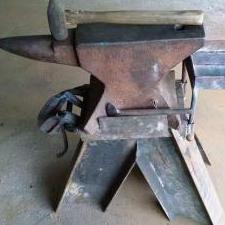
Greetings During my journey on ways to "homemade" an anvil, this is my third construction. This time I decide to try to weld a top plate of hardenable steel. The main body of the anvil is mild steel, the top plate has its origin in a plough share. Before welding the top plate, I tested the reaction of the plough share steel to 7018 welding. So, I took my stereoscopic microscopic and made some pictures. Everything seemed to be O.K, no cracks or separation between welding and steel. So I built the anvil you see above. The top plate covers only the main body and the angular horn (or tail, as you prefer) Now I am about to heat threat the top …
-
- 0 replies
- 1.4k views
-
-
Would it be possible to use some Vegatable oil to harden o1 steel?
-
- 11 replies
- 7.2k views
-
-
I know the difference between mild steel and high carbon steel during a spark test means high carbon steel puts off sparks that fork and look like fireworks while the mild steel tends to have much duller less impressive sparks. My question to all the way more experienced blacksmiths on here is... has anyone found a good rule of thumb for identifying different high carbon steels from spark tests? I use almost exclusively salvaged metal in my forge and I know different metals prefer different heat treats. I know springs from cars are spring steel, tire irons are tool steel etc. but a lot of what I use is scrap from a metal fabrication shop and I have no idea what most of it…
-
- 25 replies
- 7.1k views
- 2 followers
-
-
-
Greetings I have access to agricultural machinery and scrap steel I can extract from there (flail shredder hammers, mechanical hoe and soil tiller blades, plough shares, springs, harrow disks and such) . Usually, before I use this steel, I normalize it a couple of times. But, during the Winter it is much easier for me to anneal this steel. I Just toss the steel inside the wood stove by the evening, the next morning the steel is annealed. So my question is, what is "better" (obtain a less brittle steel) to reuse scrap steel, anneal it or normalize it before forge my tools? Thanks
-
- 2 replies
- 2.6k views
-
-
Hay all I am trying to build a Kiln (Heat treat oven) for my knife making so that I can temper my blades but I am no electrician and I need help figuring out how much resistance I need in the coil that will be heating the oven I'm going to be running it on 220v the oven inner chamber dimensions are 31,1/2 inches deep 8,1/2 inches wide and 6,1/2 inches tall the coil slot is 11 feet long the inner diameter of the coil I made is 9.5mm I wrapped the wire around a 3/8in metal rod and the kanthal wire is 16 AWG, Average wire diameter: 0.0508 in. (1.29032 mm), 0.324 Ohms/ft at 68°F ALLOY: Kanthal A-1 (22% Cr, 5.8% Al, Fe balance). Rated for temperatures up to 1400°…
-
- 2 replies
- 5.4k views
-
-
There used to be sold a style bicycle handlebar bag that used what I think is a formed spring steel rod that fit over the handlebars and looped under the handlebar stem that supported a handlebar bag. For whatever reason this style does not appear to be available any more. I think it is a superior design, very light. I would like to reproduce roughly the shape of the bent metal seen below. The metal rod frame appears to be spring steel, you can squeeze the ends together a fair amount and it returns to its original shape when you let go. I have bent the rod below with and without heat to fit various bikes I have owned, it is very strong but not brittle. …
-
- 4 replies
- 1.5k views
-
-
While doing my hammer tinkering project I had to drop in on the old machinist down the block to get him to turn a drive shaft for me from 4142. Whenever I drop in on Jake it's an experience. Stories, information, tool talk, etc. He was a machinist for Hershey for 30 years and has had his own shop now for just about as long, the old guy sure is busy - I know my phone doesn't ring that often! Inevitably while he's punching numbers into the old black and white VGA CRT attached to one of his lathes or mills, he'll start talking and asking questions. He asked me about quenching and I explained my processes, Parks 50, high temp salts, low temp salts, etc etc. He's no metallurgi…
-
- 4 replies
- 2.1k views
-
-
Hello hello everyone. I want to make a farrier´s brush, and I'm thinking of making it out of used hacksaw blades, annealing, removing the teeth and cutting them in half to make the wires. ¿what type heat treatment should I give to the wires once they are formed into shape, so they don't bend too easily? thanks
-
- 2 replies
- 1.8k views
-
-
I made a set of single jack drill steels for hard rock drilling competitions. The are made from s7. Sent them to phoenix heat treat to have them hardened . Problem is I had them harden the hole tool/ tools. They work great . The working end is just right . The other end that the hammer strikes is to hard and starting to chip. Can I take some of the temper out of this end / soften it up a bit? I was thinking a wet rag over the working end and heating up the striking end ?
-
- 1 reply
- 1.2k views
-
-
So ive poured over PDF files, and forum posts. Even asked questions thru social networking.... But I find the most insightful, soumd, and logical information to be here, on this forum... It is just so difficult, sometimes, to find a clear, to the point answer in all these posts... So what I am curious about is the annealing process of salvaged steel. For conversation sake, let's say a piece of 5160 leaf spring that's been cut off of an old F150. From what I can understand, I need to anneal this piece of steel, before I begin to shape it, if for any reason, to make sure it's as strong as can be... In my readings and research, I was informed that it is nearly impossible to …
-
- 14 replies
- 7.4k views
-
-
I found some properties for the 43xx family of alloys that would seem to apply to 4350, too, but the tempering color for a spring swage is a bit of a mystery to me. Does anyone know generally what I want for a spring swage that will not be used under a power hammer? Do I want straw color, or a bit darker into bronze/purple? I want to minimize deformation while also minimizing brittleness, but not sure what I'm supposed to target for a tool like this. I've never made one before. The 4350 blocks (x2) are just an inch thick each, and about 1.5" long each. They are connected with a 3/8" mild steel bar that acts as the spring. I will be hammering on this to put texture into ro…
-
- 4 replies
- 3.3k views
-
-
I don't know what you call them around the world but in the UK we have a tool called a Fox Wedge. Think a thin wedge about 3 inch long, 1/4 or maybe 3/8th at one end, 1/16th at the other end and a taper ground on the last 16th and about 1 inch wide. You use them to hammer in between machine components to split the faces. I'm going to forge some, mild steel is a bit soft so I'm thinking of using some 9/16th section coil spring that I have from a mate fitting new springs to his 4x4. Does the hive mind think they will be tough enough without hardening? I don't know what steel the springs are and I have not done any heat treating since I made a center p…
-
- 4 replies
- 1.7k views
-