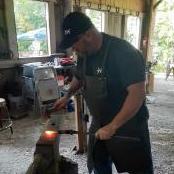
Heat Treating Knives, Blades etc
504 topics in this forum
-
Introduction to Heat Treating simple steels. I would like to start off by stating that this is in the blade section because thicker items need different procedures than the thin cross sections we are dealing with in blades. Mill specs that come with an order of new steel are fine for dealing with cross sections that are inches of thickness, but leave the poor blade smith in the dark as to where to begin. Example of 1095, while fine with a water quench for a large tool, when we use it for a knife, it can crack with a standard water quench. In order for our newly made blade to hold an edge, we must get it hardened. Many have asked how to heat treat a blade. So her…
-
- 99 replies
- 107.6k views
- 1 follower
-
-
British metallurgist Graham Clarke shared his thoughts on how to get good grain size. There’s a good discussion of quenchants starting at the 4:47 mark. https://youtu.be/Yv5Xz8rI6Fs
-
- 1 reply
- 2.3k views
- 1 follower
-
-
For hardening, what type should you use? I was wondering if motor oil (used or new) or something like canola??? Thanks for help.
-
- 29 replies
- 130.2k views
-
-
I've been reading up on some different HT treating techniques, for those of us just using coal forges, and one idea I've seen is using a piece of pipe in the fire to hold the blade in, to help even out and control the heating process. I was thinking of giving that a try. I don't have any scrap pipe I can use since what I have is galvanized, but I do have a 40" chunk of 2x5 tube. The walls are 3/16. I was thinking of cutting off a 12 or 14 inch section, welding some scrap on one end to close it off, and just using that. My question is, do you think this would be an okay option? As I got to thinking about it, I wasn't sure how the rectangle shape of the tube…
-
- 16 replies
- 9k views
-
-
I have been trying to use satanite to produce a hamon on 1095 steel for some time now, but I cannot get the stuff to stick. I have left the blade at a rough 85 grit finish, and applied a slip layer, which I allow to dry before applying the rest of the clay. I then lay down a thicker layer, maybe between 1/8" and 1/16" thick, with the rough consistency of slightly thinned peanut butter. I leave the blade chucked up (or down, I've even tried sideways) and leave it overnight to dry. inevitably, there is clay on my floor after having flaked off the blade. usually at least halfway down it. I'd like to not need to bind the blade in wire, and cant buy any extra ingredients, but…
-
- 5 replies
- 228 views
-
-
I have several old rasps I want to convert to knives, what is the best way to anneal , and then retemper them. I,m pretty new at this and just hope I,m asking the right questions.
-
- 18 replies
- 14.9k views
-
-
Hi, I'm not entirely sure this is the right place for this kind of discussion, but I'll post anyway. Please relocate if necessary, then forgive me ;). Oh, wait, let's first introduce myself a bit ! I'm Stan, DIY enthusiast and woodworker from Belgium. I like most things involving creating beautiful objects and experimenting with new techniques. Last Sunday, I was invited by a friend to try and forge a knife in his workshop. Exactly the kind of things I love. What could possibly go wrong? Well, I had a wonderful day, but ended up with a bit of a disappointing result (to say the least). To be honest, failure didn't really come as a surprise (when you forge your f…
-
- 15 replies
- 2.1k views
- 1 follower
-
-
I want to heat treat axe in oill then in oven but i have problem with convincing folks around me that it will be ok having oven for 2 hours at certain degrees temperature. I can quench it in oil then temper in oven.- Second option is to do it old way with water, get it to red non magnetic, then quench in water for 1-3 seconds then again take it out of water and "chase" colors wich come first and quench it completly What you suggest me. Previously i have bad luck with it i leave weak axe temper maybe blue one, because iam afraid since iam working with water that i will quench it too much and it stay too much soft , i was afaraid it will be brittle and …
-
- 10 replies
- 1.1k views
-
-
Hi, I have been working on a drawknife from a leaf spring, and I am about ready for heat treating. I have read lots, and haven't come up with a good step by step process for hardening/tempering leaf spring. Can anyone give me a simple run down? I was also wondering what to do for quenching, because the bent handles make it near impossible to fit in a pipe. Can I quench it in a shallow pan? Thanks all! Asa
-
- 16 replies
- 1.1k views
- 1 follower
-
-
Up until today I've been heat treating knife blanks in a simple charcoal forge. It's not easy to keep the temperature steady and even harder to keep the tip of the blade at the same temp as the rest of the blade. One trick is to place a piece of steel tubing inside the forge and place the knife blank into that to get a more even temp, but even this doesn't seem to help much since the tip always seems to get way to hot. So, I made a propane forge from a can lined with 2 inches of ceramic fibre blanket treated with waterglass and a thin layer of refractory. The burner is just the burner that came with my propane tank and the 2 bar adjustable pressure regulator. …
-
- 26 replies
- 8.2k views
-
-
I have some dull farrier's grasps. Rasp on one side and file on the other. I'd like to know how some of you heat treat you rasp 'hawks and knives.
-
- 15 replies
- 27.6k views
-
-
I've got a nice cylindrical steel kitchen trash can with a galvanized removable insert. Was thinking that it might be a nice large quench tank. Can one safely oil quench (canola) in a galvanized container or would that be problematic?
-
- 14 replies
- 2.9k views
-
-
Here's my newly completed heat treat furnace, and have yet to see a furnace that is like it or that can do as much. Just put the paint job on it this afternoon. It is digitally controlled with a PID controller, which takes in a temperature reading from a k-type thermocouple and then operates a gas solenoid valve to regulate when the burner is fired to regulate temp. It has about a 40" blade capacity (built it so I can start getting into swords again. I had put aside the long blades until I got a better HT setup). The blades hang vertically into the burn chamber (this is a pretty uniqe design feature that I havent really seen in other furnace designs) which really cuts…
-
- 11 replies
- 5k views
-
-
While browsing through some Facebook videos, I saw a clip of a bladesmith with an interesting twist on quenching — or, more precisely, a quench designed to prevent twisting. I know that there are people who quench blades between aluminum plates to keep them from warping. This appears to be a way to combine that with a standard oil quench, by hinging the plates and adding long handles both to squeeze the plates together and move the blade into the quenchant. I couldn’t save the video itself, but here are some screenshots of the process: Given that the plates are clearly welded to the handles, I suspect that they’re not actually alumi…
-
- 1 reply
- 1.5k views
- 1 follower
-
-
So I've read that some people use a torch, some use a heated chunk of metal they dip in the tank, and some use electric heaters for the quench tank. I'm looking for the easiest best technique. Any ideas would be helpful. I think I'm going to build a tank like the one below. It was posted here and I think it is a great design.
-
- 19 replies
- 11.6k views
-
-
Hi folks, I know that 1080 and 1095 are able to be hardened and tempered at home without a fancy setup. I've done that with just the charcoal forge and the toaster oven, is there any stainless steels that can be similarly heat treated at home without a special kiln for tempering? Oddly enough I've got a pretty bad metal allergy and I instantly rust normal carbon steel knives i've made or owned. Thanks, Corey
-
- 4 replies
- 10.5k views
-
-
Okay so, I've made a knife and it comes to the point where I need to harden the blade. This is where I am stumped. The knife is made from a grobet file that some guy broke. So I have a few questions. 1 How do I gauge the temperature of my piece in the fire without some sort of pyrometer? 2 How do I figure out what the right temperature is? What am I aiming for? I read in "The Art of Blacksmithing" by Alex Bealer, that "In recent times the proper hardening color may be realized by touching the steel with a small magnet as the heat rises. The magnet will stick until the metal reaches a red heat. At the exact moment that the magnet ceases to stick, the steel should …
-
- 15 replies
- 21.9k views
-
-
I put four knives through two normalization cycles before hardening and once they came out I went to try and break it as a test for the others. When I started to bend it, it bent clean over 90 degrees and I was able to move it back and forth across the vice 5 times before it broke. It seemed to have a thin brittle shell but a very soft inside. Felt like I was moving hot steel instead of hardened.
-
- 18 replies
- 3.2k views
-
-
Heat treated in an evenheat oven wrapped in SS foil at 1850 for 20min. Air cooled to about 150 then tempered 220 for 2h then 200 for 2h. The darkness on the left isn't buffing out... and edge feels a bit soft to the HRC test files. Is it a prob with the steel or prob with my heat treat? Thanks Joel
-
- 11 replies
- 2.1k views
-
-
Hello everybody. I'm a new forger. I've been experimenting with forming hot metal for about 3 years but until recently it's been very casual. I have a sword that I've been working on for about 10 hours. This is my first large project, everything else has been made of rebar or rail road spikes. The sword is shaped and I've made the guard and handle. After some more sanding on the handle, it'll ready to be put together for the last time and the pommel made and fit. Therefore, I guess the next step is treating it. I've been looking around for how to go about this process for a long time, longer than I've been making this sword actually, but everything seems to be…
-
- 13 replies
- 2.8k views
-
-
Apparently this technology has been around for a while, although I’ve personally never encountered it before. A fluidized sand bath is a container full of sand (here, aluminum oxide rather than silica, to reduce dust) with compressed gas injected from below, which keeps the sand grains from packing together, making them behave more like a liquid than a solid. In this setup, that container is surrounded by an electric kiln that heats the bath to the precise temperature needed for a specific heat treatment step (e.g., 1,675°F/913°C for normalizing 52100). The result is the fine temperature control of a salt bath or a heat-treatment oven without the environmental hazard…
-
- 2 replies
- 3.6k views
- 2 followers
-
-
I have one again let my hammer overtake my senses in pushing myself on challenging blades. This time I have a rapier blade blank that is 42 inches on the blade itself and currently 49 inches overall. 5160 1/4 × 1 inch at the base tapering to 1/8 inch at the tip. I have 2 options, 1; I go to another shop that has a 5 burner forge and bring the quench tank I'm going to build for it or 2; I do a trench forge with an air pipe and charcoal and laying the blade itself on a piece of angle iron to help keep it straight and heat evenly until I quench. I will have a straightening jig ready to go in my post vice and I'm probably going to have to torch temper to straw…
-
- 2 replies
- 1.9k views
-
-
So as I understand the heat treat process it is a sequential process of normalization, followed by the quench, then ultimately the temper. Here is my dilemma: I forged a piece of 5160 with intentions of making a filet knife for a fisherman buddy. I made sure to only strike while the steel was a dull orange color or brighter. After forging I profiled and did my preliminary grind to make the final grind easier. I normalized twice ( I have recently read on this forum the preferred number is 3 and will implement this next time), quenched in preheated oil and tempered at 400 for 2 hours and allowed it to cool inside the oven down to room temp. I got that straw color I ha…
-
- 17 replies
- 5.1k views
- 1 follower
-
-
finishing up a blade I made and running into some trouble with keeping the blade straight steel: 1095 spine thickness: .07-.08 in oil: parks 50 Quench temp: non-mag +4-8 seconds oil temp: 6*C doing best to move blade in up-down motion only on second try immediately after oil stops boiling placed between anvil and a large flat piece of steel, still bent. 3rd try same plus pushing on plate with my weight, not as bad but still some. Now figuring I need reanneal and normalize again before trying any more on the plus side the blade did come out hard (take half a win over a full loss) results: #3 TIA for any…
-
- 24 replies
- 3.6k views
-
-
What causes a blade to bend when quenched? All was going well, it was straight in all directions, heated to just above critical temp, and held there for a minute or two. Then into the quench. It took an immediate hook to the right. It's a cable billet that I'd welded up a couple of weeks ago. It was an experimental blade, using clay on the spine to get a "Hamon". It took a beautiful curve, but also a bend to the right. Could it be the clay was thicker on one side, causing one side to cool faster than the other?
-
- 8 replies
- 4k views
-