Finishes for Metal
236 topics in this forum
-
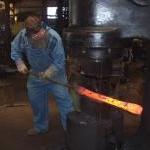
I guess this is a nice problem to have. It seems that when people are watching at demos they often want to buy the piece you're working on. They like to have something still warm off the forge. I do a lot of bottle openers from rail spikes because they are reasonably quick and visitors like watching the twist and the drifting of the opener end. The one in the photo is pretty much off the forge with a bit of wire brushing. What could I finish this with so that it can be sold straight away? I've tried beeswax and it's gluggy. Spray finishes are fine but they take time to dry. Do you sell stuff straight off the forge and if so, how do you solve the finish problem??
-
- 6 replies
- 2.8k views
-
-
The subject of a finish for iron projects comes up here now and then. Thought this might help. xxxxxxxxxxxxxxxxxxxxxxxxxxxxxxxxxxxxxxxx commercial links removed
-
- 6 replies
- 2.2k views
-
-
A bit stranger was my experiments with tannic acid. They were speculating that tannic acid rich waters in peat bogs could be used to bring out a pattern. Not having a peat bog locally I sourced what I did have---loose leaf black tea. So I boiled up a very strong mix of tea leaves and water and immersed a test blade in it overnight. In the morning I went down and it looked furry---a build up of sludge on the blade. "Well so much for that" I thought but when I took it to the sink and started to wash it off the sludge slipped off leaving the pattern visible in sort of a purple/blue/black shade; again no topo. I plan to do some more experiments with this as my rental h…
-
- 33 replies
- 6.2k views
-
-
-
I had not seen this done before so I gave it a try. we use floor sweep to keep dust down when we sweep the concrete shop floor ,it is made of a mix of saw dust and oil and works well for its intended task. Last week I got to wondering if it would work for putting a oil finish on parts so I gave it a try today. I wire brushed one side of a new RR spike and then brought it up to a black heat in a gas forge. I them dropped it in a pan of this stuff and shook it around like I was putting corn meal on fish to fry. the spike was hot enough to smoke and sizzle. After shaking it for a few seconds I just set it down and walked away for a 1/2 hour or so. here is how it came…
-
- 4 replies
- 2.2k views
-
-
Hello All, Almost everything I make these days seems to be finished with carnuba wax. It leaves a really nice finish, is hard and durable and completely non toxic/food safe. Generally I hang a finished piece on a wire then heat it with a small hand torch and touch the piece with hardened wax all over until it is finished. On small pieces I seem to spend about as much time wire brushing and waxing them as forging. In a effort to spend more time actually forging rather than finishing I am looking for new ways to finish pieces. I have a shaker that is almost built which I am hoping will partially get me out of the business of wire brusing everything with the angle …
-
- 5 replies
- 3.9k views
-
-
so from what i've gathered to rust blue something you must clean the surface from any coatings, oiled, other finishes, then you must allow it to rust a deep red, thick and thoroughly, then you must 'boil' it in distilled water and then essentially rub/polish it down with a cloth until it turns a blackish color. now if there is more to it than that i am all ears! (i figure it wont be terribly easy to do, but those are the steps i've come to understand) now my question here is this, i want to blue a certain part of mild steel but not another section of the same piece. so lets say we have a 6"x6"x1/4" piece of mild steel that has had its surface cleaned by heating it to a…
-
- 7 replies
- 4.1k views
-
-
Hi there! Just wondering if anyone has had success tinting or coloring the classic beeswax/linseed/turpentine mixture? I've definitely made it darker by using black shoe polish. I was wondering about using dyes for coloring candles... Or perhaps gilders paste is the answer? - basically I like making my own coatings where possible and I'm cheap. Thanks, Nate
-
- 4 replies
- 2.5k views
-
-
How do ya'll treat jewelry after the forging is done? will linseed & wax work? Thank You. Pete
-
- 13 replies
- 3.2k views
-
-
Im typing this on the fly before i head of on a trip. But i have been making stuff now more often thanks to request for my openers. One thing i failed to concider was a coating to apply to everything after i was done to protect them. Im sure this is already posted but what have you guys been useing. I was on youtube and saw some recipe for a solution made from beeswax, tupitine and some oil. I thought about spraying a polyuathane on it but thought that would chip after a while. I am still learning as I go and i learn after watching how stuff is done also trial and error kind of guy. Thanks in advance. David Sanders
-
- 18 replies
- 7.1k views
-
-
Can anyone suggest a finish that has colour options (not just black), is food safe & able to withstand high heat? This would be for a kettle BBQ made of mild steel. The local finishing firms only really offer galv/hot zinc spray and powder coat. My best guess is enamelling. Any improvements on that?
-
- 0 replies
- 2.1k views
-
-
hello all... I recently attended a weekend course at Touchstone Center in PA and noticed their big mechanical hammer had some sort of oil finish to the main body of the hammer. I have an old camelback drill press and a homemade power hammer that would be extremely time consuming to dismantle and strip away the old paint. My question is what is the recipe for a finish like that? I live where it snows 8 out of 12 months and the fall and spring is very rainy. Thanks for any help and/or suggestions... Sean
-
- 1 reply
- 1.5k views
-
-
Hi all, I'm in the middle of a project that will be going outside so I want to finish it with graphite paint. Now, I've never used it before so I was wondering if anybody could give me a bit of advice on correct usage. Also I seem to have run into a problem getting it. I don't know if I'm just looking for the wrong things in shops or they simply don't have it. If anyone has links to places that sell it that would be awesome as well (I live in the UK). Many thanks in advance.
-
- 7 replies
- 2.9k views
-
-
(swear when I get enough hives that's gonna be the name of the wax product if I sell.....) So, how far do you take making your beeswax finish by hand? To bee fair (pauses for the groans), they did all the hard work. Pic is of the wax cappings draining off the honey (they cap the honeycomb with wax, gotta cut it off to get the honey). Lessons learned? Get ALL of the honey out before putting the wax in the double boiler. It seperates out, but still.. Also got a couple of gallons of honey. Pretty warm here, so may go into the hive for a little bit more once more in September, maybe not, and make a much larger hive next year (deeper brood boxes and honey supers). …
-
- 10 replies
- 3.2k views
-
-
Bees wax application??? How do you do it??? I've coated with beeswax extensively. Right now I have a piece that's been outside in the pouring rain for several weeks. Coated in beeswax, no rust! I also have half a dozen dinner bells on the porch that got misted on once and rusted immediately. Coated in beeswax as well! So what's the problem? I heat in the forge and coat when the wax smokes lightly on the metal. After coating generously (where it's dripping off the metal,) I quench. Is this incorrect method? What is the success rate of linseed oil? What is the best mode of application? Thanks!
-
- 33 replies
- 36.6k views
-
-
Yes, exatcly,I don't mean the commonly known colours after tempering steel. I can't remember when of by whom i was told, but i've got something in my mind like: quench steel in a water allum mixture and the steel will get a fuchsia colour. May that be possible? Anybody who has experience with it? Many thanx!
-
- 9 replies
- 2.5k views
-
-
Hi all: I am looking for some suggestions for some reliable and consistent oil or oil and wax finishes for steel. We have been using Sculpt Nouveau metal oil which has wax in it as well as a hardener. On smaller surfaces it worked fine, but we did a large fireplace feature with smooth metal and we found that the wax kind of separates and then leaves streaks in the oil. First, has anyone used Sculpt Nouveau's metal oil and do you have any pointers on the streaking thing? Second, I have been reading about linseed oil mixed with wax and turpentine. How does that work on smooth flat surfaces? What oil can you substitute that is food safe? Any t…
-
- 18 replies
- 18k views
-
-
I needed more of this wax and found that my local sources don't carry it any longer. After searching online I found it at this link: http://www.bwccompany.com/bowlingalley.html The can label looks different. Tried calling the company for info and always get their vx mail. So I left a message for them to call me. Anyone know if this is the original formula?
-
- 14 replies
- 18k views
-
-
I've got a customer who has a reasonable list of jobs for me to do, but he wants everything to look aged, as though it's been there a century or more, even internal brackets, etc... What would be the best way of achieving this?
-
- 16 replies
- 6.4k views
-
-
Anyone run into this problem? I was just applying a mixture of boiled linseed oil, mineral spirits and beeswax to some finished pieces and within minutes I was run out of the shop by bees. I used to keep honey bees and never had a fear of them until several dozen found their way under my hood and sent me to the hospital. Needless to say, I'm a little nervous around them now. I really love the look of the finish but wonder if I'll ever be able to safely apply it without sending out smoke signals and attracting bees.
-
- 4 replies
- 2.1k views
-
-
Having read about galvanic action in Peter Parkinson's Architectural Forgework, has caused me to think closely about how I will be doing an awning for a client. The awning is basically a copper sheet riveted to mild steel bars. I'm wondering if the nobler "copper" will concentrate the corrosion to the mild steel rivets causing them to rust out in no time. So now... I'm thinking copper rivets to fasten the copper to the steel. Now, I theorize that the galvanic action will spread out over the bars in a similar fashion to a copper rivet spreading the rust over the area of sheet steel. Now another question comes to mind, will the combined mass of the copper rivets and sheet m…
-
- 11 replies
- 3.4k views
-
-
Hello there, does anyone know of a decent coloured patinas for steel supplier in the UK.. quick search of google doesn't appear to find anything obvious.. Easy as to what type, chemical based or water based stains or whatever.. Nice one! Sam
-
- 4 replies
- 2.8k views
-
-
Hi I'm looking for a cold finish solution for a large chandelier i just finished building. Usually I apply either bees wax or linseed oil to smaller pieces of work while they are hot, this chandelier is far too big to do this efficiently. So i'm looking for something which I can apply to work cold. The person who commissioned the chandelier wants a 'traditional' finish so ideally I'm looking for something i can make up which can be applied to an unheated chandelier. Is is possible that I can simply paint it with a mixture of linseed oil and turpentine? Any suggestions would be gratefully received. Nate
-
- 14 replies
- 3.1k views
-
-
I've just been reading quite an in depth leaflet about primers, it was geared towards fabrication but still a worthwhile read and it's raised a few questions in my mind. The leaflet subdivided primers into epoxies, silicates and acrylics by zinc and aluminum. It said lead based primers are the most tolerant of rust and scale however they are being phased out. Do you know of a modern primer type that can handle a bit of forge scale/oxide after manual cleaning? Are there primers that don't require industrial surface preparation? I.e sandblasting. Are primers needed for handrails? How reliable are the All-in-One primer and top coat paints? Ultimately I'm …
-
- 19 replies
- 3.5k views
-
-
I guess you experienced blacksmiths have been asked this a thousand times. I would like to know, when you are doing items at a show, how you finish the pieces so that people can take them away?They look a bit raw straight off the forge. I prefer to take mine home, buff them on the wire wheel and then add a spray metal sealer followed by a light coat of wax. That's not practical on site where people want to take an item home. Straight beeswax appears to be gluggy. I do mainly small items like hooks, handles, keyrings, reo snakes, roses and so on. Is there a quick and easy method to make a forged item presentable?
-
- 8 replies
- 2.9k views
-
.thumb.JPG.02282a54c88e6a190e3ce9545787d4bf.JPG)