Heat Treating, general discussion
Annealing, Hardening, Heat Treating, Tempering
541 topics in this forum
-
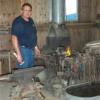
I took some pics of how I temper a hammer with a drift. I think you can make out the colors.
-
- 12 replies
- 4.1k views
-
-
Hey folks, Figured I'd post this newbie question here as well after I spotted this section. I hope that is not 'politically incorrect' ...since I posted similar question in the general section that got moved to the tool section. After reading most of the topics here, this area really seems to deal best with what's on my mind. I am trying to make my own tools such as fullers, hardies, swages, etc. I have some pieces of 4340 that would do nicely. The question....do these tools need to be heat treated? Seems that tools such as fullers or swages that are in contact with hot steel for significant time would lose temper anyway. So is it necessary? For that matter, could s…
-
- 6 replies
- 2.2k views
-
-
hello guys, im just a mechanic at a golf course and haveing problems with some axles on some small greens mower trailers, the axles are 3/4" maybe 7/8" round stock, they are bending because of the weight of the mowers bounceing on the cart paths. the mowers are about 212#'s just wondering if i can heat up the part of the axle thats bending and dipping it in oil. would that help or am i just trying to push a lenth of chain up hill? any and all suggestions or advice would be outstanding thanks
-
- 5 replies
- 2.2k views
-
-
ok sorry but this is gonna take an explanation before i can get to my question. since case hardening is essentially getting steel hot and putting it in carbon causing the steel to "soak up" the carbon... when we put steel into a fire aren't we doing the same thing when we heat steel in a coal or charcoal fire? so wouldn't that make any steel you put in the forge actually a higher carbon content?
-
- 6 replies
- 2.4k views
-
-
Can 52100 be heat treated by eye ball or does it really need exact temps and times?
-
- 10 replies
- 32.7k views
-
-
I've got to make some lightweight chain, and I've got some annealed steel wire that's just the right diameter that sure would be easy to make links out of, cold. Can I make up the chain, then harden it? I'm thinking something like "Heat to XYZ degrees then quickly quench in PDQ." TIA
-
- 5 replies
- 2.4k views
-
-
Apparently the heat treating part of blacksmithing goes back to before metalworking: Early Humans Shaped Stone Tools with Fire : Discovery News
-
- 2 replies
- 1.8k views
-
-
Anybody fix hammers for stone masons??? If so what is your proceedure? do you Heat treat them? how do you know what kind of steel they used?
-
- 7 replies
- 6.5k views
-
-
I want to anneal a piece of coil spring from a 1/2 ton truck to forge into a knife someday. I'm new enough to blacksmithing that I have a hard time judging colors sometimes, even using a temperature color chart. Would I be right in thinking that if I'm not quite sure of the color by using my judgement that I can test the piece of spring with a magnet and if the magnetizing is gone out of the piece I can start the cooling down process?
-
- 17 replies
- 7k views
-
-
Used pottery kilns seem to be fairly cheap are set up for tempurature control and even for ramping up and down in temperature. Does anyone here use them for heat treating? How well do they work for lower tempreratures for tempering ? I have found a used kiln in fairly good shape for $200. I just got a PO for job where I have to forge quench and temper about 180Lb of 4340 and I also have a job that is supposed to be coming up soon where I have to forge quench and temper 250Lb of 4140 and 100lb of W1. The heat treating cost on the job I already have the order for, will more than pay for the kiln. I am also thinking with a few simple modifications it could be used…
-
- 4 replies
- 2.6k views
-
-
I've been given a piece of Atlantic-33, a Flutegon. I would like to make a rounding hammer head out of it. Any tips on heat treating. I would like this head to be pretty hard for cold working copper etc. How far into the orange or yellow spectrum of heat should I take it before quenching. Its a water quench steel, so I'm wondering if I should use running water, standing water or warm standing water. Thanks guys-
-
- 12 replies
- 12.5k views
-
-
OK, I am not really that new to this, just getting back to it after a long break. I know I probably already know the answer, but I have never heard the term Normalizing used before. I know it is to de-stress the steel while forging, but what is the normal proceedure? Regards, Tim
-
- 2 replies
- 2.3k views
-
-
Hello again, all! I was wandering if anyone could tell me the best way to temper a prod (metal bow) for a crossbow. I was thinking of making the prod from a piece that is about 2" wide, somewhere around 20" long and around a fourth inch thick. I believe that straw is the correct temper colour for springs, right? What is the best way to get a nice even temper so the prod snaps back to it's original shape after bending?:confused: Thanks for any insight!:cool:
-
- 11 replies
- 2.6k views
-
-
Why does the Upper transformation temp (AC3) slope down to meet the AC1 line? I see that AC1 (pearlite) remains at a constant temperature across the diagram. Why is the free ferrite line not the same- set at a constant until it reaches the Eutectoid? I want to say that the pearlite when it changes to Austenite is acting as a catalyst upon the free Ferrite - but I know that is not correct. What is happening? Any thoughts?
-
- 9 replies
- 7.7k views
-
-
I have a commercially bought cross pein hammer (Czech type from Kayne & Son) that I just recently started using. The face is a tad soft for my liking. (And yeah, I realize it wouldn't be an issue if my hammer control were better.) I wasn't going to worry about re-HT'ing immediately, but last weekend as I was making a forge weld the head flew right off the handle! I'm kind of underwhelmed about that, but, err, well....as long as the handle's off, I suppose there's no time like the present. I've never heat treated a hammer head before. I've read about it, but I've never done it. So if any of you folks with experience in this area would like to offer any tips, …
-
- 8 replies
- 3.9k views
-
-
There are many threads on this subject. I've searched and read quite a few of them. I know tool steel is best but right now all I have is truck coil spring. My punches mushroom or mushroom and bend on the working end. I anneal, quench in water, polish and heat treat with a propane torch to bronze. Seems like I might be getting a little better, last one only mushroomed slightly but only punched 2 holes ( 3/4" , my 1/2" punch does the same ). Any suggestions Billy
-
- 24 replies
- 12.4k views
-
-
I broke my dear father's favourite chisel whilst bashing apart a rusty old chimney setup for a forge I bought. I have promised to replace it, and intend to make a replacement from a section of vehicle coil spring of around 2/3" thickness. The problem is, all the how-tos I have read for chisel making suggest running the colours to temper. I have been told several times from various smiths that this is not an effective method of tempering. Can anyone suggest a suitable time and temperature for oven tempering a cold chisel? Thanks in advance.
-
- 17 replies
- 19.9k views
-
-
Greetings everyone! I'm a newby here so all advice is much appreciated. Recently I put together a "Lively type" forge. Made a few bags of charcoal and put together my set-up in my back yard. Fired it up a few days ago and it worked great! Here's where I need your help...... I was given a piece of RRtrack to use as an anvil, but quickly saw its limits. So I've picked up a 4" x 4" x 12" bar of 4340 so I could fashion something similar to a Japanese sword makers anvil. Here's my question..... Will I need to heat treat the bar or will it be ok to work on cold? If I need to heat treat it what process would you suggest? My plan is to route out a channel in the center…
-
- 11 replies
- 2.5k views
-
-
I forged a 2" hitch ball into a hot cut hardy. Anyone have suggestions on how to heat treat something this big/thick and to what color....THX, Keith
-
- 2 replies
- 1.8k views
-
-
Someone in a related thread asked me to post a separate note on how I have repaired anvils, including the heat treatment - so here is an expanded text of a post I put up in May 2008. When I started blacksmithing in the early 1980's, good anvils were very hard to obtain and usually pretty expensive. I traded a couple of rifles for this 250 lb Peter Wright (at that time, I was gun-rich and anvil-poor) and it has been my regular shop anvil since it was repaired almost 30 years ago. Initially, a large piece of the face was gone plus the heel was cracked and trying to come off at the hardy. It was replated with a piece of spring steel off a scrapped bucket crawler and I w…
-
- 8 replies
- 10.8k views
-
-
When I make a hammer it is for myself and I usually make it out of truck axle but I've also just used large chunks of steel that had spark tested to a higher carbon content than mild steel. To harden I've found that heating the hammer to right above magnetic and then cooling the whole thing in water gets it deeply hardened. Then, to temper it I put it in the vice with a mild steel heat shield placed over the threads of the vice and use a torch to heat from the center of the eye until the face and pein reach the bronze to purple range. Finally, I'll cool it again if it seems that it will be passing the heat range indicated by the purple color. This has worked very well, bu…
-
- 4 replies
- 9.9k views
-
-
I want to make a touch mark out of h13 on the cnc machines at the polytech I go to. my tutor told me to bring the metal as soft as possible. So can i just anneal h13 in the normal way or does the air hardening property of it mean that the longer it takes to cool the harder it gets?
-
- 9 replies
- 4k views
-
-
Good afternoon Folks, I have been using water and transmission fluid and there is a feed store close that has mineral oil. Yes these do work but part of the fun is finding what works best or what will do more than one job well. From reading superquench is good for mild steel to get that little bit extra from the material ( some say alot extra). It appears to be fast quenching and consistant, nonflammable, saline enough to retard some smelly beasties and inexpensive componants which could be adjusted if desired. Alot to recommend it. My question is has anyone thought about retarding the cooling rate or is this chemically not possible easily? I do realize that graded …
-
- 5 replies
- 2.2k views
-
-
Hey, I just forged myself two punches out of some old railroad tie (similar to 3/4 inch round 5160). How shall I go a bout heat treating them? Do I want them hard or soft? Hard in one place soft in another? Thanks, Archie
-
- 2 replies
- 1.8k views
-
-
Hello everyone. Just a quick question about soy oil as a quenching medium. Will it work? I have seen Tai Goo's crew use canola oil, but I can buy soy oil for really cheap here and its nice and clean(as opposed to used motor oil:() Any help is more than welcome! Thanks guys.
-
- 8 replies
- 5.4k views
-