VaughnT
Members
-
Joined
-
Last visited
Everything posted by VaughnT
-
-
The forging seems rather straight forward to arrive at that shape. My biggest concern would be the heat-treating. For a commercial application where someone could be hurt by a wrench breaking at the wrong time, I'd want to have it professionally heat-treated by a firm that specializes in that type of thing. Better safe than sorry.
-
-
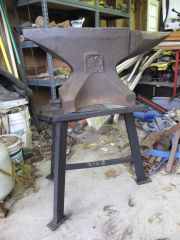 No sway in the face, but it looks to have been well-tended by someone. The edges could certainly be better, but I'll clean them up as I find I need to. The stand is made from 1" solid square stock welded up and weighs approximately 150#.
 -
Pricing depends 90% on availability and 10% on usability. What's available in your area will determine the value of it to those that are actually using the items. In some places anvils are scarce as hen's teeth and that makes the value climb. Same as anything else. Will you use the tool any time in the near future? If so, it might be a good purchase if the price is right. Again, what are you seeing available in your area and what are the prices like? Personally, after getting a decent anvil (and that can be a simple chunk of steel, not a "london pattern anvil") I would focus on MAKING the various tools I need. Chisels, punches and drifts are the life blood of blacksmithing, and making them is very simple but teaches bunches about hammer control, fire maintenance and sundry other critical topics that you'll use on more complex projects. Hammers are easy as most any ball-peen hammer will do, and a variety of weights will allow you to work efficiently depending on how you want to move the metal. A cross-peen or straight-peen is very nice, too, and I wouldn't pass one up. You can buy older ones at the flea markets for pennies, so grab whatever feels comfortable for you. 1# to 4#, they all come in handy for one thing or another. Study your local market to see what prices are like. At $200, that post vise might not be that great of a bargain - but if it's the first one seen in six months, you might want to grab it up. Using some place like uship.com to get an anvil delivered from far off is certainly worth considering, too. My 350# anvil traveled halfway across this great nation for only $200, and the total price was still less than $3/lb, so I count that as a very good deal. You can do the same if you're not interested in waiting on that $10 mint condition anvil to pop up out of the blue.
-
Odd that I'm so nostalgic for a time long before I was born, but I have a soft spot in my heart for this generation and think it's absolutely wonderful to see such incredible shots from their time. I can't imagine what it must have been like to live in a time before 90% of the modern conveniences that I take for granted..... http://fullym.com/shot-70-years-ago-but-these-wwii-photos-could-have-come-fresh-off-a-hollywood-set/?pid=160
-
The description seems to indicate that you have a flat-bottomed forge with a grate over the air entry, but are considering something like a rectilinear pot like is seen on a lot of forges. Either one is fine for working. The "cone" shaped pot does help to concentrate the fire, but you can do the same in a flat-bottomed forge by wetting the surrounding coal so the fire doesn't migrate outwards. The easiest way to do this would be to line the bottom of your forge with an inch or two of fire cement/dirt/clay that's formed into a shallow dish or bowl centered over the grate. Or, you can buy a proper fire pot from centaur forge, etc, and simply drop it into the forge body that you have. Depends on how you want to go at it.
-
Definitely a gold mine! Those bigger chunks will make nice stand-alone anvils even if they are mild steel, and you could always sell them to smiths that are wanting an anvil for a treadle/power hammer build. I would get what could be afforded with a focus on the big chunks, and be sure to stay in touch with them in case the 4140 comes in any time soon.
-
I wouldn't doubt it a bit. Sometimes flaws are unavoidable and I can't see them scrapping a usable anvil because of cosmetic issues.
-
-
Very neat work, Tanto. Those hooves are looking very nice, and details like that really showcase your craftsmanship. Potential customers will take note of that!
-
Beautiful! I would absolutely love to have an anvil like that, even if it's not a Fisher!
-
If the threads are still good and all the parts are there, spend as you see fit. Any good quality vise that you bought brand-new would cost you at least $100, and you can't get new post/leg vises, so you really can't go wrong. Before you pay top dollar, though, make sure it has all the parts to mount it. You should have the flange with the bolt holes, bracket that attaches to the flange, and the gib key/wedge combo that cinches the bracket tight to the flange. Oh, and it should have the leaf spring to help open the jaw. If the threads are sound, but a part is missing, that's grounds for a drop in the price. Just explain to the auctioneer that parts are missing and that it needs to be mentioned to the bidders. I paid $50 for mine.
-
Depending on what you are doing with the vise, I'd certainly consider a set of micarta inserts and a set of brass inserts. Both would have magnets inset into them so I didn't have to use screws. Of course, this is only for finer work, like knifemaking, where I didn't have to torque down on it.
-
I absolutely love my Fisher anvil. But, my Wilkinson anvil rang like a bell and was very annoying until I set it into a bed of silicone caulk. No chain, magnets, roofing felt, etc. Just silicone caulk and wait for it to set up. Went from church bell ring to almost as quiet as my Fisher, literally! As for that anvil, I'd buy it. The horn looks a bit weird, but certainly a usable bit of kit. And, I've found that getting that first anvil seems to call all the other anvils out of the woodwork. Is it worth $425? Depends on the weight and the general availability in that area. I'd certainly pay $2/lb for that anvil, maybe upwards of $3 if it was within driving distance. And, don't forget to check with uship.com and the like to see what it would cost you to have an anvil shipped. My Fisher traveled the original 13 colonies to get to me, and it was only two bills. Well worth the price!!!
-
If you have a coil spring from a car, I would first make a hold-fast so I can hold other things to the anvil for piecing, cutting and filing. Then I would make a couple of chisels so I could cut metal being held in the hold-fast. Then I would make a few punches of various sizes and shapes so that I can pierce and decorate metal held by the hold-fast. With the hold-fast, chisels and punches done, I would work on making tongs. I would buy the mild steel locally if I couldn't scrounge it, and I would practice making all sorts of tongs. You need bent-nose tongs, roundstock tongs, square stock tongs, flat stock tongs, offset tongs..... There are so many options it's not funny!! The key is to make tongs that are better than the last set. While you're learning hammer/heat control, you'll be steadily improving the quality of the tongs in both looks and function, and you don't need a set of tongs to make that first set of tongs! It's such a wonderful skill to have, but start with the tools that allow you to make other things. They are simple shapes to form, but teach a ton and are indispensable around the shop!
-
Ha! I like that idea!! My anvils are collecting dust right now. I was hoping that that old saw about too many irons in the fire would mean more forge time, but life seems to not want me working metal lately!
-
Well, if you rotate the table so that it's over the flat part of the dolly, and then put the fire pot at the far end of the table, you'd be a good bit from the rubber tires and could use the dolly the way it was intended. Using larger tires wouldn't be a problem, either. I'd be inclined to find a set of cast iron wheels off an old farm implement simply for the cool factor. A single leg for the far side of the table would give you a three-point landing that would be easier to stabilize on uneven ground. I do like the idea....
-
Pull the trigger and walk away happy! That's a might fine anvil and is just the right size to be both portable/movable and workable for any size project. While I'm a weight snob and want the biggest, heaviest anvil I can find, I realize that smaller examples are often better to work on for some projects. Less than $2/lb? Assuming the rebound is good, I wouldn't even think about hesitating on that purchase. Truly good stuff.
-
Sounds like it's from a Blacker, and they didn't make shoddy gear. For a bloke all alone, she'll do fine. My main anvil weighs over 300# and I've never seen a problem caused by the anvil being too heavy! The key is to have it bolted down tight to a stump or stand that doesn't jump around. If the anvil moves when you hit the hot iron on it, you're wasting energy that could be used to move the hot iron you're trying to move.
-
Works better if you weld 3/8" round stock to a jaw that's at least 3/8" thick around the rivet hole. From that hole, you taper down and it gives you clearance between the reins so they don't rub against each other. When you look at new tongs from a store, you'll see how thick they are around the rivet area compared to the reigns. Just seems to work right for some reason.
-
Good work. Tongs are a tool so make them how you can, or buy them second-hand. One thing I can see..... you're doing the same thing I did all those years, and it never dawned on me until I saw a recent video on the net. The area around the rivet (the boss) should be the tallest and thickest portion of the tong. The reins drawn down from there. The jaw area doesn't matter much because they are shaped to the task, but making the boss area the same thickness at the reigns will cause collision and it doesn't look right.
-
If you were near me, I'd certainly entertain the idea of buying it even if it doesn't have all the parts. Location, like in property, is key to pricing the forge. You might also consider marketing it to decorators and movie studios. Personally, if you were close enough for me to drive over, I'd go $200 simply because I want it and those types of forges just don't crop up that often in my neck of the woods. I don't know what I might have to replace or repair, but I think we could definitely talk about it. The problem with pricing something like that is that a lot of working smiths might like it, but have to prioritize their purchases. Would you rather have an antique forge that cost $500 with shipping, or build a working forge that meets all your specs for significantly less? Are you forging iron, or creating a display?
-
Excellent job. A detailed report like this really needs to be pinned at the top of the page so it doesn't get lost!
-
The price isn't that bad, actually, when you consider that you got the stand, too. It would cost you time, energy and money to make a stump of similar quality. If the stump is too low, you can always add 3 blocks under it to raise it up. Inletting the anvil base is a nice touch. Overall, I think you did really well for yourself. If you decide to sell the anvil in a year, you won't lose any money!