VaughnT
Members
-
Joined
-
Last visited
Everything posted by VaughnT
-
Sounds like it could be a good one. 1) The body of the anvil are often "decorated" with pits and gouges from where the smith would test the temper of freshly-made punches and chisels. I once had a chance to buy a Fisher that had a softball sized scoop taken out of the side! I wouldn't worry about how the sides look unless your are planning on laying the anvil on it's side and using it as a swage block. If the top plate is not pitted or gouged too heavily, you're golden. 2) Yep, a thin top plate is normal. In my neck of the woods, I've found anvils that have faces that are only 1/8" thick. Turns out a lot of "smiths" thought it was a good idea to sand/file their anvil's face to remove dings and preserve the flatness. Of course, back in those days you could buy an good anvil at the corner store or, often, send your anvil back to be refaced. If you have more than 1/4" of top plate and the edges are good (not a lot of chipping), sounds good to me! 3) Not fishy at all. Being made "back in the day" things weren't always aligned properly and and makers weren't concerned with "perfect" like manufacturers are today. An off-kilter hardy hole is perfectly serviceable and, as they say, perfect is often the enemy of good enough. $2/lb is a "fair" price from everything I've seen. If your area is anvil poor and you're set on getting a london-pattern anvil, I don't think you're going wrong at all. If you can talk him down a few dollars, great. But if you can't, I think you'll have done just fine.
-
There's an entire blacksmith shop for sale on CL. Starting bid is 5k, but they might part is out after nobody goes for the whole noodle! New York is thick with anvils. I use searchtempest.com to hunt cl and ebay. There's a 266# Peter Wright in Hudson Valley that needs a good home. Ad says that it's been professionally resurfaced at a blacksmith meet.....
-
I have a blower just like that!!! I've tried every "soak" method I could find and it's still frozen solid. Doesn't look like anything's mechanically jamming the gears, but I can't get even the slightest wiggle in the gears. I'll have to give electrolysis a try......
-
Looks like some seriously good work. The fit and finish appears flawless!
-
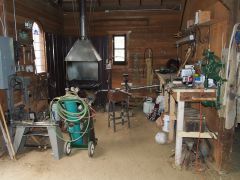 Just about as perfect a smithy as you could ask for.
 -
NJ, my Fisher is somewhere north of 300# and south of 350#. I haven't bought a scale big enough to weigh it, yet, but it's on the to-do list just so I'll have a definitive number. Every Fisher I've personally come across has been in the sub-200 category. I wanted to snatch up every one of them and give them a good home! Very happy to have a true hoss in the shop! :D
-
I'd buy it! I'm not sure who made it, but if it was a cheap knock-off casting of an anvil, I would expect a far worse surface than it's showing. Looks to me like it's a top notch anvil in almost new condition. If the rebound is better than 60%, I'd be very happy with that purchase. Secure it to a heavy stump that's sunk into the ground a foot or so and you'll have a dandy of a set up. You can do big work on an "light" anvil that doesn't wiggle and wobble!
-
I definitely agree with buying new steel as opposed to working with "found" metals. Not to say that you can't make nice stuff from car springs, but it's a guess as to what it is and how to heat treat it for maximum effect. Sure, if you find a coil spring on the side of the road, grab it and re-purpose it. But don't hesitate to buy the right size stock from an online resource and go to it. In the end, it's every bit as cheap while often being easier and faster.
-
I'd max out at $2000 if the edges had minimal damage. Fisher anvils often have glass-hard faces and can chip rather easily, all things considered, and it isn't an indication of abuse. The chips you describe don't seem that bad - I'd look at the package as a whole (sway, edges, weight, need) and go from there. Secondly, big Fishers are fairly hard to come by. The biggest Fisher that I've ever personally seen is now residing in my "smithy" and I'm very happy to have gotten her for less than $3 per pound. The edges are heavily chipped, but she was more than worth the price I paid and I wouldn't trade her for anything. A brand-new 242lb Papa Rhino anvil will set you back at least $1200, so going a bit higher for something with some history and extra weight isn't unreasonable. If you can afford it, go for it. If you can talk them down, talk them down as far as possible and be happy.
-
I don't have any problem with some sort of national standard being set for the various levels of ability. Knife-makers have been doing it for years, and folks that have their "Master stamp" are very happy to have earned it. There are even collectors that won't buy anything except what's made by a "master". How could that hurt anyone in the blacksmithing field? More to the point, if you don't want to go through the bother of getting your journeyman or master stamp from the knife-maker's guild, that's no problem and nobody thinks less of you for it. There are countless bladesmiths turning out truly spectacular work without it. Would I ask a non-certified smith to build me a gate? Absolutely. The quality of your work is apparent and adding a stamp to it isn't going to make it better. What curriculum should there be? Why not take it straight from the old books you can find on line? Learn how to make simple tools (nothing that might require a striker) and then learn how to use those tools to make stuff. The quality of the stuff should be judged as no journeyman would be accepted if the appearance wasn't as pleasing as the piece was functional.
-
Very good anvil! The weight is just about perfect. Just be sure to mount the anvil to a very secure, very heavy stump so that it doesn't move in the least. Any wiggle or wobble will detract from your ability to move hot iron.
-
Hoist and chain will certainly do it. But be very very sure to secure the anvil once it's in the van. Put down a sheet of plywood over the floor to strengthen it, and put another sheet between the anvil and the rear seats to spread the force if the anvil should slide forward. You cannot have too much strapping or blocking to keep that anvil from going airborne if you have to make a hard stop.
-
That's not an axe, that's a hardy-mounted hot cut! Great work. Keep at it, focus on the details and you'll be in high cotton before too long!
-
Great forge! I've been hunting one like that, but, as you say, they're usually too far off to make it workable. With a nice hood/chimney, I'll bet she's a dream to work with.
-
https://www.blacksmithsdepot.com/page.php?theLocation=/Resources/Product/hardware/Pyramid_Head_-_Diamond_style_-_L.xml/ Traditional Tolkeinesque appearance and a speedy installation. Depending on the thickness of the door, you could use these babies and nobody would ever know they weren't pyramid-finished rivet heads. If the door is rather thin, you can offset the holes for the screws by a hair or two so that opposing screws just barely miss each other. The casual glance wouldn't notice such a small difference. And just so they don't look too "factory made" take a hammer to them. A few light taps will given them a unique look, then throw them in the fire so that the finish is burned off. You want them to age naturally with the rest of the metal.
-
Awesome work, Tig. That almost reminds me of something you'd see in a starship's engine compartment. Maybe to secure the dilithium crystals prior to insertion into the fusion chamber. If you can create a similarly wonderful manifold that allows you to cut the feed to the burners independently, you can use that one forge for work big and small simply by shutting one or two burners off. Of course, you'll have to make a sliding wall that shrinks the chamber size, too. But that would be small potatoes for someone of your obvious skill.
-
You're a lucky fellow to have found something like that, never mind all the tools! I've been fascinated by the trunnion style of swage blocks as the seem eminently practical compared to the stand-alone blocks we're all familiar with.
-
-
I've missed out on a dozen anvils because they were somebody's Pa's or Granpa's from way back. One of those anvils was a mint Fisher in the 150# range! I'll never understand what people are thinking that they would let a treasured tool of their dear departed just go to pot rather than have a few hundred smackolas in the pocket. "Really? You love your dad so much that you'll let his tools simply rust away? You love him so much you can't even cut the grass around the monument to his life?" If someone ever offers me $20 for my grandfather's tool box, I won't hesitate to take the money. It's worth $20 and I'm not using it, so why keep it around to collect dust and get in the way? A tool sitting out in the elements, unloved and unappreciated, is truly a sad sight. :mellow: I honestly get angry over things like that!
-
While I admire the creative twist, I'm with the sad crowd! I don't need another vise, and I doubt that one will be any worse for wear in a decade or two, but I sure wouldn't mind having it in my shop! And don't get me started on that hammer. Ugh! Every once in a while, I'll do an image search for 'custom mailbox' and get some really neat ideas that I never actually try out. Still fun, though.
-
-
Make a table-mounted wine bottle lantern. Empty a wine bottle. Drill through the cork. Insert copper/steel/brass pipe through cork. Insert cotton lantern wick through pipe. Insert fitted bottle into a decorative stand that either sits on a flat surface or can be driven into the ground. How decorative it is is entirely up to you. If you don't have simple chisels and punches to build the holder, make them before you make the holder. With a hammer, anvil and tongs, you can make a very decorative stand that will be all the rage with your wine-drinking friends.
-
A bunch of as-new anvils? You're a lucky fellow! Weight and condition will set the tone, but I wouldn't hesitate to use $2 per pound as a good starting point. If they are literally unused relics, the price goes up. Smaller, lighter anvils are generally more expensive than larger anvils because of the greater demand for starting smiths and those that do demonstrations and have to haul their kit.
-
The weight on the side of the anvil is, you say, 1-1-1 or 1-1-2. That's hundredweight measuring, not simple pounds, and means the anvil is heavier than 111#. The first number (1) is equal to 112 pounds. The second number (1) is equal to 28 pounds. The third number (1 or 2 or 3 or 5?), whatever it might be, is actual pounds. So, it would be 112 + (1x28) + whatever that last number is. So the nominal weight is 140lbs and the actual weight won't be known until you put it on a scale. Due to casting magic, the stamped weight is usually a bit heavier than the actual weight, but I wouldn't expect it to lose 20# to chipping, rust, whatever. If it rings like a bell and the looks good, jump on it!!!
-
An anvil for less than $3/pound? That's a good price. To get a mint-condition anvil for less than $3/pound is a very, very good price! The edges, cutting table and horn all look like they've never seen a day's work. Maybe it's the photos, but those are some seriously good lines on that anvil. My only worry is that anvil looks brand new. I'm not saying that an "as new" anvil couldn't be found, and very few hucksters would go through the effort of welding up any dings in the horn and cutting table, so it might be a very very good buy. From my perspective, I would honestly consider the purchase. A small anvil is a joy to work with, and is even nicer when it comes time to move. Put that anvil on a heavy stand and bolt it down solidly, and it will act like a 300# anvil. Brian Breazele does most of his work on a 150# anvil, and he can really make metal move! I would consider the drive down there simply as an excuse to get away for the day. If the anvil is sound, has a good ring and no evidence of welding up the corners, it is very much worth the investment and you'll be able to recoup your money should you decide to sell it in a year or two. Lighter anvils are always in demand, and one in perfect condition is very rare.