December 4, 200817 yr "$49.95 mower " i dont think they sellem that cheep any more and the carbon content and alloying are a real crap shoot with every one
December 4, 200817 yr Well the mower blades we tested were from a $15,000+ mower which may move them into a different catagory as well.
December 4, 200817 yr What did you find out about the blades from the $15,000 mower? As for the $49.95 mower, it's been a long time sence buying mowers for me, but I bought good commercial mowers, like Snapper, they last a long time. I'll admit that I need to study types of steel, still learning, but at this time I'm working on various ways to bend iron, weld, the usual basic stuff. Welding is a pain in the behind, like one person wrote in a book, with mild steel "it's more like a glue job." Anyway, I'm here to learn and interact with other blacksmiths.
December 4, 200817 yr I've tested two blades from it so far and neither one would harden in a water quench
December 5, 200817 yr I Tried one just after i started, my files were rather... ineffective (after quenching in superquench, in feb.). get the good stuff, it pays off.
March 6, 200917 yr I have been slowly gathering stuff to build my forge but hae found some old lawn mowers. They have been burned and was wondering if it is worth getting the lawn mower blades off the machines. and what they are good things to maek out of them.
March 6, 200917 yr As a search of this forum would show you, lawn-mower blades can be made of almost any steel from a basic mild steel to an air-hardening tool steel. You will have to determine for yourself what they are made from -- spark-testing and/or quench-testing. All the usual caveats for 'scrap' steel apply, but I try not to pass up free steel! :D
March 6, 200917 yr I was told one time that because of an ANSI standard, lawn mower blades are not to be hardened when they are made to keep them from breaking and go flying if you were to hit something while cutting. I don't guess this means they are not higher carbon steel, but they are not supposed to be hardened while in use. As a lawn mower blade.
April 4, 200917 yr I just happened to be looking around my shed today and I noticed a few old lawnmower blades that were pretty beaten up around the ends, but the rest seemed alright. Does anybody know what kind of steel/alloy they're made from?
April 4, 200917 yr I cut some sections of lawnmower blade(from 2 seperate blades) to make small flat pry bars for some carpenter buddies. They use them to pry baseboard and trim loose. Any way, one piece heated, hammered, and sparked like mild steel. The other heated,hammered and sparked like medium carbon steel. I know that's not much help, except to say that they seem to vary a lot in carbon content.
April 4, 200917 yr as you read through this site you will find lists of assumed steels for various items we can salvage. But the main thing to remember is Found or salvage steel is a crap shoot as to its composition. There is no way other than a Lab analysis to know what it is for sure. there is a search function to find this question already posted. and its answers. At the right hand top in the orange bar. simply take a guess or since I searched using that for you, and combined 4 of these threads into one, look at all these other people that asked the same thing and read their answers...
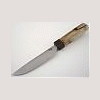
April 4, 200917 yr I made a knife from some mower blade. It turned out Real Well, I quenched in water and tempered in the oven. pictures ASAP
April 5, 200917 yr Here's the one that I just finished made from a lawnmower blade. Water quenched, then tempered. It's my second knife and is holding the edge pretty well. --Jim
April 24, 200917 yr My advise is if you going to make it mirror shiny buy lots and lots of fine grit paper because they eat it up like its nothing.this is my knife from a tractors l/m blade
March 22, 201016 yr I have a 52" commercial mower and the blades are 18" long and thick steel. I've made 4 knifes using the blades. I cut the steel with my angle grinder carefully and grind to shape the knife. While flat grinding with belt grinder to make edge, as it gets hot I dip in water each time until edge and polish is done. I use a propane torch to heat the spine of knife to blueish color just before it gets to blade edge and dip in water, let it cool and polish again using fine grit to final step on buffer to put a mirror polish, lastly put a sharp edge and test hardness of edge by rolling the knife edge on a brass rod. If the edge chips it needs to be torched again or set in oven for 400 deg.for 1 hour. If it the edge holds it's good, if it don't oven cook again and it should be ok. Maybe because it's a commerical made mower blade the steel is good, I don't know but, it works for me it even cuts mesquite branches well and holds the edge here in south Texas.
March 24, 201016 yr I have had great success with lawnmower blades. I made a drop point bowie out of a lawnmower blade about six years ago. It was left in a wet tackle box for about a year by my nephew. I found it, took it out, and cleaned it up. I use it as a kitchen knife now. It cuts meat like hot butter, and since I made the blade a little thick, it hacks through bone with ease. I can cut through bone and the edge is still sharp as can be. I don't use water as a quench medium though. I use burnt motor oil.
March 25, 201016 yr I have used many mower blades. I believe that the mfr.s tend to use mostly 10 series steels in pretty much unhardened states. This way they get pretty decent wear and yet the blades tend to bend rather than chip (which would be dangerous). Nearly all that I have used will harden well for blade or chisel type uses in oil quench. I think they tend to be 1090 or similar mostly. Most of mine are used from riding mowers with a preponderance of John Deere models as the local dealer saves them for me sometimes. I have also gathered thinner blades from (I think) walk behind mowers and find they behave pretty much the same. IMO you would be best advised to quench in oil unless you cannot get good results that way (I am pretty sure that you usually will). I've made some huge wood carving gouges with these salvaged mower blades and they cut extremely well when fully honed... in fact some of them are the best wood cutting tools of their type that I have ever encountered. I have made knives both large and small from them and I get consistently excellent performance from these blades! RECYCLE and REJOICE!!!
August 3, 20169 yr I made this small cleaver out of a lawnmower blade. Hardened well, slightly differential, Tempered in the oven at 450 for an hour and a half. It has an axe grind and holds an edge extremely well. Left the scale somewhat intact for a rustic look. White oak handles, with burn stain and well oiled, brass stock pins. On 3/23/2010 at 9:51 PM, Tarnick said: I have had great success with lawnmower blades. It cuts meat like hot butter, and since I made the blade a little thick, it hacks through bone with ease. I use motor oil as well. Cheap and plentiful lol...
August 23, 20169 yr This is from a John Deere lawnmower blade. Water quench, two 1-hour tempering cycles in the oven at 375F. Did a bunch of hardening tests on the offcuts before final heat treatment.
June 2, 20188 yr I have a bunch of new blades I picked up on clearance at WalMart so these would not have the had the very hard life of a used blade. I almost want to take one and harden it just to see how brittle it gets. I would think these would be good for large bush knives or machetes. In these cases you need a blade that can bounce back from things but you should not expect it to hold a razor edge. I have some used bush hog blades like you see the highway crews use. I would think these blades a maze of micro fractures and metal fatigue.
June 2, 20188 yr I researched brush hog blades and it looks like one company is the main supplier for a lot of OEM's. They are a high boron steel and use a very specific heat treatment to get the best out of them. The heat treating is beyond just about any backyard smith's capabilities.
June 3, 20188 yr 9 hours ago, BIGGUNDOCTOR said: one company is the main supplier for a lot of OEM's. I was in a blade factory many years ago, maybe the one you mentioned. They used molten salt heat treat. Nothing accidental or haphazard about their processes.
February 17, 20197 yr I believe even good lawn mower blades are 45% at best carbon. John Deere brags about having high carbon. But they also state that they only get a hardness of 40 to 45. There again that might be good enough to play with for a sword... but a longer piece may allow for more cracks to slip in.
Join the conversation
You can post now and register later. If you have an account, sign in now to post with your account.