
Mike BR
Members
-
Joined
-
Last visited
Everything posted by Mike BR
-
I think the last one I took apart had crimped connections between wires. Those are worth checking as well.
-
You can see it about 3/4 of the way down here:https://www.dr.dk/nyheder/webfeature/brand-i-borsen-fra-alarm-til-sidste-gloeder
-
I enjoyed the Hagley (especially the old powder mill) when I was up that way years ago.
-
Wheels first doesn't seem that unusual. Just don't put it before the horse.
-
It's a lot cheaper to replace one layer than two when the inside wears.
-
Last week, I was watching one of those makeover shows, and the homeowner had mounted a TV on the end of the stub wall that separated their living room and dining room, so you could swivel it either way. The host was making fun of it, because whichever way you turned it, it stuck out pretty far into the passage between the rooms. I kept thinking: If one had a couple of short lengths of heavy roller chain. . .
-
I had a friend who made mild steel hammers for driving punches and chisels. Kept the struck tools from mushrooming, though the hammer became a consumable.
-
Wrapping bare copper wire around a steel stack sounds like a big short circuit. But maybe the dissimilar metals and the temperature difference between the stack and the battery would set up some form of thermocouple?
-
I think I’d hold out for a motor sickle.
-
What is the world coming to? I go 56 years blissfully ignorant about any drunken herbivores. Then yesterday I watch something about Tycho Brahe's moose, and today I learn about Tusko
-
I probably shouldn't jump into this, but hardware store "boiled" linseed oil contains driers -- metal salts that catalyze polymerization. These remain toxic even after the product has hardened. You can get true boiled linseed oil, without the driers, as a specialty product.
-
Looking at the bright side, if it did have LH threads, there's a good chance it will be for sale again soon.
-
The magnetic field from the welding current could possibly damage (demagnetize) the chuck. I’d avoid grounding through the chuck, and try to set up the ground clamp to keep current as far from the chuck as possible.
-
The stop block on my fly press has left-hand threads. If I’m not imagining things, I see them in one of your pictures as well. In any event, I suggest checking before you order the faceplate. If the threads do match, you might need to cut away the “plate” part of the faceplate to get the nut part flexible enough to clamp down evenly.
-
I'm guessing you can't grind for long before plain ol' Chuck turns into Charlie the Chia Pet. I'm O.K corralling swarf, of course, but I'm curious: Does it drop right off when you turn off the magnet? Get in the way sometimes?
-
I'm pretty sure pliers are hardened; after all the jaws need to bite into whatever you're plying. But you haven't said what you plan to use yours for, so they might or might not need to be hard. A good starting point is to heat them a little above non-magnetic, then quench in oil. Or better still, do that with one of the pieces you cut off, and set the tool itself aside until you hit a combination that gives you what you're looking for.
-
Not drawing isn’t the same as not measuring. My bandsaw table is covered with number I’ve scribbled after I pulled out a calculator to figure a particular dimension, even though the overall design existed only in my head. Of course, I might work differently if I could draw better—or at all.
-
Am I understanding right that you put a fuller at each end of the pineapple twist? That's what it looks like in the picture. If so, the steel will bend in the fuller (only) so a short fuller means a short, sharp bend. Next time, work out how to make a wider fuller (perhaps making a double fuller and setting down the ridge between with your hammer). That should permit you to make a wider radius bend.
-
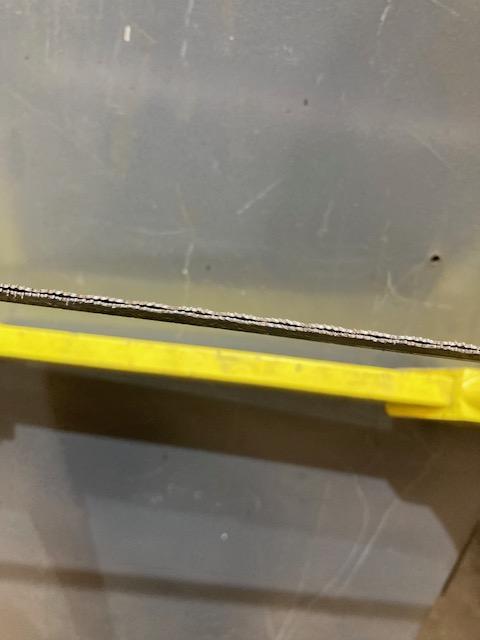
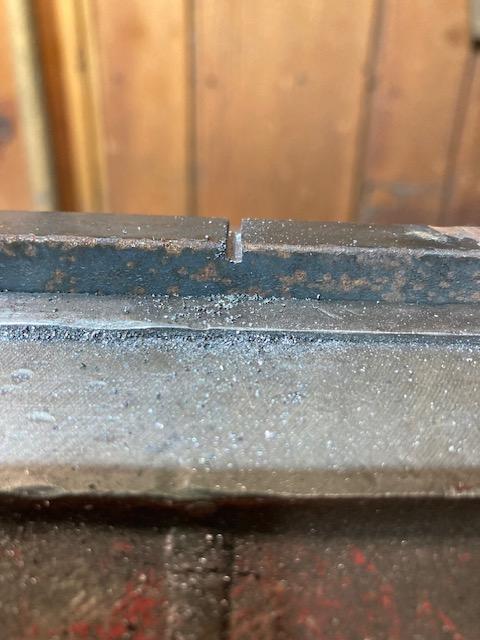
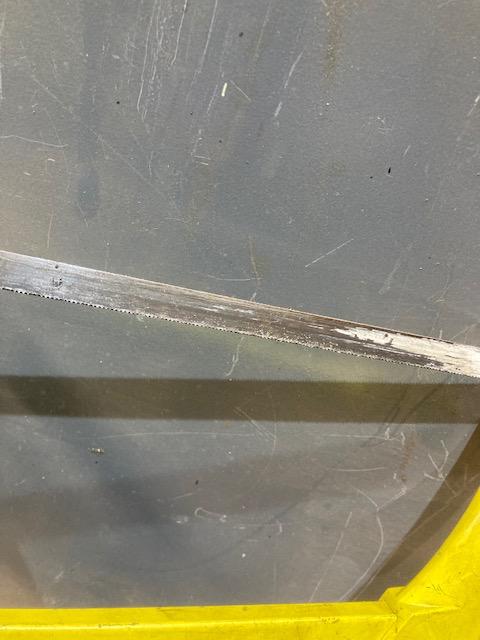
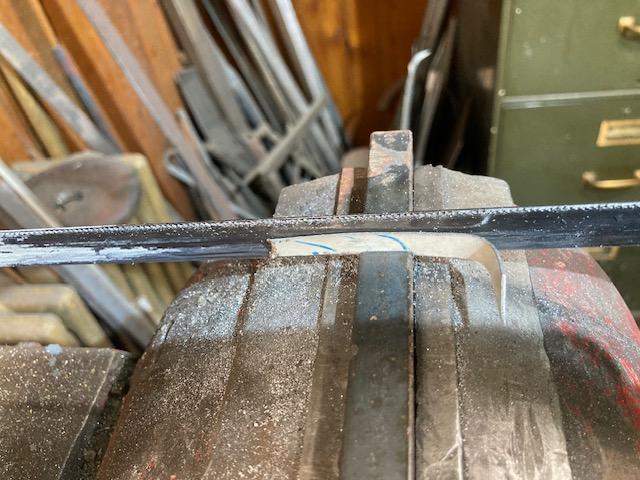
I can't seem to find my earlier post -- hopefully that isn't a sign. But here are photos of: The ganged blades in the saw; the first kerf; the saw with one blade reversed; the saw with one blade reversed in the cut with a shim; and a shot of a partially completed second cut, where you can hopefully see how the tooth-down blade is widening the kerf on the right-hand side. Sorry for duplicate photos and poor organization -- can't figure out how to fix that. Mod note: we cleaned it up for you
-
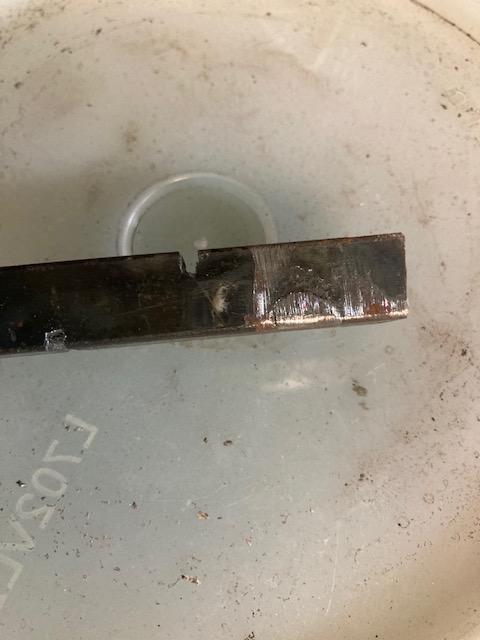
I worked out a new (to me, at least) way to cut a wide kerf with a hacksaw -- in this case to cut an internal keyway in a gear hub. First, I ganged two blades in the saw and cut a kerf to the appropriate depth. Then I took one of the blades out and reinstalled it upside-down (teeth toward the saw frame). I found a piece of sheet metal a little thinner than a hacksaw blade, cut an narrow shim, and placed it against one side of the kerf. Then I put the saw back in the kerf, with the reversed blade against the shim. The shim forced the live blade to cut beyond the edge of the existing cut; the reversed blade rode along the shim without destroying it. I went to a couple of progressively thicker shims until I got the kerf thickness I needed. It didn't do as neat a job as a keyway broach (If I could afford one of those), but I cut a keyway in about 10 minutes that I think would have taken close to an hour if I had to use files small enough to fit in the bore.
-
Not sure what you've tried for grit removal, but I just took the side of a diamond masonry cut-off wheel to a 60 grit belt, and it seemed to work pretty well. Of course, much of the grit had already been removed by more conventional means . . .
-
I've made a couple of settings of "silver"ware from stainless rebar. I have to say the handles look sharp with the fire scale polished off the tops of the ridges.
-
Also, it can be hard to align a punch well enough that the finished piece looks straight. And all things being equal, a square rivet will withstand a lot less torque than two round ones (or two square ones for that matter). But if you don't want your rosette twisting under idle fingers, a square rivet can be a pretty slick choice.
-
I guess roughly speaking, the bypass would set the pressure and the choke would set the volume. A low pressure high volume blower could stall before you could restrict flow enough with only a choke. And if you used only a bypass, there might not be enough pressure available at the tuyere to overcome a tighter-packed fire. The better option is probably to use a more suitable blower. But then I make do with what I have too much to criticize someone else.
-
Either way, I wouldn’t want it stuck in my head.