August 27, 20169 yr So I was asked to be the on-site blacksmith at our local rendezvous. In repayment for me doing demos, I'm given a prime location free of charge, and can sell any period appropriate items. Sounds great, but here's where I could use some advice. Equipment: I am knocking together a dirt box side draft(thank you Charles R Stevens) and simple bellows. My 1908 Trenton at least looks the part, but when did things like post vices, and hand drills really enter the scene? Demo items: Well, flint strikers are a given, but I was also considering small "medieval "style knives that are so popular. These can be hammered real close to finished, touched up with a file, hardened and a rough differential heat treat.(knife makers be kind....I stray meekly into your realm). Besides toasting forks and fire pokers, what do you find is easy to demo, but also sells? Thought about nails, but I'd have to practice that. Any and all advice is helpful. I've frequented rendezvous for years, but this is my first time participating. Thanks!
August 27, 20169 yr I have a cool rifle stand. The bottom is like a Shepard's hook so you can mount it in the ground. The top has two square holes. In each square hole sets an s hook horizontally. So it will hold two rifles. Thanks Mike
August 27, 20169 yr Camp fire hardware such as tripods, grills, grates, pokers, and the name escapes me at the moment, the two uprights and a horizontal bar between them for handing cooking pots, S hooks, trammel hooks etc, should go will. Tent stakes are always needed. Large (think long) S hooks to hang a lantern from a tree limb. Candle holders such as johnny picks. Look around and see what is already in use by the people participating. You may want to look up ice creepers and have a few pair on hand. They are great for walking on snow or ice.
August 27, 20169 yr Cooking and eating utensils, particularly Spoons, Sewing Thimbles, Hardware like Buckles and Rings for harness and tack, Scrapers.
August 27, 20169 yr Tools to work on locks, screwdriver, touch hole picks. Spring vise, would be hard to demo though. Flint knappers though I prefer brass. Small ladles for running balls. Patch knives, could knock those out pretty fast from old small files. Traps
August 27, 20169 yr If I were a mountain man heading for a rendezvous, I would be riding horseback with probably a pack horse. In terms of ironwork, I would have my rifle, a hatchet or small axe, knife, fire steel, and small tools to maintain the rifle. Not to forget beaver traps. I doubt seriously whether I would want to carry iron tripods, fire crossbars, s-hooks, and pots and pans. Gin poles (cranes), crossbars, and hooks can all be made of wood on site with hatchet and knife. I know. I know. At a modern day encampment, we're making a few exceptions to the way things were done in 1835.
August 27, 20169 yr Frank, most likely they rode to today's 1850 rendezvous using a V8 and 350 horses (grin).
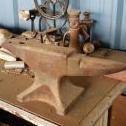
August 27, 20169 yr Author Thanks for the ideas. It's only a 3 day event each year, so I have plenty of things to fill some time. I'll be honest, it's the equipment I'm becoming more concerned with. Realistically, I would think that a blacksmith traveling upriver to a rendezvous would bring a stake anvil of some kind. My Trenton is 90# so is at least somewhat portable. But a post vice would be handy.... Any idea about earliest patent on a post vice? Hopefully way earlier than 1840
August 27, 20169 yr 4000-6000 bca On the Post anvil, tho the patten may have came along later. Frank is more familiar with the southwest, but I have seen Mexican civil war pictures were small anvils were set on top of nail kegs full of dirt. block anvils, London pattern, French pig and Spanish double horn (they didn't usualy have feet, but a mounting spike) as well as a simple block or double horned bick would be appropriate. So thing in the 10-50 pound range, depending on if you came by wagon, cart or pack train. Wouldn't think anything larger than a hand vice unless you came by wagon and had a toung vice (might be a bit early) Wooden rope and wedge vices would work for any cold work, and a large set of tongs and a helper for hot work. A woodsman's work bench would be most appropriate for most of such work, look up Dave Canterbury's videos of such a device. (A couple of foot of log about o foot a cross with notches cut in it to make a bush multi tool)
August 28, 20169 yr Jock Dempsey has an article on post vises. He states that the basic design was perfected in the 1600's. long before the 1840's. The vises were exported to the Americas by British manufacturers well into the first half of the1800s. (as were a majority of the anvils in the 1700's and the early 1800's). SLAG.
August 28, 20169 yr But if you are packing your kit into a rendezvous (as opposed to working a trading post) a post vice is one more peice of heavy and expensive equipment to transport (and risk loosing).
August 28, 20169 yr 4 minutes ago, Charles R. Stevens said: But if you are packing your kit into a rendezvous (as opposed to working a trading post) a post vice is one more peice of heavy and expensive equipment to transport (and risk loosing). A post vise is just a little more insurance your canoe will stay on the bottom. Frosty The Lucky.
August 28, 20169 yr Is it a juried event? If it isn't then I wouldn't worry about if an English pattern anvil or post vise is correct. Now worrying about theft or damage is another thing.
August 28, 20169 yr The earliest vise like objects I have seen in illustrations usually involved a cleat and a wedge, Screw vises can be seen in some Renaissance engravings and wood cuts in armourmaking workshops. Travelling to a Rondyvoo I would think the smith would like to bring as much premade items and stock and as little in heavy stuff he would have to pack both ways. BTAIM I have a tiny post vise very light duty with 3?" jaws that Frank once looked over and estimated that it was pre1800. The screwbox is forged brazed from a half dozen pieces and the screw thread in the screwbox itself was wrapped around the screw hot and then left to cool and unscrewed and then forge brazed in the screwbox, (probably all the brazing was done in 1 heat.) I can lift this vise with 1 finger and if I had to posit a travel vise that wasn't a hand vise for gunsmithing it would be the one! Bought it one Quad-State for US$20 with no mounting bracket or spring. I use it for earlyish demos but will not allow ANYONE else to use it---it's old and fragile! (Same Quad-State I bought a 6.5" postvise for $50...Have I mentioned I'm leaving for Quad-State in a couple of weeks?!)
August 30, 20169 yr Author Thank you all for chiming in. Thomas, It was a total "duh" moment when I read your post. While the demos are meant to be instructive...it doesn't mean I can't have material prepped..ie twists and cuts. I'm not really expecting a small scale rondy to pay off anything more than fuel costs, but it'll hone my skills. Thanks again....now it's time to work...
August 30, 20169 yr 1840 is close to 1850s, so documentation on what was used for backpacking in during the 1850s are likely to apply to the 1840s. Hand vise yes. Here is a small-stump-anvil and hardy-mounted-vise documented in the 1850s by and for use of the U.S. Army. Leg vises were not carried on horse back and not mounted on wagons,,, for wagon mounted vise see wagon/tongue vise.
August 30, 20169 yr Thank you for a wonderful mental image Dave. Just the thought of a waggin tongue vise puts a smile on my face. I can think of so many tongues that need clamping in a vise. Frosty The Lucky.
August 30, 20169 yr Author Holy smokes Dave.....that is invaluable! Like I said, they're pretty lax for requirements. But the history nerd in me is screaming..."build it...build it...." MAYBE not the stand, but the stake anvil is too cool NOT to fabricate. The clamp may be beyond my skills though. Then again, I'm with Frosty...THE TEMPTATION to use the "tongue vice" could overpower me. And that wouldn't be the best demonstration of smithing. Even if it is accurate
January 18, 20179 yr On 8/30/2016 at 8:48 PM, John McPherson said: Someone posted these a while back on facebook, IIRC. They still exist, if rare. So, the anvil packs inside the stand? Cool!
January 19, 20179 yr Doubt you could document it as a split piece of wood would do it and you wouldn't have to carry it.
January 19, 20179 yr Drive hooks. They are simple to make and cost you virtually nothing to produce while still being able to turn a profit. I sell ones maybe 6" long for $10, not bad for 5 minutes of work!
Join the conversation
You can post now and register later. If you have an account, sign in now to post with your account.