
mike-hr
Members
-
Joined
-
Last visited
Everything posted by mike-hr
-
If your punch is made of mediocre steel, or if it's good steel and it got too hot and lost its temper, it may be mushrooming a bit in the bottom of the hole, creating a semi-mechanical lock. Most of my punches are made from sucker rod, which is tough, but doesn't harden real well. McraigL bought a stick of H-13 and shared half with me, that stuffs awesome. I'm slowly redoing all my punches with H-13 and really noticing the difference.
-
We used a 33 anyang a couple weeks ago for a tong-making workshop. A couple things I found of interest: The oiler is junk. It went from not oiling, to dumping a solid stream and draining itself, at its own schedule. The adjustment screw is goofy. I worry about this kind of thing probably more than most, I had to shut the hammer down often to add more oil. The bottom die kept working loose, we kept it in check by wrapping the wedge key with a slice of beer can. This could be fixed by making a new key. The dies were all a bit different dimension, necessitating the need to keep individual keys for each different die. This made it inconvienient to switch from flat dies to drawing dies. It didn't start hitting hard until 20-30 minutes after startup. I was told that if it gets used often, it gets better, but don't know for sure. It had moments where it worked quite well. It's affordable, but I worry about technical support issues a year or three down the road.
-
I use a stump that rocks on the floor a bit. I keep a cedar shingle or two on the floor and just tap it into the low spot. Works fine.
-
 Free-form chunk of nasty old scaled up flatbar that grows into a grainhead, and a junior stalk growing out of dad's roots. The only way I can get out of my machinist/analytical mind is to do this kind of stuff is in the 6-10 beverage window.
 -
That's a good find. I reckon what I'd do is coat with ITC100 in case there's nasty lung worms inside, put a piece of steel on a chunk of it, and lay into it with a torch. See who melts first.
-
?? Both sides are supposed to be identical...unless you're making a groove or box on one bit, and a flat bit on the other.
-
Mark, if you feel like jumping over the cascades for a day, I would be happy to work with you on some stuff. I try to take a couple classes a year, it really helps to have the instructor come over and have me drop my shoulder a bit, pull in my elbow, etc. Most of the time, very subtle adjustments reap large rewards.
-
Look at BP0163, Handled Punch, and see what the eye drifts i make look like. They fit the Cherokee brand handles the local hardware store sells pretty good. I make them from mild steel, and case harden with Kasenit if I feel like taking the time. There's different ways to make the initial hole. I was taught to slot punch, and drift to size. Figure out the circumference of the eye drift, and use a slot punch that's the same or a bit smaller. I usually use a 1/8inch by 1 inch slot punch, or a 1/8 x 7/8 for smaller holes and I get by fine. I don't know what traditional eyes are supposed to look like, I buy a case of handles and make all my hammers and set tools fit them, so everything I pick up feels natural to my hands.
-
Pete, that works real well, except it helps having a friend over to keep the spare drift hot in the fire and help switch them over. it may take 6-8 heats for a 3 pound hammer. Also remember that heat rises, so if the pien end appears to be coloring faster than the square end, turn it towards the bottom...
-
Different means to the same end. Say you want a cone that's 2 inch dia at the top, 8 inch dia at the bottom, and 10 inches tall. Cut discs out of plywood, 2 inch and 8 inch. Screw them both to a stick so the construct is 10 inches tall. Mark a starting point on a disc, roll and trace the path of one revolution. Cut out the pattern. Thats how I make crawdad trap funnels.
-
I'm building a new forge, I'll share what i've found out. Mizzou is dense and tough, but not the best insulator. Its themal conductivity is 7.4 BTU-inftsquared hr degree F At 2000 degrees F(whatever that means). Kast-O-Lite 30 LI has a thermal conductivity of 4.4 which makes it a better insulator, but the guy at the boiler place said it's not as durable as Mizzou. So in the interest of fuel economy, it might be better to make the floor from Mizzou, or simple boiler bricks, and the walls from Kast-O-Lite 30 LI. Both of these products have a shelf life of six months or so, I put my bags right into gasketed ammo boxes to keep ambient humididty away.
-
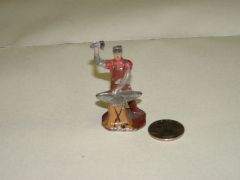 My Mother-in-law had this in a box of treasures and gave to me. It's made from cast lead, says France on the bottom. He's swinging a French pattern hammer.
 -
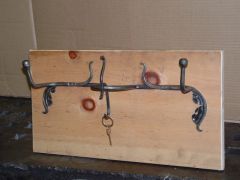 Coat rack with genuine factory accessory deluxe keyhook. Base made from 1/4 x 1 flat, ball rods made from 3/4 inch round.
 -
Congradulations! Image #4 made my day!
-
Go to some hammer-ins, there's usually a blower or two in the tailgate sections. Become friends with your local second hand store proprietor. Tell them what you want, and leave your card. I have a friend who has serious yard sale addiction disorder (YSAD). I can't afford to buy therapy for him, so instead, he usually has a hundred dollars of mine tucked in his wallet. I don't have time to hit all the sales, he can't avoid them, it works out fine for everybody. Last year he got a champion 400 blower w/stand for $3, small power drag hacksaw for $15, etc. etc
-
I make most of my punches and chisels out of potato chain. It's pretty finicky to heat treat, but really strong when done right. Mark Aspery said it behaves like 1090 or so, but we're all just guessing. Digger chain is getting harder to find, as most of the tater farmers around here are going to rubber belt machinery as it bruises the taters less.
-
How did you drift the eye and keep the straight lines of the edges?
-
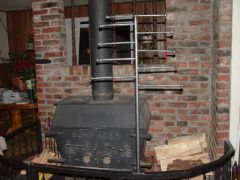 forged ball and stick rotating drying rack for gloves and other wet sundries. clamps to the woodstove guard rail.
 -
I'm using my block less and less since I got into making bottom tools (see BP0369). Two guys can whack out a good bottom tool in about 20-30 minutes. You can throw the tool in the fire to pre-heat it and get more mileage out of whatever you do. As far as holes in swedgeblocks, consider your local waterjet company. Our local guy can cut up to 5 inch thick steel, with very little blowout curf, and quite reasonable priced. I've measured a few old swedgeblocks, the cast square holes vary wildly, plus or minus 1/8" easy. As already mentioned, ain't nothing wrong with a wooden stump, either.
-
I built a nice 10 foot long ramp out of expanded metal and angle iron, with a pivoting attachment bar on one end. I take the tailgate off the pickup, pull the ramp off the contractor rack, and attach with pins to the lip of the pickup bed. All my tables, forges, etc. have at least one bar welded across the legs, pretty low, so a handtruck can scoop them up easily. We use a cheap HF offroad version handtruck with higher quality tires and the whole system works real good.
-
My buddy that builds drivelines uses a flat woven copper grounding strap, similiar to an old automotive battery ground cable. It clamps loosely around the tubing via the welders squeeze clamp. The tubing is free to spin around in the press, and he can do an uninterupted weld around the whole circumfrence spinning the driveline with his free hand as he welds.
-
I'm in the camp that thinks H-carbon steel rings nicer than mild. There's an abundance of potato digger conveyor chain in these parts, most likely 1070-1095. They make real nice dinner dingers. Take a nice 3/4 inch Snap-On endwrench, made of the best steel they can come up with, suspend with a leather thong, and ding it. Next take a 3/4 inch chinese end wrench purchased from the traveling tool gypsy folks, and ding it...lotsa difference.
-
I have a 1924 SB that has a missing tooth on the forward/backward carriage feed lever. My lathe may be older style than yours, it has a whole mess of different gears in a separate box and I change them around manually according to the chart on the cover. Anyway, I was getting something done at the local waterjet shop, and mentioned this broken gear to him. He said he has software to waterjet cut straight gears, given all the measurements.. Might be worth seeking your local waterjet shop out. I'm sold on his work, the tolerances the waterjet keeps are pretty amazing.
-
BP0017 Plow Work
-
On the west coast US, $400-1500. It will also cost you a bit to load/unload, and build a heavy duty stand. Worth it in my opinion, I love mine.