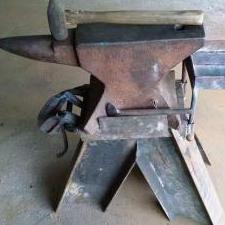
November 23, 20169 yr Here is my new portable hole: Height is about 24"; weight, 43.6 lbs. (I plan on adding some chains and other weight. As a side note, I'm pleased that my MIG welding is getting better.) This is an idea I've been playing with in my mind for a little while: using segments of heavy tie plate stood on edge and welded up to make the square hole. You can see how the ridges wrap around the corners to give a bit more strength. The base is some salvaged pipe, with some gussets for extra rigidity. The piece at the bottom is from an old ladder jack; it was mainly to help keep the legs aligned for welding, but was left in place on the theory that it will help keep the legs from spreading. I might also stack some more weight on it as well. The hole still needs a bit of filing, as it is slightly undersized relative to the hardy hole in my old Mousehole. I'll keep you posted on how it works under the sledgehammer.
November 23, 20169 yr Author Addendum: a big Thank You to the college theater department for letting me use the welder in the scene shop.
November 24, 20169 yr Cool smashing block you got there! I am hoping to build something for a similar purpose this winter. I intended to grab a big chunk of A36 at Logan Steel and weld stock to one side in order to create a hole. I was hoping to incorporate it into a stand with my swage block, but my plans are in the fantasy stage.
November 24, 20169 yr I like it, looks good. Scrappy Brutish how fitting a description. Good one both of you. Frosty The Lucky.
November 24, 20169 yr A quick suggestion: try to weld only on clean, ground steel. It looks like the legs were welded over the rust. Cleaning, and grinding the area to be welded will result in better and stronger welds, and they will also look better.
November 24, 20169 yr Author 41 minutes ago, njanvilman said: A quick suggestion: try to weld only on clean, ground steel. It looks like the legs were welded over the rust. Cleaning, and grinding the area to be welded will result in better and stronger welds, and they will also look better. Good point; thanks. I did a lot more prep on the pieces for the upper part, but probably could have done more on the legs. Next time! (Which is to say, I could always cut the legs off and put new ones on. I had already considered that possibility, in the event that the height turns out to be too low.)
November 24, 20169 yr Looks great. I wouldn't worry about prep. Most of the stress is compression and not in the direction of most of the welds. I just used 6011 for the root and welded right over any light rust. Mine worked just great for upsetting a flatter, which is a pretty heavy job.
November 24, 20169 yr Author 1 minute ago, Charles R. Stevens said: What did you use to cut the sleeper plate up with? Cutoff wheel in a 4-1/2" angle grinder. And patience.
November 24, 20169 yr Author 46 minutes ago, evfreek said: Most of the stress is compression and not in the direction of most of the welds. For the upper part, yes. The gussets are to keep the legs from spreading, so that's a shearing stress. 7 minutes ago, Charles R. Stevens said: More than I have! Lol La patience du taureau est énorme, comme sa force.
November 24, 20169 yr ; JHCC, A most learned chap has said, in French, that a bull's patience is as great as its power. SLAG.
November 24, 20169 yr Author A line from "Diva", one of my favorite movies (if sadly lacking in blacksmiths).
November 26, 20169 yr Author Having made this hardy hole slightly smaller than that in my Mousehole (so that tooling made in this would not jam in that), I realized that the Brazeal-style hot cut that was too small for the Mousehole should fit nicely. And so it did
December 10, 20169 yr Author Update: FIRST USE. I fired up the forge tonight for the first time since making this, and did some upsetting of a piece of torsion bar to make a flatter. Some observations: 1. It's rather light. I piled up the base with some chunks of stone and a lot of railroad steel, which helped somewhat. The addition of a lot of chain is definitely something I'll want to do ASAP. 2. The height is just slightly lower than ideal. I had thought of welding on some tie plates for feet, which might help with both the height and the weight. 3. The size of the hole is perfect. The workpiece never got stuck, and its shank fit the hardy hole in my anvil perfectly. Here is the workpiece being upset: And here it is partially completed: There are a couple of folds that need to get ground out before they turn into cold shuts. The workpiece it is currently in my annealing box, and I will do the grinding before I do any more upsetting. Here is the top surface. A couple of the welds appear to have opened up slightly, but it's holding together quite well, on the whole. I can always grind those welds out and redo them if necessary. Interesting to note the discoloration from the hot steel.
December 10, 20169 yr Author A thought occurs to me. As noted, the portable hole is a little smaller than the hardy hole in my anvil. I've realized that this doesn't allow for shrinkage: anything I forge hot is going to end up smaller still and thus be rather loose in the hardy hole. I'm thinking of filing the portable hole a bit larger to compensate. Any thoughts?
December 10, 20169 yr I'd make it the same size and the very slight shrinkage would be handy to make tooling easy to remove in your anvil's hardy hole. In the Victorian Farm their cartwright said to make a tyre 1/4" shorter for every foot in diameter so a 4' diameter wheel would be 1 inch shorter in circumference---when you are talking 1" hardy hole the shrinkage is not a lot.
December 11, 20169 yr That makes good sense to me Thomas....1" reduced is nothing really and would work well.
December 11, 20169 yr Author Well, it's actually 7/8", but yeah. The current size of the portable hole is about 3/32" smaller than the anvil.
December 17, 20169 yr Looks good Just a constructive comment I would say by looking at the welds your arc length is too long, The end of the rod should be almost or touching the work. I would recommend using low hydrogen rods especailly if you have an inverter or DC welder run the rods electrode positive though low hydrogen rod s are harder to restart if you chip the flux off the end by pushing sideways with the palm of your glove makes a huge difference in the restart as not so much flux chips off as just banging the end on the work piece. Low hdrogen rods make a much stronger weld and is less likely to crack when welding high strength steels Cheers Beaver Rough rule of thumb 3.2mm 105 to 110 4mm 140 to 160 amps
December 17, 20169 yr Author Thanks for the advice, BeaverNZ. I'm actually wire-welding with flux-core, as that is what the folks have whose welder I've been borrowing! Point taken on keeping the arc short, though, and I will keep that in mind for next time.
Join the conversation
You can post now and register later. If you have an account, sign in now to post with your account.