July 27, 201510 yr I forgot about that one historical drama they did recently about that one railroad goon too. I forget the name of the show. I think it was on the History channel. One of their more educational shows as of late.
August 27, 201510 yr There's a short rail line near me that went out of use about fifty years ago and then was legally abandoned in the early Seventies. Jump forward a few decades, and one of these private railroad groups buys the line and sets about restoring it for use in excursion trips. Turns out, some joker had decided to tear up a whole section of rail and sell it for scrap, thinking that "legal abandonment" is the same as "free for the taking". Getting arrested and charged with theft cured him of that misapprehension, and I gather he's still paying back the current owners after a civil case.
August 27, 201510 yr I am a firm believer in using known materials. Scrap and rebar is good for some limited items. I use for the most part, 1018 and A36 for general use forged items. I know how it will act. I understand its properties and I don't have to guess, test or worry. For some things I use acquired springs. And while I may not know its exact composition. I can give a good guess based on past experience. Some of the best advice I've gotten over the years is, "Use known steels." My two Kopecs worth of advice.
August 28, 201510 yr welding chain links w/low carbon steel. That is so easy. Makes one look like he/she knows what he/she is doing before an audience. I operate before an audience, you may not. Yet have some friends over. Demo some simple stuff and hit them with a chain link weld. WOW. Your status will escalate.Another is a nail. Have 'em try that. You will now be invited to all the parties. Along with a fist bump and slap on the back.
September 6, 201510 yr I see a lot of talk about "taking things from the railroad" thought I'd add in my 2c.Recently in my hunt for coal in my area, I cornered the local railroad mechanic. (I work at an auto parts store so he's in frequently) He didn't really have a good answer for the coal situation, but he was telling me that sometimes if you can talk to the road master for the area, they could possibly help you out. He explained that if coal gets dumped out of a railcar by accident or whatever may happen, it renders it useless to the RR. So possibly you could score some used spikes or something that way. He said the RR is unbelievably wasteful.It never hurts to ask, I get tons of free scrap and things by just being polite and asking the right person. In fact i scored an anvil for free on Friday. My coil spring, and leaf spring supply is also nearly endless haha.
September 6, 201510 yr calling up a steel yard is also a good place to get beginner materials, the owner or person in charge will always be glad to sell you drops. WHat exactly is a drop?Is it the steel thats missed the mould and hit the floor?
September 6, 201510 yr WHat exactly is a drop?Is it the steel thats missed the mould and hit the floor?I call them drops but when they do a project they will cut stock to size and whats left is often to small for them to use and is a drop. it drops to the floor and doesnt get used, another place we call is a fabrication place not to far from the house, pretty sure he makes trailers. not sure how much of what he has would work for forging but he had the steel we needed to take the saw mill from 8ft to 20ft so dad was satisfied.
September 6, 201510 yr Exactly, a "drop" is what's left over when stock is cut for a project. The term meaning it's been Dropped from the stock inventory. Another good term is rem or remnant or remainder.What I mean by a "good term" is one that is known and understood by folk in a trade or person on the street without needing a long explanation. Drop and Rem are good examples of "good terms," in my book.Frosty The Lucky.
September 8, 201510 yr In a good sized shop it might cost more to store, inventory, measure, sort drops than they are worth and so they often just go as scrap. I recently bought about 200 22" pieces of 1/2" sq A36 that were drops. An apartment complex had to go back and redo their stair and balcony railings to meet the 4" Rule---a big project! They had no use for the ends of the 20' sticks that were remainder when chopping out the needed pickets and so sold me 200 for US$10 which was below scrapyard price I'd pay to buy at! I also bought the remainder of the 20' sticks for about 1/2 new price. They had no need of them and no place to store them and so it was worth it to them just to get the space cleared out.This was a craigslist find and I lucked out as I was the first person to show up prepared to deal with 20' sticks---brought my angle grinder with cutting disk, face shield, hearing protectors, extension cord, pickup, etc (that was when I was offered the drops for a pittance---large fancy---incised twist---S hooks and tent stakes are churning out the door!)
November 8, 201510 yr For a new fella, can someone define for me the A36 characterstic mentioned above? I'm no metallurgist, so what are the identifying features for metals? I see hardness ratings, Krup, etc. Anybody want to give the Campbell's soup condensed version on this topic?
November 8, 201510 yr In general terms, A36 denotes only the physical properties, that being approximately 36,000# tensile strength. The A36 does not describe the chemical, or metallurgical composition. That can vary, but it is a low carbon steel.
March 4, 20251 yr On 7/23/2015 at 12:50 PM, Jacob Nothstine said: I would fine a metal supplier and pick up some 1/4 mild steel round and square. Cheap around .70 a foot by me, cuts easy, heats up fast, bends easy and you can make a lot of different stuff. Hooks, candle holders, harts, nails, pop holders, hotdog cookers, marshmallow cookers, pokers, corkscrew, practice twist. Exactly the answer I was looking for. Thanks Jacob. I know it's been years since this was asked, but it applies to me today, I'm going to hook my forge up for the very first time next week and start hammering something. Oh, and thanks for asking your question Forging Carver and taking all the hits! Seems like that's a brave thing to do around here!
March 4, 20251 yr If you’re going to a steel supplier, pick up some 3/8” square and round also. It will hold heat a bit longer and give you more mass to move around. I usually start kids off with 1/4” just because they see more results from the low force exerted, but I will usually give 3/8” to someone with more strength. A miss hit is less devastating to a 3/8” bar than 1/4 bar and can usually be recovered from with 3/8” stock. Of course, it could force better technique… just food for thought. Keep it fun, David
March 4, 20251 yr Good Morning, The best Steel for starting out, is the drops that are on the floor. 9 times out of 10, it is headed for the recycle anyway!! Before playing with it and sometimes after being played with. LOL. I let my feet feel what is on the floor, before I bend over and pick it up!!LOL Neil
March 4, 20251 yr 1 hour ago, Goods said: just food for thought. Thanks Goods! 46 minutes ago, swedefiddle said: The best Steel for starting out, is the drops that are on the floor. Thank you Swede!
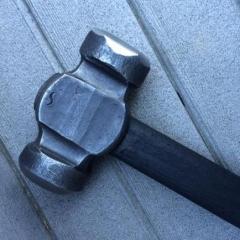
March 4, 20251 yr Ayup, I start folks out on 3/8" sq. or 1/2" end. Both weigh about the same per linear foot. They have enough mass to hold heat longer so a person can take a LITTLE longer forging between heats but it's light enough to move easily enough to not strain muscles. Don't use too heavy a hammer, 3oz will do good work but isn't so heavy it'll do soft tissue damage before you feel the fatigue. A heavy hammer can sneak up on you in a few blows. Once you've developed good hammer control and the muscles heavier hammers are safer. My go to hammers are rounding hammers, one long handled store bought and one a friend helped me make on s tapered slab handle. I'm a huge fan of slab handles but that's another story. I have a straight pein, like a cross pein but the pein is in line with the handle. I have a cross pein too but favor the straight. My go to for finer control is a 24oz "drill hammer", they were designed for drilling holes in mines and have short handles like a small single jack sledge. They have enough mass to do good work but the shorter handle provides easier control and precision. The hammer that's always in the rack though I don't use it unless I need heavy is a 4lb. single jack sledge. It's too heavy for daily use but when you need serious authority it's the one. I have a couple sledges as well but rarely use them. Hack saw, hot and cold chisels and tongs are handy in a big way I pick chisels and allan wrenches up at yard/garage sales. Both can be reforged if you need a higher carbon stock for a tool, say specialty punch, etc. good stock to have on hand and it's cheap. It's getting late, more later. Frosty The Lucky.
Join the conversation
You can post now and register later. If you have an account, sign in now to post with your account.