Marc1
Members
-
Joined
-
Last visited
Everything posted by Marc1
-
Aiaiai .... not a flap disk! only a wire wheel!
-
What do i put on my hammer handles? Besides the head and my hand, nothing at all. They get smooth with work and I don't need them to look any particular way. Have a rounding hammer I bought from a Slovenian smith and he sold it to me with a charred handle. Sure looks nice but it is a handle. Nothing more. I feel no difference between that one and the others. I am too distracted by the work at hand ... or should I say handling my work?
-
Good for you Jerry. Activity and satisfaction of doing something are the best medicine.
-
Was it something I said?
-
Older anvils are nice work horses but very overrated in my view. The weight on that anvil is on the lower side and depending on what you want to forge, can be rather small. As for value, it depends on the market in your location, more than the brand. Antique value does not apply and older means made with less reliable technology and more likely to fail ... relatively speaking of course. Many people forget that there are good quality new anvils, that are fully forged and will outperform any old anvil. The "old is better" was mostly false for most modern anvils and only applies to chinese and poor example of modern eastern europe anvils, but was successfully exploited by those who sell older anvils alluding to antique value or some other mystic, non existing properties that push the prices of older beaten up anvil way beyond the reasonable. I wouldn't pay more than $300 for that anvil and I live in a area of very high prices that believes anvils improve with age.
-
When I first saw this thread I thought someone was trying to forge his own hip prosthesis! Seriously now, "back surgery" is a bit non specific. There are many procedures that work to alleviate pressure on the spinal cord. The one that is least successful, about 11% success rate is fusion. Best back problem treatment you can think of is losing weight ... if you are overweight of course. Same goes for knees. I had trouble with one knee, lost 5 kilos and no more trouble. it does take very little sometimes.
-
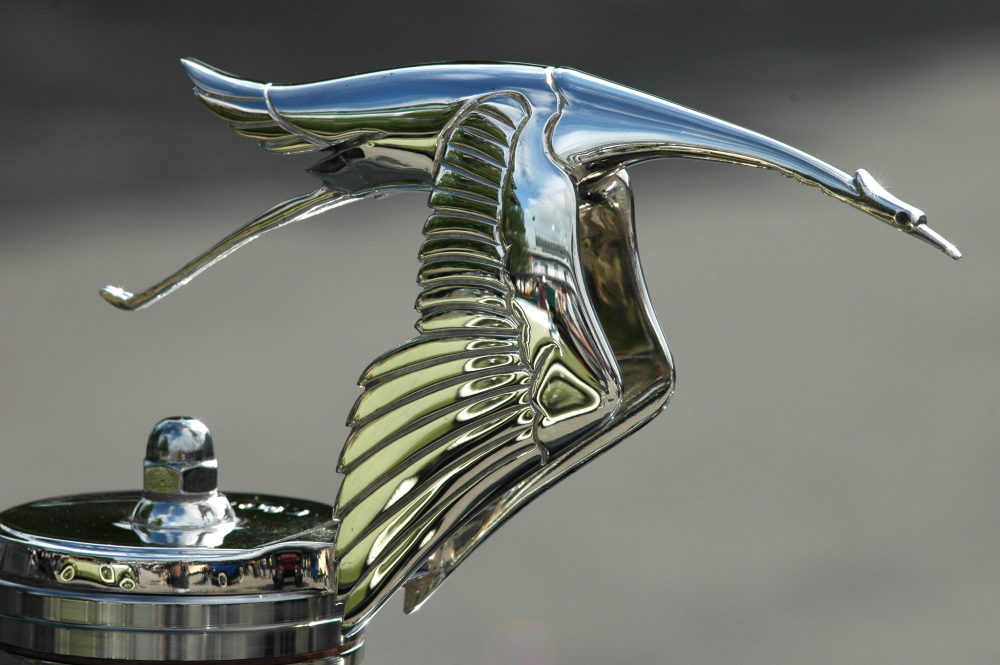
Petunias .... So it is not pecuniary interest just petuniary I would like to see somthing like that. Offer to make a concrete replica in exchange for it and the selling point "it does not rust" K6 Hispano Suiza hood ornament
-
I like it actually, has a nice robust shape to it. And one advantage too ... no need to fall in the tempation of "restoring" it. Nothing there to weld!
-
A collector that buys anything worth collecting for the sole purpose of possessing it and show it, rather than using it for it's intended purpose, clearly makes the item go up in price. That is undeniable. Take an old Coca Cola sign. Why is it worth $3000? Coca Cola does not want it anymore. If such activity is reprehensible or not is a matter of opinion and the fact that anvil collectors push the price up may be one factor. To me, collectors are a fact of life and they play a role in the market of any collectable object. i would like to buy a K6 Hispano-Suiza but collectors keep me away from it. in the case of anvils, I know we have a collector in Perth somewhere that has hundreds of them and advertises regularly at astronomical prices. last time I checked it was $10 a pound. Good luck to him. I think he imports them from England. Plenty of fish in the sea I say. Keep on looking you will find what you want soon enough. Let others be.
-
Mm ... In previous photos the face plate seemed obvious, on this one not so much. i don't know. Inconclusive I say. Yet if you say good ring and rebound, then that's what it is. it seems it has not seen much work, and the damage on the face is more from corrosion than hammers. Just use it and hit hot steel on it. Time will tell. Best of luck !
-
I am making a gate with 60 x 6 mm flat bar that has a lot of bends and doglegs and need to use a 4 lb rounding hammer for expediency, The hammer has a long handle and i use it from 3/4 to 1/2 up the handle. It is what it is. Carpenters use the whole length of the hammer handle to drive nails and frown upon "choking the hammer" for good reason. THeir hammers are from 18 to 24 ounces. Forging is different from driving nails. I agree with Thomas and Vaughn, use the lightest hammer you can get away with. And also ... it is the work that determines the hammer not the blacksmith's strength or lack thereof. PS Also ... the blacksmith's hammer blow comes not only from a downward movement but also from a circular motion that saves a lot of joint injury when you get it right. This technique makes a conventional hammer blow using the whole length of the handle, redundant in a way.
-
Experimental fuel is a pain, and adds one more layer of difficulty for the one trying to learn. I know I know ... the Egyptians made coal with dried out seaweeds and crocodile bones and forged the mask of the pharaoh. ... well, almost ... I am told. Seriously now ... about clay or rather mud cracking. Very true. Cracks you can stick a finger in. How to avoid it? Drumroll .... taratata tata ... mix lawn clippings from when you mow the lawn with your mud, nice an even in a paste. No more cracks Oh and poking the grate? Sure it works ... for a while.
-
All the suggestions are good. I think the problem with those rivet forges is the lack of a functional way to clear the air passage from below. You will find that it works but for a while only and then the air has no way to pass through the coal. One way to make rivet forge work a bit better is to build a fire pit as suggested above but with steel plate, and a clinker breaker that can be actioned from outside. Then you can fill in and level the table with just ordinary mud you make with dirt and water.
-
The difference between a mechanic workshop press, besides if it is made in China or India ... and a forge press is not the nominal capacity in tons, but the way it is used. Those workshop presses are designed to push a bearing out or to press a bush in as a one off operation, they are not designed for continuous industrial use. A forging press by its very nature works continuously up and down at a very fast speed, and imparts continuous stress on the frame and goes from zero to full capacity in a matter of seconds over and over for the duration of the forging process. Those presses wouldn't last a day if subject to such treatment. People get them to work simply by underperforming and doing things extremely slow. If you are going to build your own press, listen to those who have built their own press like the one in the book (not me). Steel is relatively cheap in the scheme of things when you consider the small amount required. You are not building a shed, just a little frame. The difference in price will be forgotten very quickly yet an undersized frame just like a slow pump will make your blood pressure go up substantially. Bribing the fabrication shop or the steel merchant for his offcuts with (legal) incentives is not a bad idea either. I can get "I" beams from demolition at half price from new. Just needs a bit of cleaning with a wire wheel.I go for ... mm ... $226.50 So the paperwork is to prove ownership ... I see. In Australia we used to have a monopoly on welding gases by just one company. High rental and low price for gas. Convenient for the workshop that uses many tanks per year, no good for the small workshop. Eventually and only a few years ago, some companies started to trade by selling the cylinders rather than renting them yet their gas prices is higher. To prove ownership is not necessary since all cylinders are marked with the company name and each company fills their own. If someone steals the cylinder he can still go and get it refilled. The cylinders that are rented require an account with the refilling company and you can buy a stolen cylinder on Gumtree, but no one will refill it. As for my original question if you get your cylinders refilled or if you swap them for a full one, I read that IF&C bought his cylinders in 1972 ... but i surely hope they are not the same in use today ... yeeeks! I get a different cylinder every time. They "belong" to me legally but the process of refilling by swapping puts the need for periodical checks back on the gas company.Should have said you do the casting in Hollywood.That article is very interesting but contains a few inaccuracies. The name cassowary comes from the Malay language Kasuari. The cassowary was known to exist way before captain cook's time and was classified by Linneo in a book published in 1748. The bird existed in the Indian archipelago and has a few different subspecies. Our Casuarina tree (She oak) gets its name from the similarity between it's foliage and the bird's feathers. Who was first if the casuarina or the Kasuari ... i don't know.When you make a scroll, you always start with making what will be the center of the scroll and work from there regardless if you use flat round or square. What sort of center you chose depends from design. Flat bar usually has a fishtail but not always. If you use a cross peen hammer you can leave the marks you make to do the fishtail as a feature. That is what the hebo machine does to mimic the work of the hammer in those scrolls you bought. For square stock most people would make a round center and start from there. The center also helps to hook into the jig if you use one. Making a scroll hot freehand without a jig is not as hard as people think, and you get to see the defects and correct it if you draw the scroll with chalk on your bench. Use a small hammer and work it gently tapping towards you with the curve upwards, and turning it sideways to look at it a bit at the time. A jig helps if you need to make lots of same size scrolls. Bending cold has the disadvantage of springback I find rather annoying.Yes. Easiest to deal with because there are so many outlets. My Argon tank needs to go to one welding supply only, but it's much larger (E size)Do you get an exchange tank when you buy a refill or do you get your own refilled? I go to the local hardware and jus swap the tanks for a full one. What's the paperwork for?By the way no new anvil has sharp horn, may be a more than desirable crisp edge sure. You can imagine why ... "Sir ... my new anvil has rounded edges, I wanted a new anvil not a used one" But sharp pointy horn? never seen that. Then again, I have seen horses throw up, so nothing will surprise me. Yes, and sell that surface grinder you used to flatten the anvil will youIt takes very little to forge the start of the scroll even if you then roll it cold and the result is a much nicer scroll, but I don't want to tell you how to do your work. I am intrigued by those tube scrolls you use for the chandelier. How do you get the groove? Do you have a Hebo scrolling machine or you buy the scrolls ready made?"Sharp edges and needle sharp horn" ... that was a joke by me. Not intended to be taken seriously by anyone I hopeOnly reason I ask is because you keep the start of the scroll flat, usually a sign of machine scrolling.