
Marc1
Members
-
Joined
-
Last visited
Everything posted by Marc1
-
You made that stand?
-
Just to clarify what seems to be a recurrent mix up. CO2 is Carbon dioxide, formula is O=C=O. The only contribution of energy to our planet that is a closed system, an island if you want ... comes from the sun, and CO2 makes it possible to convert light into carbohydrates through the process of photosynthesis in green plants. Bottom line, without CO2 there would be no life on this planet. CO is carbon monoxide. Formula is one molecule of carbon and one molecule of oxygen linked by a triple link, ( not easy to type). This is a toxic gas, slightly lighter than air and that needs to be vented out of the room. The greeks used CO to execute prisoners. The confusion between carbon, carbon monoxide and carbon dioxide is easy to trace back to the latest eagerness to blame CO2 for about everything under the sun including baldness, and call it "carbon" . CO2 sensors are very useful in greenhouses where CO2 is artificially increased to increase yields. Also necessary in submarines and other enclosed spaces like tanks or caves to see if it is safe to enter. Submarines operate with CO2 up to 5000 ppm as opposed to 400 ppm in the atmosphere. Higher concentrations are not toxic but reduce the available oxygen. The atmosphere is 78% nitrogen, 21% oxygen, 0.9% argon, and 0.03% carbon dioxide. From that 0.03% of CO2 present in the atmosphere, humans produce 3.4%, so 0.000102%. Carbon monoxide (CO) on the other hand is highly toxic, and kills by reducing the oxygen carrying capacity of blood ( it binds with hemoglobin) It is a very common cause of death and it's effects are cumulative. Very common in boats and very dangerous since there are no warning signs. concentrations as low as 30 ppm (part per million) can lead to problems including poor judgement. CO sensors are important and the location should be as stated before, at head level. A CO2 sensor would be useless in an ordinary workshop. Plenty of good information on Wiki and other sources. Please learn about CO2 and it's importance for life on the planet, and make sure you can distinguish CO2 ( the good ) from CO ( the bad ), and C ( the ugly ) that is solid and very useful for writing, heating and even forging if you are so inclined
-
How refreshing is that! A quality build without claims of mastery. Well done mate ( are you sure you are not Australian? ) Your anvil deserves the term "Design anvil" rather than improvised anvil. Good for you Looking forward to see what you forge on it.
-
You should include a sound file to hear the sound of that fantastic improvised anvil. make sure you hit only hot steel on it
-
Agreed Kozzy, the mill is a luxury process that can cost more than the part you try to fix. A Die Grinder is a cheap way to get rid of any hard inclusion. Robert ... you have made it abundantly clear that you are a multi decades long weathered professional as opposed to us poor plebs down the flat. A detailed step by step write up, based on your experience would have been more useful ... but it is too late now. Maybe next time.
-
Yes, of course when buying a new anvil, you have to consider what you intend to forge on it and choose accordingly. Farriers favour narrow anvils, decorative/ architectural work benefits from a wide face possibly with a side shelf. Bladesmiths i suppose would probably benefit from a narrow face, but i don't really know that one. As for prices, to pay ~$2000 for a 260# Blu, or $2000 for a 260 Nimba Centurion or ... to pay $2200 for a the best anvil, spanking new shiny beautiful polished 275# Refflinghaus model 57 .... is a no brainer.
-
Most likely a broken drill bit, or a broken off stud extractor. The sort of left behind bits you find when you try to fix someone else's unfinished repair. And that reaffirms the principle of never using those wretched extractors unless you have a plan B and a plan C to apply after they break off.
-
The big blu anvil 260 LB is priced the same s the Centurion (260) Nimba anvil. I buy a Nimba anyday.
-
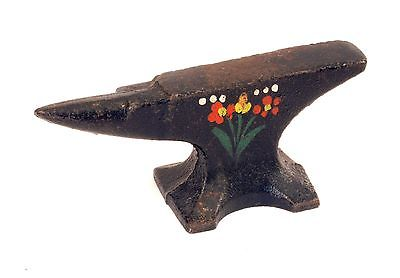
What's wrong with paint ? It can brighten up the shop
-
The problem with extracting broken bolts from a blind hole using a stud screw reverse extracto thingy, is that this things are hard ... and they are brittle. If you break one of them in the hole, good luck drilling it out. M8 is a very small size. Easy to break. I would keep on drilling and honestly I don't see how M8 even structural will perform long term under the hammer. You could go to M10, with no ill effect to the jaw body and have a beefier bolt in place. But I can be wrong. You need to careful measure the top of the wall and ponder if it will take the beating. To me it seems that the right hole, the 'good' one is higher and has therefore less steel on top of the hole than the 'bad ' one. Of course you can take a pragmatic approach. Weld both holes shut. Drill and tap new M12 holes in a slightly lower position ... and make new jaws to match. If I had to take this approach I would clean out both holes using a Die Grinder and carefully weld it shut with a stick welder, bit by bit, cleaning out the weld scale every time carefully even grinding the weld every time to avoid scale inclusions. Or TIG weld ? I don't have a TIG welder nor do I know how to.
-
It is a patience game. Last time I replaced the elbow in my boat engine exhaust, I found one of the bolts had broken off and half of it was still in the hole after pulling it out. Drilled it out with progressively larger bits. In my case the forward section of the hole was stripped, so had to bore all the thread out, cut an oversized thread and screwed in an insert to bring it back to original. My suggestion is to use high tensile screws. Those screws will take a beating, look at how the edge of the jaw body, rolled over the jaw insert from the hammering.
-
May be this thread is a good opportunity, for those who are as long in the tooth as i am ... to reflect on what and how much we are accumulating in the way of tools. Look around for someone close to us who would be grateful to receive something. May be Christmas is a good excuse?
-
Etching WI is trial and error, due to the many variations and qualities around. Try first with a slow less aggressive acid. You must clean the surface from all oxides first. If it is not satisfactory try different acid.
-
Considering that a post vice is designed to forge on it, I wonder how well those screws will withstand hammering on the jaws. Of course for ordinary vice work, swapping jaws and replacing with different metals and surfaces is very handy. Not sure I would want that on my post vice. Having said that, I wouldn't modify what you have. Just repair it to original conditions by drilling and tapping for new screws. Not hard to do, lots of good advice in youtube for such procedure. If you then smash the screws when forging, you know you need a different post vice.
-
It's worth the try, but I am afraid that is not going to be easy. For what I can see, it seems someone had a go at welding the edges already, and the repair was soft and mushroomed. But I may be wrong. If I am right, you will need to grind out the soft weld before you use the correct rod. A tough call.
-
What's wrong with you guys? The man asked for a book recommendation, how hard is it to answer? I second "The Backyard Blacksmith" by Lorelei Sims.
-
After using mainly Hofi style cross peen hammers, I once bought a Brazeal rounding hammer and that is now the one I use the most. They are great hammers and I was over the short handle of the Hofi style ones anyway.
-
I don't know if this counts as something i was given ... but anyway, I once bought a small 40Kg anvil from a now defunct foundry, I needed as a portable anvil. When the anvil arrived, it had a large number of little voids visible on the surface of the body. I was disappointed and got on the phone with the foundry who told me to return it and that they would replace it. Return it I said, are you for real? You want me to ship 40 kg 1500 km to you? So they sent me another anvil and I kept the defective one. However ... I had a go at working on the bad one, and I have used it for cold work for a decade, and abused it in all ways possible ( within reason) with no ill effect. The replacement one still has the factory paint on it
-
Diluted FC or hot white vinegar.
-
Ha ha, I remember my brother who lives in Italy and only knows 220V asking what do we have in Oz ... when i said 240V he said : Ooooh Fanatic ! As if i have a home generator and crank it up that much more to be that much bigger than him. A much more interesting debate, rather than voltage is frequency. 60HZ is actually better for the generator side than 50HZ yet most of the world goes on 50. 220V~240V requires smaller cables than 110~120V, so one would think that ideal domestic power should be 240V 60HZ, however most countries that use 60HZ use 120V and those on 50HZ go for 240V. Japan actually uses both and that does not seem to faze them one bit Standardization of power supply is old hat and would cost a bomb to change, a bit like changing the side of the road you drive on. Just plug and play, and follow all the rules. I believe that you guys can do electrical work in your own home without being qualified? We can not legally do any electrical or plumbing work unless we hold a trade license in Australia.
-
The first picture is fires in the state of NSW, the second picture is closer to home. The shaded area is the area that is burning It is going to be a long summer.


-
If you google USA power supply you will find the answer. Far from being a technical issue today, is actually a historic nominal issue. Edison chose 110V as the first power system as a good compromise. It worked well for incandescent light bulb without burning it too soon. By 1930 the voltage was increased to 115V and in 1968 motors had to reflect this voltage rating. In 1984 the code for load calculations changed again to 120V. Does it matter for the consumer? Unless you are an electrical engineer that needs to work out loads and wire sizes, probably not. After all you as a consumer don't have any say over what comes out of your outlet. if you had a voltmeter plugged in permanently next to your outlet, I bet the voltage will change from day to day and between day and night time according to your location and your area overall load, summer or winter, population etc. Read the nameplate of your domestic appliances and motor plates and you will see 110,115 and 120 in any irreverent order, just like we have 220v 230v and 240v in Australia. We used to have 240V but now is more like 230V Does it matter? Not really. As long as you plug in the right outlet, and they are shaped to prevent errors.
-
I believe you ... only I have never seen a Fisher anvil in the flesh. The question was tongue in cheek, of course eventually the crates will give in after flexing one time too many. . I was hoping for a smart answer like ... the hammer blow is absorbed by the anvil so the base does not contribute to the system ... or words to that effect.
-
Milk crates are stronger than cardboard, but only just ... Interesting how the anvil has offset anchoring lugs. And just in passing ... if you had your anvil on milk crates and worked on it like that, do you think the milk crate would collapse?
-
Off topic ... i would like to try those noise suppressing ear plugs that allow to hear speech. Not cheap though.