Joel OF
Members
-
Joined
-
Last visited
Everything posted by Joel OF
-
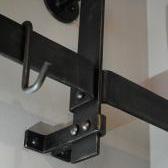
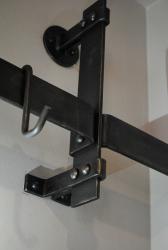
It's just a bit of angle iron that slides left and right in channel. The chunk of steel on one end of the angle iron is a counterweight to stop it falling off when it's slid open.
-
That hunk of I beam is overkill in my opinion, you don't need such a heavyweight forge table, I think you'd be better off saving that for something else at a later date. Without knowing what materials you already have or what you can scrounge it's hard to know what to suggest, so sticking to generalised advice - if you're not very experienced at welding for the minute I'd stick to something like the 55 Forge and fabricate your own setup at a later date once you've got a feel for how much size you need. Just to give you food for thought when you do fabricate you're own setup and how much you can achieve with a relatively little forge - I fabricated this little forge out of a chunk of box section I cut up to make the firepot (approx 30cm long and 10cm deep) along with some box section legs and extra bits of angle iron. It was a thankyou present to a guy who came and helped me out for a couple weeks when I was preparing for a big 3 day fair. I use a similar size forge for demonstrations and I find it very useable. Note the sliding gate at the end to allow longer pieces to be passed through, (It's all fully welded underneath, the top welds are just kinda long tack welds).
-
Right, following a call to the Foods Standards Agency and a chat to someone in the "materials in contact with food" department, the info is laid out in European Regulation 1935/2004. This is the link via the FSA website you want if you're interested. http://www.legislation.gov.uk/uksi/2012/2619/contents/made I chatted to the guy for about 10 minutes and came away happy that the regulations follow common sense. (He obviously knows them inside out). In short, it's the parts that are in contact with the food that are the most important and materials like stainless steel are best because you can clean them easily and you know how they're going to react. With regards to finishing your mild steel items in vegetable oil - to keep within the rules you've got to state how the item can be used and an aftercare procedure to be done by the customer. That's bascially because you have to make the customer aware of the limitations of the product and the oil finish isn't going to last as long as the steel itself.
-
I've made and sold food items finished in vegetable oil too and been confident that they're safe, but that's just me saying they're safe, what I'm wondering now is what's needed to be officially safe. Have you ever seen paperwork saying finishing mild steel in vegetable oil is a safe utensil treatment? I know I'm playing devil's advocate a bit by being so pedantic but I don't think food hygiene is an area where you can legally afford to wander off the rules. My health has been permenantly damaged by the food poisoning I got 9 years ago, massively affecting on my day to day life. I don't want to give anyone legal ammunition to say something I've made has played a part in harming them in a similar way or leave a trail of breadcrumbs that gives the caterer room to point the finger at me. Here's the list of guidelines on the European Hygenic Engineering & Design group website. http://www.ehedg.org/?nr=9&lang=en When you click on each one it brings up a blurb describing the guideline contents. I would imagine No.8; Hygenic equipment design criteria and No. 32; Materials of construction for equipment in contact with food might give some answers to your question. There's also guidelines on the cleanability of products. Unhelpfully this website mixes and matches the words "guideline", with "criteria". A guideline has flexibility, criteria doesn't. I need to find out which these are, a call to Environmental Health first thing next week will probably clear up a lot in one swoop. A few lines copied from the blurb describing guideline No.13; Hygenic design of equipment for open processing "This means that in open plants, environmental conditions, in addition to appropriate equipment design, have an important influence on hygienic operation. The type of product and the stage of the manufacturing process must also be taken into consideration. This paper deals with the principal hygienic requirements for equipment for open processing and applies to many different types, including machines for the preparation of dairy products, alcoholic and non-alcoholic drinks, sweet oils, coffee products, cereals, vegetables, fruit, bakery products, meat and fish. It describes methods of construction and fabrication, giving examples as to how the principal criteria can be met." I think BBQ's would definitely fall into that category. I read "environmental conditions" as "rust" and "equipment design" to include material spec.
-
Hi folks, pardon the following essay... This subject has been on my mind for a while as my girlfriend is starting a home baking business and seeing the amount of hoops she has to jump through at every stage regarding food safety to be signed off by Environmental Health as fit for business has got me wondering what forging/fabrication methods would meet official approval? The common "finish your mild steel food implements by cleaning them then baking them in vegetable oil" advice might be ok for the local bohemian craft market but Environmental Health would laugh you out of town if you wanted their approval. This really is at the front of my mind now as I (may) have two frabcation/forging commissions for outdoor cooking equipment to be used by catering companies, namely a hog roast spit and a large BBQ. Obviously safety is my primary concern and with that in mind I've begun researching hygiene requirements and will also call the Environmental Health dept at my council. Early research has led me to 6 documents I will request from the European Hygenic Engineering & Design group (for spec on things like stainless welds). Whilst I'm not wanting to cut any corners I would like to hear any experiences or advice that might speed up my research. Two immediate thoughts are whether every part needs to be "food safe" or only the parts in direct contact with the food, and secondly, it might be wise to buy in the parts that will be in contact with the food and simply make a housing for them. One client has already rejected another fabricators quote for a stainless steel hog roaster on the basis of price and has told me he's happy for everything to be made from untreated mild steel, except the bar the pig is skewered on which he agrees should be stainless. I have told the client that 100% stainless construction would be my preferred method for sake of hygiene and the possibility of cleaning it without rusting, but if they want an untreated mild steel construction then I'll do on the grounds they sign something saying I've warned them of the rust potential, possible impact on food safety, they take responsibility etc etc etc. Obviously it can't be zinc treated or primed for safety's sake and regulations state that the materials used can't impair the taste of the food either. I suppose one saving grace of this is that I'm not involved in the food preparation and could argue that I'm just supplying something for someone to use and maintain with common sense, though this is the dark realm of food hygiene where common sense alone doesn't cut the mustard - no pun intended. I suppose one of my conerns is that these items will be used to cook food which will be sold to the general public, it's not just for personal use. Any pearls?
-
Well here's hoping commissions follow at a steady rate for many years then. By the end of this month I'll have handed out over 500 cards in the last 3 months and averaged 1 demo a week. Fridge magnets sound like a good idea when I can afford them. I've discovered my most profitable items are the ones that are "fun and useful" and fridge magnets fit that bill, though obviously not something I'd sell.
-
Do you know roughly the ratio of how many calls/emails you recieve from business cards taken at fairs/demos? E.g 1 call/email from every 100 cards. For the sake of arguement let's say a month after the event is long enough for someone to call/email you.
-
I'm sure it'll be an amazing event nonetheless, I wish I could make it but I can't afford it a.t.m (let alone the weekly food shop). Hope everyone films lots and uploads to YouTube!
-
Cheers for the pointers. I am looking into the possibility of clearing a space in a disused barn next to my workshop, this would serve as a space for either blasting or pickling.
-
Hi folks, I've been cleaning scale off exterior work with an angle grinder wire wheel but now I'm looking into buying blasting gear or setting up some acid cleaning area. I've done a bit of research on this site and others about the two different processes but I still don't have a sense of what's more convenient and better to live with. Can anyone give me a comparison of the two process considering things like: running costs time efficiency size of work suited to the processes convenience of waste acid/blast media disposal space needed noise Any pointers would be greatly appreciated, cheers.
-
Clever idea Judson. I reckon each wing will be about 3 feet wide, Chinobi. It's not going to be anotomically accurate in any way. Dystopian is probably the right word for what's in my head.
-
Haha, spot on. And if the thread hasn't gone off on a tangent before you've clarified what you mean, that's a miracle :-D
-
I went to a War and Peace show the other day, it's the biggest one in Europe and attracts stall holders from all over Europe, especially Germany. There was this German guy hand stamping dog tags on this anvil. Didn't get to ask him much about it as he was talking in German to someone and I didn't hang about as there was a concerning number of swastikas in his area. Looks to me like it's been milled, the top's so flat. Just a hardy hole, no pritchel. Weird hollow shape at the back, it was in shadow so I'm not sure how well you can see that. Anyway, there you are...
-
Blacksmiths are susceptible to all the personality flaws of mere mortals, my girlfriend will vouch for this. Shrug it/him off.
-
Cheers for the ideas, lots of people suggesting flat products which is interesting. Nice pattern on that stuff Chinobi but I've only ever seen it in galv. This is when I wish my engineering/mechanical knowledge was better, (or actually existed at all), I keep wondering if there's tractor parts or boat parts that might be suitable. Would be nice to salvage something.
-
Cheers for the ideas. Yeah that's right Frosty.
-
Hey folks, can anyone suggest some easy to find pre-patterned steels that are good for forging with? I've got a dark/industrial bird skeleton sculpture in mind that's going to need a lot of feathers and I thought I might experiement with some pre-patterned steels to see how they come up. They don't have to be steels that will produce a true to life feather pattern, it's going to be a fairly abstract sculpture. On my list so far: Rebar Rasps and files Wire rope Threaded bar
-
A better reason to leave your phone in the house is to not get bothered by your girlfriend texting you every 5 minutes. Mine's my business phone so I want it on me at all times. Mine's always been in a decent case but the crud still gets in. The fabricator has his in a folding case which goes inside a 1mm steel case he made!
-
Does anyone else have problems with their mobile phone's speaker or microphone due to workshop filings/dust? The speakers on my phone are complete shot and the fabricator I work next to says no one can hear what he says on the phone because his mic is shot. Mine's in warranty so can be sent off for repair thankfully. I tried squirting air into the gaps to clean off the magnetized junk but alas no joy.
-
Hi guys, just thought I'd share a couple pics of some trestle tables I made today. I needed some for general measuring out, bit of cutting etc. The pics are fairly self explanitory, I don't know what you'd call this type of hold down method but I got the idea from my anvil hold down. I make a variety of salvage items using light guage railway track and had some spare lengths kicking around the workshop so used them for this project. All the box section and angle iron was just what I had to hand and was left over from my welding bench build. You don't need railway track to make these, anything heavy and flat will work. The trestles are very sturdy and hold the workpiece tightly, obviously not as tightly as a vise but very well nonetheless. I might be reinventing the wheel here and for all I know this idea could be really old hat but I haven't seen any pics of them before. One design improvement to the framework would have been to raise the bottom bracing arm off the floor so one trestle could slide under the other. You live and learn.
-
The beeswax, turps and linseed oil wax doesn't require the metal to be hot to go on, that's the beauty of it. Alas it's not an exterior grade finish and won't stop rust in the long term. Getting a couple weeks of rust protection out of it matches my experinces of testing it outdoors on mild steel.
-
What do you think is the best solid fuel for forging with at public demos? Reason I ask is because I've been using coke on my small hand cranked forge but I don't like the way it spits when moist (I've got virtually no forge table to dry it out on so I have to be very careful when putting more coke on), the fact that in sunlight there's virtually no flame visible so there's no "theatre", and it smells unpleasant. On the plus side it barely smokes and is a bit of a talking point when spectators ask what I'm burning. When I first started smithing a couple years back I think I had a go with every other solid fuel type once or twice but I don't know them well enough to know their pros and cons for a public space.
-
Pushing and pulling your stock through your brake drum is a way to do it but depending on your stock size it may require attentive fire maintenance as your fuel will constantly be disturbed, keep a rake in your other hand to shepherd any wayward coals back into the middle. Depending on your stock thickness you may need to rotate it regularly to ensure an even heat across the diameter as well as length.
-
Just a quick post to say that if you haven't tried plasticine as a way to deaden the ring of your anvil - give it a go. I knocked up this lightweight stand to take to demos but I think it's going to take the place of my usual oak stump because sticking some plasticine under the feet/on top of the angle iron does an amazing job of saving my ears.
-
Today I rang a blacksmith that I met briefly once, he works just outside of Canterbury (about an hour away from the Appledore forge) and it came up in conversation that he was an apprentice under the smith in the video...so yep, they're about!