Joel OF
Members
-
Joined
-
Last visited
Everything posted by Joel OF
-
Water/steam/liquid on the anvil. The other day I noticed a bit of scale on the anvil face just before I was about to weld so I quickly blew it away but accidentally spat the tiniest drop of saliva, when I welded on top of it I yelped from the almighty crack. My heart burst out of my chest like in the cartoons!
-
Hi, are non-hammer shoulder pains common? I think I've had a trapped nerve in mine for a few months, I can rotate it up to a vertical position but I can't lift it up by my side, I can't even get it 90 degrees. I think it's just a ware and tear product of that arm getting into xxxxx positions when bending/twisting etc.
-
Top banana!
-
Hi, does anyone have any pics of their work finished with hot zinc spray, without a paint top coat? I'm ideally after a couple pics that show what the colour's like when it's first done then a pic to show how it mutes down over the years. Google's only giving me pics of structural steel work that's not going to be very inspiring to clients. I've seen some intricate floral work at a gallery that's got a galv finish on it and it looked great, but I've been warned that my local galv firm are a bit heavy handed with items and work often comes back bent, so I'm more inclined to use another smaller local business that hot zinc spray & are a bit more considerate. Cheers
-
Thanks. Since taking that pic I now do the loops slightly different but I still need about 5 inches of drawn out stem to make the loops. I've also started softening the tip of the leaf slightly. To get the shape/raise the vein I squish the leaf down slightly (as normal) with a couple blows to start the general shape, then I hammer diagonally in from both sides to flatten out the leaf whilst creating a centred vein. I'm right handed so it's much easier hammering the right side of the leaf than it is the left.
-
Some people get a kick out of having made things all by themselves regardless of how imperfect it is, so I wouldn't worry about the leaf too much. You're looking at the leaf imperfections with your eyes, they probably don't see as many imperfections as you, and even if they do the buzz of having done it themselves probably trumps them ten fold.
-
I make mine from 10mm square stock. I try to make mine with a positive raised vein instead of the more common chiseled vein. Leaves don't really interest me, I just do them cos people expect them.
-
Seconded. I often prefer making the tool that helps to make the product than making the product itself.
-
Give it a bash and see, I guess it depends on what size stock you're using and what it is you're making. My gut instinct is that at some point it's fairly likely your punch will get stuck in the hot metal, then you might have to get the punch out of the guillotine tool before you're able to get the punch out of the hot metal and all that time the heat from your hot metal is affecting your punch temper. Also, if you generally want to keep your punch cool by quenching it then it's generally more hassle to get it in/out of the guillotine.
-
Are you talking about a top and bottom guillotine tool along the lines of a "smithing magician", or just a punch coming from the top? If you're talking about a top and bottom punching setup then 3 possible problems spring to mind: The punches not lining up exactly/you holding the metal slightly off kilter so the punching happens at a funky angle. (Most likely with round bar). Getting your work out of the punches and keep the punches cool to avoid deforming. Not driving the punches in too far so that they end up deforming eachother in the middle. If you're just talking about punching from the top and want a way to hold your work whilst also holdind your punch + hammer, making a "hold down" tool is the simplest option. Lots of design variations, the most basic of which will take approx 5 mins to make.
-
No no, good stuff, rock on.
-
No I know, but it what they're doing is super cool and it was convenient opportunity to link to the video.
-
Cheers for the replies so far. I should have made it clearer that I was hoping for some modern examples so he can't shrug it off as being out of date. I'm thinking along the lines of these fellas...BARRY CAN'T 'ARF WELD:
-
Heya, can anyone give me an example of forge welding being used in some sort of heavy industrial engineering? I need an example of industrial forge welding to subtley drop into conversation with a fabricator who (despite my best efforts remains) is frustratingly sceptical about forge welding. Me forge welding is too lo-fi to convince him, I need an example that'll really make him sit back and think. Cheers
-
I was concerned that the steel blocks would naturally want to toe inwards as they're only fastened at the back by the nuts, but they do stay parallel thankfully. It was a bit dark in the workshop by the time I took this pic so you can't really make out the radius I ground on each block as you described John. Cheers for the flypress jig pics, looks like a nifty little setup! To help keep my collar seams centred I find the half way point of the collar material, then centre punch 3 times across the width of the material. I then start the sinking process by opening up the jaws of a vice, lay the collar material across the gap and hammer on the centre punched line with a ball pein. Hopefully it'll soon be put to good use as I'm keeping my fingers crossed for a commission to make 2 smaller versions of some large driveway gates that have lots of scrolls and collars.
-
Hey folks, thought I'd quickly share some pics of a collar jig I fabricated. I found some ABANA instructions on how to make an adjustable collar jig from a monkey wrench, my tool is inspired by that. I made this jig from stuff I had lying about the workshop. The mild steel chunks are 2 inch x 1 inch. The threaded rods are 12mm stainless (1/2 inch). There's a hardy shank welded on too, obviously. I've attached a pic of a test collar made from 40 x 6mm stock. Measure out the collar material as you would anyway, then set the gate(?) opening to the width of your mandrel + 2 x the width of the collar material. Lay the collar material across the gap, put your mandrel on top of that and then strike down on the madrel to force the collar material into the gap. I only made this today so I haven't had a chance to live with it and see how much I hate it in a week's time, but for the moment I'm really happy. One great benefit of it is that you can strike against the side of the jig so you're not chasing a skidding collar about your anvil face - I've tried to show this in the pic where you can see my hammer. (Blurry as it's hard to hold everything at once!) Laters
-
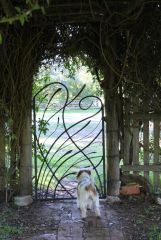 Very elegant! Well done.
 -
Exactly what my Dad said, Ian! Very true Jim, I've raised issues like that with them (including the possibility of their kid climbing the gate as this does look very "ladder like") but they're not concerned. Most of these infill sections will reach out to the outer frame and be riveted to it so it won't be dangerous, and the gaps will largely get filled out with other softer details. They're not fussed about their dogs getting through as the gate's are going in a very loose hedge which the dogs will get through anyway. They want the gates to be like 3 pieces of art/sculpture, so within reason I think I've got a bit more freedom than a standard garden gate project.
-
A friend has asked me to design and make 3 garden gates, the brief being "bold and not traditional". I sketched out some ideas and made this sample section to help explain the designs. As this is just an unpaid sample I didn't bother making everything 100% perfect - the biggest room for improvement being the wraps. This sample secion is loosely inspired by the face huggers in the Alien films (I like their knuckles/fingers) and as I'm still designing the gates I thought I might include some "organic" wraps that trail around the gate and bind onto various areas - a bit like the face huggers choking their victim! If the designs get the go ahead then I'll add more pics. Here's hoping anyway.
-
I used a UK version of those Tapcon screws the other day for fitting a railing panel between 2 brick piers - I used a brand that had quite a deep thread & generally felt like they'd have a lot more bite than some concrete screws you see which barely have a thread at all. 3 out of 5 worked but I had to fall back to Fischer screws with plastic anchors for the 2 that didn't take. I'd tried these 'no achor' fixings once before and didn't like them, but recently I've heard good things about them from various sources so I thought I'd give them another try - I doubt I will again. I think unless the screw enters the hole at exactly the right angle the screw will just kill the hole and the thread won't bite, they don't re-centre themselves like ones with plastic anchors do. These quick snaps show what I mean. It was raining when I installed so I didn't paint over the screw heads, I'm going back to do that.
-
I'd love to see his work in the flesh, I recently discovered him and he became and instant hero. I can't describe how much I love these gates: http://www.artonfile.com/detail.aspx?id=FFII-27-04-04
-
Can anyone suggest a finish that has colour options (not just black), is food safe & able to withstand high heat? This would be for a kettle BBQ made of mild steel. The local finishing firms only really offer galv/hot zinc spray and powder coat. My best guess is enamelling. Any improvements on that?
-
Cheers. What about on the lightweight end of the scale with things like handrails up to a front door? I've heard from a couple sources that simple plastic rawl plugs and woodscrews can handle a fair bit if they're going into decent bricks?
-
Just wondering what people's thoughts are on anchors / grouts / resins, and which you choose for which jobs? What sort of considerations go into your choice e.g weight, which plain the stresses are coming from, security, ease of installation, possibility of removing for maintenance etc As a newbie I've done very little exterior ironwork in the way of railings, gates etc so haven't had much experience with fixings.
-
Cheers guys. Yeah those are just 3mm. I have made some with 4mm, amazing how much more effort 4mm takes. I made one bowl by hand with 6mm or 8mm plate, can't remember which thickness it was, that was "fun".