February 5, 201511 yr Author sorry; I was replying to the post with the eagle stamp in it. I thought about doing copies, but it is not worth my time or effort to make them, and then to be stuck with a lot of them. I have found the people who have an interest rarely have the cash to pay for them. If I did reproduce them, it would be on a prepay/order basis.
February 5, 201511 yr I noticed on a couple other threads that it is easy to assume the faceplate on a Fisher is much thicker than it actually is. I took some scotchbrite to the edge of mine and with the correct light you can easily see it. At the edge it measures 3/8" which seems to be about right for a 150lb.
February 5, 201511 yr Author I noticed on a couple other threads that it is easy to assume the faceplate on a Fisher is much thicker than it actually is. I took some scotchbrite to the edge of mine and with the correct light you can easily see it. At the edge it measures 3/8" which seems to be about right for a 150lb.image.jpg Thank you Frozenforge for you nice photograph. Fisher incorporated that design into their patterns for both design and engineering. The thick iron under the faceplate supported the steel, and it did give the impression that the face plate was very thick. This feature is not on all Fisher anvil designs.
February 5, 201511 yr I don't understand the "engineering" for would it not be even stronger and more supportive if the steel and iron just stopped at the edge of the main body and did not protrude at all?
February 5, 201511 yr Author As already stated above, some Fisher anvils had this "thick" face plate design, other did not. The "thick" overhang was only about an 1/8", so it did not really affect the strength, but it gave the impression it did. I do not understand why you are even commenting on this.
February 5, 201511 yr i could be wrong but at one point I remember a discussion that was not specifically about fishers but about the overhanging edge in general that it did let you dress the edge back if damaged
February 5, 201511 yr As you know I own one of the Fishers that don't have a protruding top as mine was used for a Blacker powerhammer. I thought this lack of protrusion was done for strength and then you said it was protruded to add strength and I was puzzled. As a design tweak to increase sales it makes perfect sense as one to increase strength it didn't.
February 6, 201511 yr On mine you can see what appears to be where the mold was slightly shifted. The side I took the photo of slightly protrudes by 1/16 or so. The other side is flush and in one area even slightly below the side by 1/32". I dont think the casting of these was a precision operation in regards to dimensions.
February 6, 201511 yr Author On mine you can see what appears to be where the mold was slightly shifted. The side I took the photo of slightly protrudes by 1/16 or so. The other side is flush and in one area even slightly below the side by 1/32". I dont think the casting of these was a precision operation in regards to dimensions. They were also not exact in their weight. I think Fisher Anvil felt that as long as the weight was close, it was OK. Most were within the +/- 10% of their advertised weight. A few were actually their stated weight.
February 6, 201511 yr Author I think I have seen more Fishers at their listed weight than any other brand. Have you actually weighed every one you saw? My museum has over 325 Fishers, and all have been weighed. Less than 25% are within 1% of marked weight.
February 6, 201511 yr Author Thank you Frozenforge for you nice photograph. Fisher incorporated that design into their patterns for both design and engineering. The thick iron under the faceplate supported the steel, and it did give the impression that the face plate was very thick. This feature is not on all Fisher anvil designs. I took a few pictures that show this overhang. This is how the 700 lb anvil appears. Very obvious what is the faceplate and what is iron. The overhang was thicker as the anvils got bigger. This photo is of the Crossley 50 lb, one of the last anvils made in 1979, and the last to leave the plant. Note the very small overhang, with the nice curve leading up to it. The is the top of a pristine 180 lb. Note the lack of an overhang.
February 10, 201511 yr Author On mine you can see what appears to be where the mold was slightly shifted. The side I took the photo of slightly protrudes by 1/16 or so. The other side is flush and in one area even slightly below the side by 1/32". I dont think the casting of these was a precision operation in regards to dimensions. This is a good example of where the horn plate shifted slightly before casting. One side was ground flush after casting, but this side has a clear line where it is out of alignment.
February 10, 201511 yr Author The two Fisher/Blacker anvils in the collection. These weight about 515 lb. This first one came from Bill Gichner on a swap deal This second one, which is in slightly better shape, came from a Craig's List ad about 40 miles from me. One was made in 1923, the other 1925.
April 20, 201511 yr Author 1942 FISHER, 100 lb. The logo impression was made with this stamp. This anvil is almost NOS. Added to the museum collection in March.
September 22, 201510 yr Author FISHER INSONORA anvil. 70 lb, 32 kg. Made in 1923 for the South American market. Sitting on top of a 112 lb, 50 kg version. The 70 lb one is NOS. It has never been struck or used. These anvils are relatively rare in the US.
September 22, 201510 yr I picked up this 180lb Fisher a couple of weeks ago. Stamped 1922. It's in decent shape, save for the torch marks on the horn and the mounting lugs that have been cut off.
September 22, 201510 yr 1942 FISHER, 100 lb. The logo impression was made with this stamp. This anvil is almost NOS. Added to the museum collection in March.Not trying to be too nit-picky here, but if the impression was made with that stamp then it would be the mirror image of what is shown on the anvil unless that's a 2 sided stamp with the mirror image on the other side. Edited September 22, 201510 yr by Buzzkill
September 22, 201510 yr Greetings Buzz,The impression goes in the sand casting .. That forms the raised area.. Simple.. Forge on and make beautiful thingsJim
September 23, 201510 yr Cool stuff. Thanks for enlightening me on that. For some reason I had in mind that the impression was struck into the surface while hot. Now that idea just seems silly.
November 6, 201510 yr Author I recently added the missing anvils to this group of Fisher anvil in the Fisher & Norris Factory Museum. These are all early(1850's), made in Trenton, NJ. They are the style without a cutting table. Horn and face only. On the right is the biggest, a #5(50 lb). #4, #3, #2 are in 10 lb increments. The #1 is 15 lb, and the #0 is 10 lb. The two small ones on the left are about 3 lb, but have no size markings. Yes, I have duplicates of three of them. This style Fisher anvils are very rare. My biggest is a #5. I do not know if Fisher made this style in anything bigger. If anyone has one bigger than 50 lb, please post an image or let me know. I am trying to ascertain what Fisher made to make my upcoming book as accurate as I can. 3
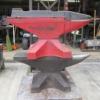
February 19, 201610 yr Author This is an example of what the original FISHER anvils looked like. This is about 120 lb, made in Newport, Maine, between 1848 and 1852. They were very clean looking, and obviously had great care taken when the mold was made. Note the absence of markings where the top and bottom parts of the pattern came together.
February 19, 201610 yr Here's my fisher. It is a great anvil, but has really poor edges and a bad hardy hole. There is also nothing left as a step either. Hopefully I will find another fisher in better shape some time. And it looks like the picture is going to be upside down
February 19, 201610 yr Author 1 hour ago, Forging Carver said: Here's my fisher. It is a great anvil, but has really poor edges and a bad hardy hole. There is also nothing left as a step either. Hopefully I will find another fisher in better shape some time. And it looks like the picture is going to be upside down Plenty of anvil left there for a few more generations. If you need a better or sharper edge, made a saddle to fit over the anvil with the edges you want, or make it with a shaft to fit the hardy hole. Anvils are out there. Keep looking and keep cash on hand at all times.
Join the conversation
You can post now and register later. If you have an account, sign in now to post with your account.