
Marc1
Members
-
Joined
-
Last visited
Everything posted by Marc1
-
True about tradition. Nothing wrong with it, (I have my Lederhosen) but when boats have been made with timber for millennia, I own 3 ... two made with GRP, the third one made of aluminium. And there are boats and pontoons made of concrete. I wouldn't hesitate in making an anvil base with reinforced concrete, poured in a pyramidal mold over a deep hole in the ground. weld 4 bolts to the reo in the concrete, lay a hard rubber mat under the anvil and pound away for 100 years on it. Forget moving it of course that is why I favour steel. Timber log? Not my thing. Termites for one ...
-
Hi Brian, g'day from the big smoke. Was down there in Gippsland country just last month. Looking forward to see your progress.
-
Agreed on both accounts. The reason machinery including power hammers need to be anchored is that vibrations will invariably shift the machine sideways otherwise, with dear consequences to cables, pipes and any other service attachments. Anchoring a big machine seems easy, just use big anchoring fasteners. The problem is that no matter how big the bolts are, they are the weak link between a large mass in movement and an unmovable concrete base. The bolts or the surrounding concrete will lose this battle every time. The solution is to provide solid anchoring to a relatively small block of concrete that is fixed and unmovable in relation to the machine yet can provide controlled movement in relation to the surrounding ground whilst keeping the machine in the same place. Just like the antiseismic houses in Japan that move solidarily footing and walls, the machine, is anchored to a footing that is itself mobile and not anchored down. The small movement created by the machine is dampened by the mass of the footing yet allowed to move elastically back and forth without damaging anything in the process. The difference is like a car with no springs and steel wheels, and another mounted on flexible suspension. I used to install diesel generators on concrete blocks floating on thick mats of cork. Hardwood, rubber or any other elastic medium will also work. As for the anvils, I believe that such a low tech piece of equipment is produced as a blank, to be adapted by the smith to his own requirements. Holes in the legs of an anvil would not meet the owners requirements half of the time. We should ask our resident anvil manufacturer why does he not drill holes in his anvils.
-
That should be OK. Make sure you devise a clinker breaker. Makes life easier. Don't go for slots. You can cut a round hole in the base and have the clinker breaker shaft between the fire pot and the tuyere
-
Another thing I failed to mention is to try different diameter wire wheels, not just 6". In fact I use a 5" cup wheel on the 6" polisher and it works well. The Ozito has variable speed and you will use it at max speed most of the time, and sometimes will need to lean in it a bit. The D handle is also much more comfortable than the usual grinder's side handle.
-
Sure Anvil, but you can not compare a hand hammer/ anvil +stump vs power hammer / anvil + base. The amount of force that escapes the first system's anvil and goes in this concrete stump, is negligible when compared to the force that escapes the power hammer anvil that is by comparison way smaller not to mention the number of blows per unit of time is hundreds of times higher. Power hammers just like any other large machine that produces vibrations, needs either an interface that is soft between its own base and the floor or needs to be anchored to a block of concrete that is itself on a soft base like cork, rubber or similar. They are not comparable systems.
-
How thick is the plate you used?
-
Looks pretty dense to me. (No pun intended) Good enough for a stump, now you have to build the smithy around the stump.
-
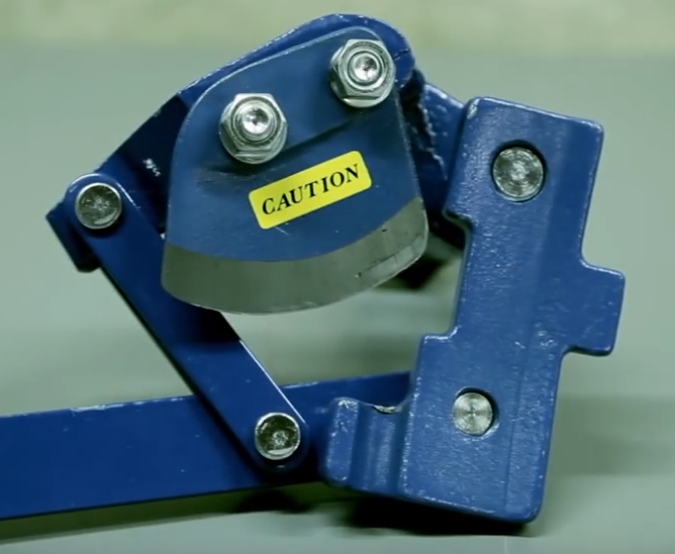
The way it works is by holding onto the rolled edge of the drum with the mobil finger and then you push the sharp flat into the top by pushing the handles forward. The other flat is for guide on the outside. Then again it could be to extract Rinoceront molars
-
That is not like you sharpen scissors
-
i think your first guess was right ... a giant tin opener for drums, called a drum deheader. www.youtube.com/watch?v=kichc9RzHew
-
Aouh you little !!! Ha ha, that would be a cyclop's forge under a volcano
-
Something about tensioning fencing wire? It's hovering around my memory chamber but does not want to come out ...
-
I use a wire wheel screwed on to the polisher. The polisher attachments are of no use for cleaning steel. My reasoning for using the polisher instead of the Milwaukee 5" rat tail grinders I use for cutting and grinding, is that the grinder at 10,000 revs, demolishes the wire wheel and sprays bits of wire all around me. I pulled wires from clothes, socks, and even skin. Not fun. The polisher at 3500 does the job. As far as Ozito tools, I must clarify they are bottom of the birdcage tools, however, as with many tool manufacturers, they make a few good tools and they are the big rotary drill and the polisher. If you want a good professional tool you have Milwaukee and Dewalt and Bosch for 2 times the price. Since I don't use the wire brush that much, I decided to experiment with a cheap throw away tool and it turned out to be OK. For those on the other side of the Pacific, in Oz, the prices of power tools are from 2 to 3 times your prices so we sometimes need to compromise. PS Another good Ozito tool is the reciprocating pruning saw. My daughter gave me one for my birthday and I had very little hope for the little thing. I thought it would be ok for a few times and then the bin. I was very wrong. It has a minuscule battery and I have used it to prune the branches off two massive trees for 3 winters. A white cedar branches 3" thick and a Mulberry tree i prune every year to avoid the Flying bats invasion. Can't kill it goes and goes. Fantastic little thing.
-
I remember seeing that contraption before, a long time ago. Looks really familiar but can't remember what it is for. It may come back ... or not. Not tongs that's for sure, so it's in the wrong section. Should be in the mystery contraption section. Whiskey ... don't mind the locals, just do your thing.
-
-
Absolutely. Cut a round hole in your table for a brake rotor or even brake drum. Seen some truck brake drums dumped by a truckie neighbor that are absolutely awesome.
-
Sure ... having said that, I do have a 280 pounder on a tripod that I can move using a trolley. Not fun though.
-
Agreed. For me the only portable anvils I have are two 40 Kg farriers anvils. The rest are "permanent"
-
Ha ha Thomas, very funny. Chuck ... Steve's suggestion is your first step, plenty of info in the right section. For a forge burning coal or coke, a 4' depth is the usually accepted average. The size of the pot and the hight of the edge depends from your source of air, volume and pressure and what you are wanting to forge. Long stuff that needs a recess or short small stuff. If you are going to make a pot from plate, it will work but will eventually burn out at the edges. I suggest using 3/8 plate and pay special attention to the top edge. You make it as an inverted truncated pyramid and add a 2" flat edge frame from same material to stop it from burning out. Add some pictures of your progress and make sure you read the many threads about forge build here.
-
Yes, Ted, a fascinating subject but said fascination seems to be a rare occurrence. Only for the outlandish and the idiosyncratic ... or so I am told Simple answer is that when talking anvils, bigger is better. Oh my ... did I say that?
-
If you want to shape that log and do so safely without using the chainsaw, get yourself an electric plane. You can shave up to 1/8" in one pass and do so safely even though with a bit of noise. Get rid of the bark before you either rip or plane. You can use a hatchet for that.
-
Not to mention it is hard to work the hammer over the anvil laying under it The reason I tend to get engrossed in the topic anvil+stand, is that most ... or at least some ... people think that a bigger stand will add mass to the anvil. It is intuitive to think so and you must excuse those who think so. The scientific explanation can be rather long and dry, and from previous attempts and judging from the inquisition replies i received, I rather let that one go. i will however attempt a thought for the thoughtful. If the addition of Mass one (anvil) + Mass two (stand), in the case of a collision system like hammer and anvil+stand, is so easy to achieve, just by bolting the anvil down ... why is it that when someone talks about repairing an anvil we make such a fuss about the faceplate and how it should be attached to the anvil? if bolting down an anvil makes the mass of the stand be added to the mass of the anvil, why can't we just make a faceplate with 4 lumps, one at each corner with a 20mm hole in each corner, weld 4 nuts on the side of the anvil and strap the face down nice and tight with 3/4" bolts and Bob is your father's brother? No one would think that such is a good idea, however if it is not, then the anvil anchored to the stand, is only good for stability purposes and not for mass adding. A 200 lb anvil on a 100 lb stand or on a 2,000 lb stand will perform almost the same unfortunately. if you then add some caulking compound between them ... well, then it will be like having the anvil on your belly ... or rather your striker's belly. Not very different anyway.
-
Debatable and depending of the type of guard. The grinder in question is an industrial bench grinder spinning at 1400 rpm, with a 3" thick wheel and the guard is thick pressed steel not perspex. The guard has a quick release to reposition it to allow different areas of the wheel to be uncovered according to the shape of the work. The operator had some 20 years experience doing the same job on the same machine. It is what it is, and there was talk about sabotage from the coroner office since they found a crack on the wheel and some lateral damage to it. I didn't want to ask too many questions but clearly, using the side of a bench grinder is a bad idea and using it without cover, a very dumb one.
-
Agreed JohnB, despite assurances to the contrary, wire wheels for angle grinders don't do well at 10,000+ rpm Their use requires full face cover and no one else around, and the little wires fly off regardless of them being twisted knotted or other meaningless gimmicks Like you I switched to a 6" buffer that spins at 1/3 of the speed, still does the job and does not demolish the wirewheel. Also a tad quieter.