NeatGuy
Members
-
Joined
-
Last visited
Everything posted by NeatGuy
-
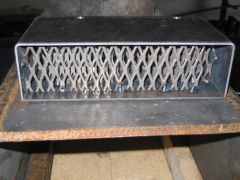
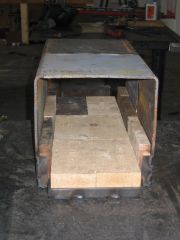
I make ribbon burners with a hard refractory brick. They work at least as well as cast refractory and can be made in under an hour. I will post some pictures of the most current version if there is any interest. brad
-
I do have a treadle hammer, power hammer and a trumpf nibbler and would normally use my treadle hammer or the nibbler for this but I currently have no shop to put them. We have moved and I will be building a new shop (30x40) hopefuly this fall. I am making rossetes and rivets I just bought this flypress as it fits my current space and is quiet. As with all new tools a bit of time is needed to understand the capabilities. The pattern is not complex and there are not alot of them I would just like to streamline and experiment a little with the tooling.
-
I was thinking of pretty much as you describe. As with most working folks with young kids I have little enough time for blacksmithing and did not want to put out the effort if the tool was not worth the time or there was a better solution. I have been rotating the disks with a pair of tongs but this is awkward at best with out consistant results.
-
I was thinking more like an rapid indexing head as used on a milling machine. I wish to incise, reasonably accurately, radiating line on a disk.
-
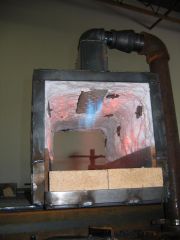 Test fire ... it works fairly well. Creates a nice even heat.
 -
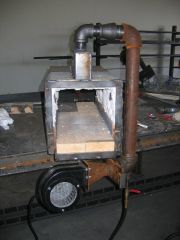 Forge with nozzel installed, doors and second nozzel have not been fabricated yet.
 -
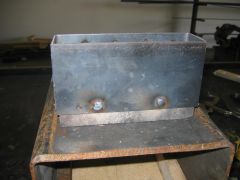 Holes drilled in nozzel and keeper pins welded in.
 -
-
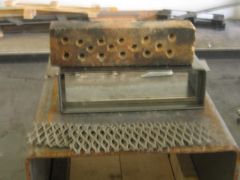 Burner body, nozzel, diffuser plates ready to be assembled
 -
-
I was thinking of building a indexing head for my flypress and was interested in input from anyone who has built such a device. I have a simple design that I would post to be scrutinized if there is any interest. brad
-
I use the scale in welding flux. Equal parts fine ground scale, borax, boric acid.
-
Some projects require more rivets than I am willing to make. Try Jay Cee Sales and Rivet Inc They have many sizes and types.
-
That is the mesta 50k ton press. http://files.asme.org/ASMEORG/Communities/History/Landmarks/5488.pdf
-
A friend of mine directed me to this link. Check out the 10 ton hammer video! Vulcan Foundry Works Interior Forge Erection Shop Milling Slotting Turning
-
Why not get some heavy plate bumped or rolled into 2 halfs then weld them together?. Grind the flats off the bumped cone. This seems simpler than tring to weld a bunch of rods together.
-
You can also buy coal from "Roberts bank" at about $120/ton (that price may not be current) the only problem is you have to buy a minimum of 10 tons. Contact Gerrard at the Kwantlen college farrier school he may be able to help you.
-
I fused and slumped glass for lighting so I can tell you what I know about glass. If you use common "float" glass you need to be aware of several thing. 1) found "float" glass does not have uniform coe (co-efficient of expansion) so just because you may be able to get it to work today does not mean it will work the same way every time. Fusing glass is great with a known COE it is also expensive to experiment with. 2) the COE of glass is generaly similar to stainless steel. Mild steel can work but you can waste a lot of time with cracked and useless results. 3) glass loves to be in a oxygen rich environment steel does not. Lack of oxygen will cause the glass to de-vitrify ie clear glass will get smokey and coloured glass will begin to loose its colour. 4) below 900 f glass begins to thermal shock. so work quick then back into the kiln. 5) float has tin on the surface. The tin will congeal creating cloudy blooms. I would advice, from personal experience, for best results for medium to largeish inlays: Forge the piece with the desired recesses to be inlayed. Cast something like bondo or into the recess. Use that piece to make a mold from jeweller investment then using glass frit (powered glass ) kiln cast the piece to be inlayed. Using frit has the advantage of filling the mold more closely so you only have to "top up" the mold once or as neccessary. Once the glass has been annealed epoxy it into you item. for smaller inlays, knobs and drawer pulls: if you try to melt directly into a recess use oxy/propane torch fairly lean and start with a small recess, anneal the glass by wrapping it in kao wool. I would also be be inclined to read up on glass bead making . There are a wide selection of glass rods available for bead/marble making. there are also little beads call millefiori that could greatly enhance your design. Murano Millefiori hand blown Murano Glass millefiori (thousand flowers) for mosaic and glass art One last tip glass fractures that are almost invisible to the naked eye can be seen with a polarizing lens; however, sometimes it is best not to know hope this helps a little and does not scare you away from trying. brad
-
Punch press can be used for texturing and incising stock cold or hot. you will need to make an adjustable lower tool holder. You could probably make rivets like there is not tomorrow with the punch press. It will work similar to a large fly press. You must take precautions to not exceed the capacity of the press; it must complete its stroke. I have a large Trumpf nibbler which is similar to a continously running punch press. There is a version of my machine called a "co-ordinated copy punch press" it operates like a nibbler but has a single stroke mode; I would love to have it.
-
Although I am a little late on this thread I also use a pullmax .... actualy a trumpf. A similar machine but has many superior features. I have some info on other items that can be made in a nibbler. Nibbler This spindle is made entirely with a pullmax P5. My nibbler is my bread and butter machine I use it for a lot of applications. brad
-
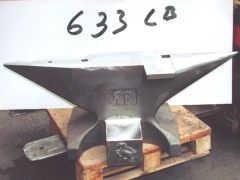 Cast by Renato Muskovic 633lbs new $2800 2008 (Traded for Scotchman ironworker for which I paid $500)
 -
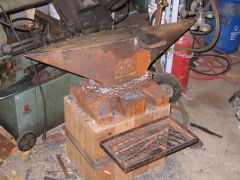 Cast by Renato Muskovic 375lbs new $1800 2004
 -
Cast by Renato Muskovic 375lbs new $1800 2004 Cast by Renato Muskovic 633lbs new $2800 2008 (Traded for Scotchman ironworker for which I paid $500) http://www.carrozzeria.ca/SiteImages/Anvil-633lb.jpg
-
The foundry which cast my anvil suggests that 4340, the material from which my anvils is cast, is one of the more stable and more likely to be successfuly heat treated steels; particularly for larger anvils. I can not speak to the truth of this but I am very happy with the anvil. I would imagine that the steel face of older anvils was only high carbon steel as the more exotic alloys would have be much more costly to produce at the time ( I sure that I wil be corrected if I am less than accurate on this account so new high alloy anvils seem like they should be tougher. I would also imagine that forge welding a face to an anvil requires a rather high degree of skill to be consistant. It would be interesting to xray old anvils to see how well they actually did stand up to years of beatings.
-
I am not sure if Kris has a website but here is Renato's. He also makes excellent sheet metal power hammers and shrinking stretching machines.