NeatGuy
Members
-
Joined
-
Last visited
Everything posted by NeatGuy
-
Forge welding can be done in a completely inert enviroment so oxidation would be essential eliminated.
-
There was an ariticle on Kris's anvils in the "Hot Iron News" a few issues back.
-
-
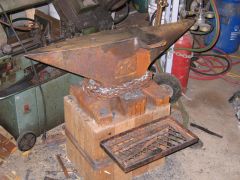
Larrynjr: Besides Nimba there are also two other anvil makers in your area I have two anvils made by one of them, Renato Muskovic. He makes a 633lb and 375lb anvil I have both and like them very much. The other person is Kris Ketchum he makes a 500lb anvil that sports a hexagonal hardy hole. I have not used his anvil but I know Kris and am sure that his anvils are excelent. Both makers will be at the NWBA spring conference April 25-27 Skagit county fairgrounds in MT Veron Wa. here is a picture of my 375lb anvil. Renato also makes a great line of hardies and stakes to go with his anvils. If you are interested I can get both phones numbers or contact information. Here is a picture of one of Kris's anvils from Caniron. 7 - Blacksmith Photo Gallery
-
That is cool! I found very little information about the drill...but the "Watts Brothers Tool Works" still make these niffty devices: 760 Airbrake Avenue, P.O. Box 335 Wilmerding, PA , 15148-1014 Phone: 412-823-7877 FAX: 412-823-4844 As complicated as they seem they are actualy oddly simple. USPTO patent numbers: 1,241,177 1,241,176 1,241,175
-
Swage blocks are very enticing; they have the promise of a useful univeral tool. I bought a swage block many years ago and rarely used it. I found it cumbersome to move into the possition I wanted. It is much easier to put a swage into the hardy hole of my anvil. This way I also had the mass of my large anvil behind it. Over time I have accumulated the swages that I use most offten since they are relatively easy to forge or fabricate I just make a new one when every I find the need. If you can afford a swage block buy one; they are very easy to resell if you find that you don't like.
-
Frosty ... I have a copula book I scanned that you may find useful. It is an old book so I hope that this is not a copyright infringment.
-
I was considering an "oxygen concentrator" because the machines are relatively inexpensive and I was curious about peoples experiences with them. My forge will weld so I was not just tring to increase the heat.
-
I was wondering if anyone has used an oxygen generator to supliment or enrich the air intake of a gas forge. They seem like an inexpensive way to increase heat, efficiency, and mixture of a gas forge.
-
The model was sp15. I emailed them for the price. I have since used a different machine and would sugjest that the sp15 is not the best for blacksmithing; the frequency is too high. A flatish coil will work; I believe that I have seen a coil that is "C" shapped so that the edge of a knife and be heat treated although I am not sure where I have seen it. The length of the heat is kind of limited; but, because of the rate at which the material heats up you can feed the the bar through the coil and get longer heats. Also you can heat treat in an inert atmosphere and get no scale. Also the machine consumes large amounts of power only while heating. I think these are the same units sold by OC tool but I could be wrong.
-
I have had some exprience with induction heaters. Coils are easy to make if you have a modern solid state machine as the machine will automaticaly retune itself for the coil. Coils can be made in virutally any shape. They are limited in the size of coil both length and diameter as they are part of the tuned circuit and are limited by the machines tuning range.
-
Is that Parviz Tanavoli? if it is he is an increadible artist. I built a bronze base for one of his sculptures. I have tried to get him interested in blacksmithing as some of his cast work shares similar themes to some of my chased work. He is a very interesting and also quite approachable for such an illustrious artist.
-
I have used a router on a pendulem mount to make a very large radius bowl form . Move the router back and forth over the work and it will inscribe an arc. Shortening up on the pendulem arm would make a smaller radius arc.
-
I would like to buy a hydraulic pump for a new press, but I would most likely put in my wallet and sit on it for a month thinking about what I wanted in a pump then one day discover that life had snuck (< is that a word) and taken it for some superflurious thing like the mortgage.
-
Why a cement pattern? I think wood wood (he he) be simpler to work with.
-
Here is an interesting treadle hammer
-
What you are describing is a stationary mechanical nibbler like a Pulmax or Trumpf, etc. The mechanism in your diagram looks exactly like a large Savage nibbler that I have. Check out nibbling machine at the uspto. Some nibblers like the Pulmax use a fine thread screw in the lower tool holder to adjust the lower tool. Some like the Trumpf use a motor with a foot peddal to raise and lower the upper tool. No nibbler that I have used has a clutch as the machine runs constantly. On the Pulmax the upper tool is controlled by a linkage the controls the stroke length of the punch. I use these machines constantly for both hot and cold work. I can not speak enough to the versitility of these machines. IMHO they are also highly under utilized by the blacksmith community in general. That said nibblers or any machine constructed in a similar fashion are a different tool than a fly press athough both can be used for some similar applications. Here is a little extra info I have comipled on nibblers.
-
Trumpf CN900 co-ordinated copy nibble machine. Traded for Pullmax P5 nibbler.
-
how did he adjust the depth of cut ? or was a different tool made for each stock thickness. If I were going to use a punch press for this opperation I would construct a tool holder similar to a Pullmax tool holder. There is a square collet in the tool holder and a nut to tighten it. Making the lowwer tool move and the upper tool stationary.
-
I like the water method as well ... especialy at demos when people are not paying attention.:rolleyes:
-
why not just use a piece of 4140 and heat treat the business end. It is more expensive than mild steel but 4140 is fairly tough and should last; I think it is worth the extra expense. I use it for my tooling and am very satisfied.
-
I would be interested to hear of your results. I have wondered how a punch press would work. I am a little sceptical about an 8t punch as my Pullmax P5 is about 12t and my Trumpf cn900 is about 22t. Finish ... ususally I like to birchwood casey or gun blue patina with bees wax and linseed oil for protection.
-
As promised ... I have some pictures of tooling I use to make pressed light switch plates. I have not used them for some time so there are a few missing pieces... including the 50t press. Also age is preventing me from remembering some of the details. Img_5071 is a close up detail of a abs die. I made this die with pin router attachment and a dremel tool. CNC routing will make a smoother die but unless there is a radical mistake or the stock is thin that level of detail does not transfer. Img_5069 is a full view of the die. Img_5076 is a view of the box I use to press the plate in. The 5/8 plate resting on the top is the "pusher" that the hydraulic ram presses against. Not shown because it is missing, is the rubber blanket that sits between the die/work and the "pusher". The pusher fits relatively tight to the box. img_5078 is the result of a pressing. You need to make the blank larger then needed and then trim the excess. This has to be determined by trial and error. The stock is 24oz copper. Anneal first! Although it is hard to tell from the picture of the die; the cut out where the switch protrudes is under cut slightly. This will actualy punch that section out. Usually this only works fo a few impressions and then you have to pre cut them. To make the under cut I used a router dovetail cutter. If you make your dies from steel they will punch that section out much better. one last thing ... well ... two things. 1) You need to experment a little with rubber density ... I used a piece of rubber belting. Harder rubber will make better detail but will wear ABS dies out much quicker. 2) use soap to lubricate the dies NOT oil or wd40. Lubrication makes much better pressings ! I am sorry I can not find any of my lead or zinc dies, they are better if you have to produce a lot of pressings; as the dies wear out you can just cast new fresh ones. I hope this helps you out a little.
-
On solid stock ... Cold ... I use a tool steel blade to incise and precision texture. Hot ... I use it to make rivets, upset flatbar along the edge; I am sure that I have only scratched the surface with the hot work.
-
I have a bit of an explaination here Nibbler I will try to create a few short videos next week demonstrating some of the nibblers abilities.