HWooldridge
Members
-
Joined
-
Last visited
Everything posted by HWooldridge
-
If you cut a piece of mild steel with an oxy/acetylene torch, you will get a very hard surface next to the cut - something machinists will curse you for if they hit it with a milling cutter. This scale is not very thick but quite hard. It sounds like you have a burned spot on your steel - you need to grind it away to virgin metal.
-
I have "quenched" a multitude of small items with a blast of compressed air. Colder than ambient air blown over the top of an item will cool it pretty quickly and of course, it's not as harsh as a fluid. In fact, this is the way I condition leaf springs when I have to rebuild a post vise. I forge the spring from a car spring, let it normalize, then reheat to critical temp and quench with compressed air - no temper.
-
If you think .001 is an easy tolerance to hold.
-
I have a fly press on my list next, followed by a plasma - I have everything else that I need/want.
-
Dave, You can also use a reciprocating saw (either a "saber saw" or a "sawzall") with a metal cutting blade. Drill a hole in the scrap piece big enough to insert the blade. BTW, whar you from boy? I see your signature line and that you are above the Mason-Dixon. Cain't get any decent Gulf shrimp that far north...
-
The short answer is "no". The best you could do is buy a certified piece of 4140 and do all the tests that Woody noted for comparison. Even then, it will be an educated guess.
-
Rich, I agree completely with everything you say... I did a bit of gunsmithing to help get myself thru college. I taught myself on my own personal firearms before I did work for anyone else. One of my pickier customers once said he gave me work because he knew it would always be better than when he dropped it off. That is because I was more concerned about it than anyone else and I did everything with files and stones - no power tools. Some of my early blacksmithing work was not up to the standards I have now but it was primarily because I just didn't know any better. At this point in my life, I would not let those questionable pieces out of the shop but that was the best I could do at the time. My grandfather once told me that the only thing I had was my good name. That led me to a mindset that each piece should be better than the last. Nothing will ever be perfect but striving toward it is the prime motivation for me.
-
Jr. Yes - I also really like the rat tail style and use it periodically - sometimes I mix it with solid ones in the same piece.
-
I assume you mean hand hammer - but depends on how big the stock is. 5/16 and smaller, I tilt the material and hammer face and make the point in the wedge shaped area between hammer and anvil. 3/8 or larger, I shoulder where the taper is to end by isolating a knob on the front of the piece and then working that into a point.
-
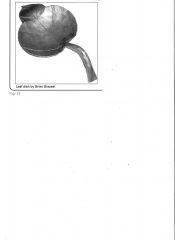 A bowl by Brian Brazeal, courtesy of the 1Q 2007 edition of Hot Iron News.
 -
This is what I was trying to describe. The parent stock was 1/4x1 flat iron. The pic is a little fuzzy but you can see the continuous flowing radius.
-
It's tough to get the ha'penny perfectly round and flowing out of the scroll body. Where you stopped on the tip form, I would have taken another heat and cooled the round side in water, then hammered down on the anvil to smooth the transition. There is also a tool which helps get this transition correct. Imagine a cut off hardy with the edge rolled naturally over to be parallel to the ground. The scroll tip is hung off the edge of the "hardy" and hammered as necessary. This isn't a criticism - just a hint to make that ha'penny as round as a coin.
-
A favorite subject of mine... A fire in a bottom blast pot will form to a natural size and for all practical purposes, not get any larger. It is also hard to make it smaller - large amounts of water are about the only way but it's also possible to cool the fire and/or potentially crack the pot. The fixed size can be a convenience or a hindrance, depending on the type of work being done. One advantage is a well regulated fire depth - assuming the fire is managed properly. In addition, the bottom blast pot is relatively cheap to make and maintain so it was more prevalent in America in past centuries and why it remains very popular. A fire in the side blast can be adjusted by using fire bricks to push the blast (and the subsequent burning fuel) into different shapes. However, the typical patent style, water-cooled, cast iron tuyere is not so cheap to make and can be difficult to use in cold climates without resorting to anti-freeze in the tank. The tank also eventually rusts out or the nose burns back to a point where a leak starts. Of course, you can always simply use a piece of pipe and let it burn back over time, which is probably the most cost effective way of obtaining a side blast. I no longer use a side blast since I have propane for long heats and my Buffalo 12x14 bottom blast works just fine when I need a coal fire - BUT - a home made side blast can be an effective and relatively cheap way for the smith to make an efficient fire and I would have no problem going back to one.
-
I use I-R synthetic compressor oil - don't recall the grade but it's the one they sell to honor their factory warranty. The cost is minuscule if it makes the compressor last some years longer.
-
This is a computer problem so I'm asking any of our gurus for help. I have had a website for a couple of years and decided to put a short forging video on it for public view. Here is the link: Our Blacksmith Shop : comalforge.com (go to the bottom of the page) However, I could not view it after posting it to the Web from my home PC (even though it worked in the browser preview before I uploaded it). The video was filmed on my wife's Kodak, which is supposedly a QuickTime format and has a *.mov suffix. I asked Ed Thomas to review it and he had some trouble with access - although he did eventually get it to run. This also took about 2 hours to upload over a dialup modem so I assume it's simply a very large file. Many people still have dialup modems so I want to make this video easily accessed by the majority of people who might want to view it. Does anyone have suggestions on a different format or some method of compression to speed things up? Would something besides a *.mov be a better format for general consumption? Thanks, Hollis
-
Anything 100 years old should have some wrought iron and I don't believe one part of a ship or another would be better, although it is generally held that chains were higher grade (more refined) because of their intended purpose. Be aware that there were many cast iron fittings on ships, which won't work in a forging application.
-
There is a lot of info on this in the world of machining - I work in a production lathe shop and get to see this daily. The main purpose of the fluid is to keep the tools or work from burning so the major advantage is cooling. Sulfur is a primary ingredient to provide lubricity so anything you buy with sulfur additives will help on some materials. IIRC, cast iron should be drilled dry but most other materials benefit from some type of cutting fluid. Plain water works pretty well and even better with a bit of soap added. In fact, many shops have switched to water with some sort of lubrication and biocide added to prevent algae growth.
-
The only problem I've seen with anthracite is that it is sometimes hard to light and keep lit.
-
To follow on to Frosty's comments, you might normalize the whole bar by passing it back and forth until a dull red, then allowing it to cool naturally to room temp, followed by twisting inside a pipe. So-called mild steel is often fairly hard from the rolling mill but a simple stress relief will make it dead soft.
-
I used to work at a ballistic protection company that used AR400 for armor applications. We always cut it with water jet instead of using heat. I think it is a fairly simple steel (chemically) so should be easy to heat treat again if it's too soft after plasma.
-
I used mild steel and welded on the working surfaces. It was easier for me to cut everything square and stick tool steel shapes to the die stock. One problem with this is that the struck end will eventually mushroom but it can be reforged when necessary.
-
Fisher's are not supposed to ring. I have my PW on an angle iron base bolted to a concrete block. If the anvil is not locked in the frame, it will ring like a bell but tightening the "cramp bolts" will make it go 'thunk'.
-
Rust, yes - paint, no. Sandblasting also works well and takes off anything that ain't nailed down.
-
Naval jelly is good - buy it at Lowe's or Home Depot and follow the directions.
-
I did a down and dirty guesstimate based on his measurements (not his quoted "weight") and believe it will go right around 600. I did a quick volume of the horn, waist and base in cubic inches and converted to the weight of steel. Did not take anything out for a hollow base, holes or anything else so it might be as low as 550. Looks like a Trenton but hard to tell without close examination and in pretty good shape.