HWooldridge
Members
-
Joined
-
Last visited
Everything posted by HWooldridge
-
I bought some 4043 rod, a couple of 3/32" pure tungsten electrodes and a 1/2" gas lens then cranked the argon flow to 25 CFH. The welding got much easier but was still pockmarked by areas that simply would not weld together. I assume this trouble was because this repair was a casting and likely oil soaked. However, by stopping to sandblast periodically, I was able to finish the job. I also welded a piece of material across the ends of the broken fragments so they are all joined by a homogenous piece. After milling away the excess, the piece looked fresh from the factory. The maintenance guys at the plant were suitably impressed (especially since none of them were willing to fix it). Thanks to all who answered, this forum is a real blessing to all of us who participate and contribute.
-
I do the same and pretty much all of my scroll jigs are on angle iron bases. I can put them anywhere in the shop in a vise and go to work. My small bending jigs (pins and other forms) are on square stock made for the hardy. Although I haven't built one, I have seen a rig that dropped in the hardy and held multiple tools simultaneously around the edge of the anvil. It was locked into the hardy by a bolt and fit the heel of the anvil. IIRC, about 4 tools could be held. This was a production setup in craft shop so they might do several hundred similar items before switching to something else. Kevin, I hear you...some days down here are miserable. Fortunately, my shop is on a slight hill so I catch a few breezes when the Gulf winds are blowing. Other than that, it's usually 100 in the shade...even a swamp cooler would be better than nothing.
-
My website is the best thing I ever did. I now have more business than I can handle and almost 100% of it started with the website. Nothing else has worked quite as well. Of course, it has to have some things on it so I salted mine with three or four things I made for family and friends before I was able to start posting "real" work. I later took that stuff off but hey, you have to start somewhere...
-
We get a lot of lightning down here - I've been through three house hits during my lifetime and have worked in large factories that took hits regularly. All of the house hits caused some structural damage but fortunately, we never had a fire. None of the shop hits caused damage beyond frying electrical or electronic equipment. I could tell you some more war stories about lightning but will refrain and keep to the thread... A lightning rod isn't worth much unless it's properly grounded so what most people are doing these days for protection on homes is to install a short rod (1 foot tall) on each end of the house. The rods then are electrically connected with heavy gauge wire and that circuit is attached to a loop of plated copper buried in the earth below the normal moisture level. The loop often completely circles the house at a distance of several feet from the structure. This is about the only way to get the lightning strike to ground fast enough not to cause a fire. The problems begin when the arc can't do that and superheats whatever is in the path. My old shop had a metal roof on a wooden structure. During construction, I drove a ground rod about 8 feet into the dirt and connected a #8 copper wire between the rod and the roof. While we were on vacation one summer, a storm passed over and a bolt must have hit the shop as the insulation had melted on the wire. However, the shop did not catch fire (the funny thing was that I didn't notice the difference in appearance until about a week later). I would not worry if you are in a pole barn with steel poles and/or steel walls as the lightning will go straight to ground but of course, I also would not stand against a metal wall during a storm - stay in the middle of the shop. On the other hand, a completely wooden structure will likely catch fire somewhere unless it is properly grounded.
-
Rust is actually a good protectant so you may simply want to brush off the loose dirt and oil it. If you are not going to use it for a while, it can also be waxed just like an automobile.
-
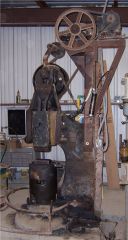
Here are three more pics. DJhammerd, Yes, the anvil rests on the pad, same as the hammer frame. You reach through the holes in the frame to get to the nuts that secure the anvil on their respective pieces of all-thread.
-
Very nice - that is a pattern from one of Otto Schmirler's books, don't remember which one - you did a good job.
-
Study on it and decide on something for your situation - either of your suggestions or a combination might work. I don't know what kind of rain you get there or how much grade is above the site. We can get 6-8 inches in an hour when a hurricane comes through - although it may not have rained for the previous 10 months - so we have to plan for deluges.
-
The only trouble with digging out the side of a hill is that you open yourself to flooding during a heavy rain. My home is on the side of a hill and even though it was originally engineered for drainage (built in 1972) the house has settled over time and we have had water in the house twice during very heavy rain. The water comes off the hill and cannot get around the structure fast enough. Not an insurmountable problem but something you should consider.
-
OK, DJ - it's in my gallery. Not a great pic but all I can give you until my wife gets home with the camera. I'll post some closeups later in the week.
-
-
You are correct - which is why I noted in this sticky... http://www.iforgeiron.com/forum/f7/general-coal-forge-notes-5921/ ...to only dampen the lining mixture and not to mix it with water like typical mortar or concrete. Too much water in your lining is a bad thing for multiple reasons.
-
Arftist, I made a typo mistake in my second post. I meant to say that I had used a 1/16 electrode on the first attempt with a 3/32 on the next try. Thanks again to all and I'll post results...Hollis
-
I am using a foot controller and the panel is set at 125. I tried a 1/8 electrode and burned it away on the first pass so went to the 3/32. I also tried higher amperage but the material started collapsing so I backed off on the current. I have the sine wave knob at 3 - I went down to 2 and up to 5 but 3 seemed the most stable. I agree that my gas flow is probably low and I may need a larger gas cup. I did get the "silver puddle" but the thing that seemed odd to me was that the sides of the joint pushed apart (sort of like Moses parting the Red Sea). I'm used to steel and titanium wanting to cross the weld root with a little extra rod but the aluminum didn't want to cooperate. Another thing I did which probably wasn't code was to run the arc all around the weld and melt the lumps a little more. I need to get a refill on an O2 bottle anyway so will pick up some 4043 rod at the welding store tomorrow. This housing is off a Japanese Miyano CNC lathe and the dealer wanted $4000 for a replacement - hence the request to have me fix it for the few hundred bucks I'll charge them. I'm quite sure this thing is oil soaked because that's exactly what it does - an oil catcher for the back of the spindle where the bar enters. Thanks for the suggestions - I'll let you know how it turns out.
-
The welding circuit is made from stinger to ground on the machine. I do not think you would have a problem if the ground was not placed above the hoist. However, I would use a nylon strap anyway as they seem friendlier than chain on both hoist and work since they are plenty safe and so much easier to use. Then the welding ground has to be good or you'll get no arc.
-
A lot of times you can grab the movable jaw and lean on it hard to line them up. You might also try swapping the pivot bolt 180 degrees from its current position (whatever that may be). They will wear more on one side over the years and cause the jaws to start slipping out of alignment. Last but not least, you can heat the pivot and frame in the forge and pull them into alignment.
-
I have a "Tiger" blower with a patent date of 1880 but it is so well engineered that I do not think it is first generation and from what I have read, Champion Forge and Blower was founded in 1875 with Buffalo Forge a few years earlier. Somewhere in my collection, I also have a woodcut sketch of large pulley blowers in the Civil War period. Those are the ones that have a centrifugal fan but are belt driven by pulley size multiplication - not gears. The industrial revolution was well under way by the Civil War and many mechanical devices existed (like engine lathes). The earliest reliable steam engines dated to James Watt in 1775 so a lot of time had elapsed to allow the rail road system to become robust and heavy industry needed efficient methods to produce enough blast for big melts so blowers must have been available for that purpose. 1875 is probably a safe date to note that hand crank blowers were at least available in some form but bellows were common well into the 1900's. I do a demo every spring that is supposed to date to 1900 and have regular arguments with spectators who claim we should be using bellows. Fortunately, we can all be right as both mechanical and bellows are correct for that period and I usually point that out as gently as possible. However, a hand crank at an 1830's rendevous or a similar time would be out of place from a historical perspective.
-
I didn't want to hijack the other thread so will pose this question here to the local TIG gurus. I have used my TIG on stainless, titanium and mild steel with great success but never welded aluminum. Last week at work, we found an aluminum casting on one of the production lathes that was broken so they asked me to fix it. This is a hollow housing with approximately 3/16 walls and there were three pieces knocked out of one side but only two pieces were found. I burned the oil out of the housing and the pieces with an O/A torch, then sand blasted everything to remove the residue. Parts were very clean when I went to welding. Since I had no idea of settings, I consulted the Miller book and based on that, I used a 3/32 electrode, on AC, continuous hi-frequency, at about 125 amps and 15 cfh of argon with a #6 gas cup (I have a 250 amp Synchrowave AC/DC machine). Unfortunately, all I have is 2% Thorium electrodes and the book said pure Tungsten or 2% Zirconium is better. However, I still got a nice ball on the end and the arc seemed normal. The problem is that the sides of the weld would not close up even when stirring with the filler rod and there were lots of little pin holes and black speckles in the weld. In addition, the material flowed to the inside of the casting so I got ugly blobs under the weld. I suppose a backup would have been better but almost impossible to put inside a rough casting and make contact over the whole surface. I also believe that I should have been able to weld 3/16 without support as that is pretty substantial material. I finally slathered enough weld metal on top of the breaks that a little mound was built up and it did not break when I ground it down so maybe the weld took. Unfortunately, I still have to add a blank to replace the piece that was never located and I am dreading trying to weld that. So here are my questions: 1. Do I really need pure Tungsten or 2% Z - or - can I use the 2% Th with AC? 2. Is there anything else obvious that I could try to get better welds? It took way longer than it should and made a mess plus I know TIG does a better job than this.
-
Great detail in the final product. Tell us about the significance of the design.
-
I have a 100 lb Beaudry and it is on a slab that measures 6" larger than the footprint on all sides and 3 feet deep. I have 4x4's on top of the concrete and a 1" thick rubber pad on top of that. Our house is about 150 feet from the shop and my wife can hear the hammer but can't feel anything nor do the dishes rattle. I have also been in the shop while other people are running it and the impact can only be felt for about 20 feet around the hammer. Even then, it is not objectionable - but of course, it's only a 100 lb hammer. I had an opportunity to run a 500 LG and it would knock the dirt out of your fingernails. I agree that soil conditions make a difference - wet weather seems a shade worse, probably from the moisture helping to conduct vibrations through the earth.
-
Ed, That's is outstanding! I can't wait to see pics. On the clutch thing, I just guessed based on what I had seen in the past on flywheel driven punch presses. Wood clutches against metal spiders must be oiled for two reasons - one is that the wood will deteriorate in short order if run dry and the other is that it grabs and won't let go. Metal on metal with oil in-between just slips (axles, lathe spindles, crankshafts and a host of other things designed to do so) so these combinations are run dry. The manufacturer just had to figure out a self releasing taper so the parts would not wedge together. I can't remember that number off the top of my head but it is in Machinery's Handbook if anyone cares.
-
Ed, Someone on the Guru's site might know so you could post the question there. It's hard to read the "stream of consciousness" writing but sometimes you find a gem. I also once knew a smith from New Hampshire named Lance Cloutier who had a Beaudry utility with the clutch style linkage but I'm not sure how to contact him anymore. Can you tell if normal external greasing will also push grease into the clutch? Maybe they killed two birds with one stone.
-
Ed, Dry - so far as I know. I believe they have metal lining running against the clutch. I looked in all my literature and of course, there is nothing about lube but the design does not look like a wet clutch. The shoes are not made from wood so oil may be a hindrance to the operation.
-
I'm doing pork ribs this Friday as I have a good process that makes 'em tender and juicy. About an inch thick T-bone is probably my favorite cut - filets are good but it's hard to beat a nice T-bone with a baked potato and some sauteed mushrooms.
-
I always use spray Pam - seems to work the best as it's easy to coat the piece and also to get the customer to reapply it.