November 26, 20169 yr If you have abandoned the idea of a london pattern, then check out the anvil design used by GSTongs: Its hardened and flat all over, with the sides being swage blocks and forms for the various work he does (eg, his hammer heads fit nicely in the half round cutout on the top of the left side so they don't go flying as he punches and drifts them). It keeps most of its weight right under the hammer, and has a minimal/reasonable amount of removed material from the base block shape. Probably still not worth making rather than buying. I'd miss having the horn. Here is his video on it:
November 28, 20169 yr That heel would not work well with my methods of work and items I do; however different people different ways.
November 28, 20169 yr All I would change is make the heel a little thicker vertically and a little thinner horizontally. Here a comparison to an actual Peddinghaus.
November 28, 20169 yr I have an A&H that I use extensively for doing fork work because of it's thin wide heel; I guess you could build a bridge tool.
November 28, 20169 yr Author I asked my EFE teacher, and he agreed to let me mill this out. possibly in wood and then cast it.
November 29, 20169 yr Author No, I have not. according to my teacher we have the tools necessary to mold and cast it ourselves... I wonder if he knows knows how big this project really is.. 14 hours ago, ThomasPowers said: Have you checked the cost of having it cast in a good grade of steel?
November 29, 20169 yr I have the feeling that he is thinking jeweler's anvil while you are thinking Battle ship anchor making anvil....
November 30, 20169 yr Author 11 hours ago, ThomasPowers said: I have the feeling that he is thinking jeweler's anvil while you are thinking Battle ship anchor making anvil.... More than likely.. that silly goose!
November 30, 20169 yr When I was working with a sword maker we attended the local college's out of hours brass casting class. Everybody else in the class was casting small "jewelry" pieces; we were more interested in sword fittings and my mentor took a small wooden hammer from a kid's toy, rammed the mold from it and then took leather stamps and tooled the inside of the bold to produce a very ornate brass hammer for removing the pegs on Japanese swords. The next time the class was offered there was a limit on the size of castings you could do...
December 1, 20169 yr Author I see what you mean Thomas. im thinking that it will not be much of a problem, considering that other students are currently making gun cabinets and a recurve bow. My project seems to be simple compared to the laminations that we have had to do on the recurve bow.
December 1, 20169 yr Author 3 hours ago, Latticino said: Sounds like a great class. I'm ready to go back to school! Yeah and the best part is that its a free class in my high school. Not to brag or anything but my school has the largest shop in a Michigan school.
December 1, 20169 yr If it was made in sections and then welded together like some of the vintage anvils were it would produce less scrap, and the good steel would only be used on the top. As for heat treating, induction hardening may be the way to go.
December 2, 20169 yr 1 hour ago, LarryW said: What if I used a torch for heat treatment I've seen videos of people who just needed to heat the top of their anvils up to 400 degrees to weld them and it took many hours with a weed torch hitting it for a number of hours. I am not certain it is possible to achieve quenching heat on and anvil with a torch. Others more knowledgeable than I am are in this conversation and will have better advice. Either way, you have an awesome project underway.
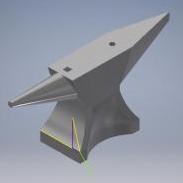
December 2, 20169 yr Author I read somewhere that a large bonfire would put out enough heat to possibly harden the anvil. However, would that harden the whole anvil? And if it did harden the whole thing would it be detrimental to the strength of the anvil? Also I reshaped the heel of the anvil so its not as long and thin, as suggested by some people. I will post an updated picture soon!
December 2, 20169 yr You would not need a torch so much as a rocket engine You will have to put a lot of heat into an anvil and heat loss is a power function of the temperature differential as I recall so it gets harder the hotter you need to get it---which is why a furnace helps. As for bonfire; they are sometimes good for a low red but not generally the higher temps---what alloy will you be using as THAT will control time and temp and quenchant and tempering... If you heat the whole anvil but quench from the face with a high pressure fire hose then the body of the anvil should stay softer. Having the entire anvil hard will increase the brittleness so differential hardening and differential tempering is definitely the way to go.
December 2, 20169 yr Larry: Have you told your instructor you're wanting to cast 150-200lbs of steel? Casting steel is not a trivial matter and requires a pretty specialized set up. Bringing a steel anvil to critical temperature is another non-trivial matter, I can get 200lbs.+/- to 400f in a couple hours using a 55gl. drum end, 40lbs. of charcoal briquettes and a mattress inflater type blower. How do you plan to quench it? Think about the project for a while. To get the face to critical temp you WILL have to get the whole anvil to so close to critical as to make no real difference. Quenching that much steel is problematical for a couple reasons: First is getting a fast enough chill time to harden it. Second is keeping the residual heat in the remaining mass from drawing the temper to a normalized state. Just getting a good quench isn't easy, water will boil on the contact surface and the steam will insulate the steel so it doesn't chill fast enough to harden there. An oil quench not so much but it will still form a smoke layer to the same effect. You MUST agitate the quench vigorously enough to wash away ANY steam or smoke on the surface. How are you going to pull that off? Have you given it any thought? A fast moving creek, small water fall, etc. and set up your furnace next to it? How are you going to move the really HOT anvil? If you go with an oil quench, do you know how much oil it'll take? While I've never quenched more than about 40lbs. I'd bet a 200lb. anvil would boil 55gl. of oil. Of course you'd want to use a proper quench oil or at least a heat transfer oil. Have you price checked quench oil? This is a much larger project to do yourself than you think, I've been involved in SMALL versions and those were more trouble than the end result was worth. Knowing what I do I'd find an industrial foundry that'd be willing to contribute to your class project and have it cast and heat treated professionally. Heck, if you go about it right they might do it for the tax write off. Frosty The Lucky.
December 2, 20169 yr size of the hardy vs pritchel looks off; lots of old tooling with 1" shafts for hardy holes, though the old anvils varied quite a bit and even had irregular hardy holes at times. (not a big issue when you could make everything to fit yourself...)
December 2, 20169 yr I like the design. I would still make the heel thinner, but that's just personal preference. To give give you my honest opinion, I think it's a WAY too ambitious project. With that being said though, I've never made an anvil over 20 lbs, and I really hope it works out for you. One thing you might want to consider is downsizing it to no more than 150 lbs. That would make everything easier, and with the beefiness of your design, you would still have a very substantial anvil.
December 3, 20169 yr I doubt your school has the capacity to pour even a 100lb anvil. I think your instructor is thinking of a MUCH smaller anvil likely in a non ferrous allloy. You will need to pour at least 150lb of steel in one shot to cast a 100lb anvil. Steel needs large risers to allow for shrinkage during solidification, especially for a chunky casting like an anvil, then there is the sprue, runner bar and ingates. This means cranes for the ladle and a fair sized induction furnace. Small by industry standards but very large by school standards. If you really want to make an anvil you can use you should be looking at the suggestions others have made or look at this thread for another option All the pictures are gone from this thread but maybe you can find them on the Wayback machine. Grant made these on a CNC mill but had to have some custom dovetail endmills made. To mill a full sized London pattern anvil you would need some really long endmills. I am not sure if you have priced 6" long solid carbide end mills. You would likely go though $400-500 of end mills at a minimum. Long end mills mean much lighter cuts so you don't break the expensive end mills.
Join the conversation
You can post now and register later. If you have an account, sign in now to post with your account.