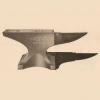
September 11, 201411 yr I came across this rail anvil this past July at a local garage sale and ended up bringing it home for $10. I was really impressed by the amount of work and talent that went in to transforming it from an ordinary section of rail into the finished piece. It's almost a piece of machinist's folk art. Anyway, I just completed the process of getting it cleaned up and wanted to post some before and after pics. When I got it, the anvil had been coated with multiple coats (and colors) of paint; all of which was peeling and flaking. I decided to remove the paint but leave the rest of the metal patina intact instead of scrubbing/brushing it down to bright metal. The paint came off with a chemical strip and gentle wire brushing. Any residual stripper was removed and neutralized by a wipe down with mineral spirits. Then the piece was coated with light application to tung oil followed by Renaissance wax to protect the steel surfaces. For some reason the lighting in the "after" pics caused the metal surfaces to look a little more "orange" than they are in real life, but I think you'll get the general idea. Before clean-up: After clean-up: The only identifying marking of any kind that I can find on the anvil is this small little "X" that was ground in on the side below the cutting table. It appears to be very intentionally done and perhaps was the maker's "signature" to identify his work.
September 11, 201411 yr Author I need to throw it on a bathroom scale and find out. I think it's about 20 lbs or so. They removed a lot of steel during the shaping process.
September 11, 201411 yr It looks like the top of a bigger anvil, grafted on a piece of rail or H beam. Geoff
September 11, 201411 yr I agree with geoff. It looks just too good to be a rail anvil. A bit of cut and shut with a broken anvil and an I-beam perhaps.Anyway, a very smart piece of 'anvilry'. It would find a place in my shop.
September 11, 201411 yr Author No "grafts" or trickery here, honest! Just a VERY talented fabricator who put lots of time and skill into this rail anvil. I'll post some pics of the underside tomorrow so you can see all of the metal removal that took place to produce this piece. The face is only about 2" wide and the whole thing is about 16" long from horn to heel. Honest to goodness it is all carved out of a single piece of rail using the "stock removal" method.
September 12, 201411 yr $10?????Want to double your money? I'll even throw in a bottle of Jack Black....GREAT find!Dave
September 12, 201411 yr Really nice. It's not art, but surpasses craft. I'll bet, whomever made it, could fix a potato digging machine, whatever was broke, better than it was manufactured, and in time to keep harvesting tomorrow morning. I hope to be close to that person someday. Hey, we can all hope for something, right?
September 12, 201411 yr No "grafts" or trickery here, honest! Just a VERY talented fabricator who ...OK. I can only say that whoever made this could have made his fortune producing more. A very professional piece. One wonders, with such skill, what marvellous things he made on it.
September 12, 201411 yr Do you think your piece had any heat treating and what does the rebound seem like?
September 12, 201411 yr Author Here are a couple of shots of the underside of the face, horn, and heel. You can see some of the grind and file marks that were left behind as metal was removed and shaped. I'm guessing that the rail anvil did not receive any special heat treating based on the way that metal has moved around on the edges of the face from blows. I have not yet done a ball bearing test on it, but would expect the results to be marginal. The face has a lot of chisel marks in it and somebody must have used it for a chopping block.
September 12, 201411 yr There is an entire chapter in The Complete Modern Blacksmiths on how to make anvils from RR rail including heat treat of them.What I would point out is that the web should have extended under the cutting plate in my opinion. I like the real thin heel as there are a number of tasks I need that sort of heel for and have to use a bridge instead.
September 12, 201411 yr Can you give us some dimensions, that will tell me what size rail they used. I have collected several over the years, But that one is very nice (super find) I will have to post some of mine if I can figure how to post pics? Ironmike
September 12, 201411 yr Author Ironmike: Attached are some dimensioned photos. I'm guessing that it may be made out of a section of 136 lb (136 lbs per yard of length) rail but perhaps you can confirm this speculation. 2014 07 30 Rail anvil dimensions.pdf
September 12, 201411 yr And thank you for preserving that beautiful patina for future generations to enjoy.
September 12, 201411 yr Hi Copilot, nice anvil,good find! Here are a few pics of a couple that I found over the years. Someone spent quite a bit of time to machine and grind them to shape. I have seen others also, I sometimes wonder if someone commercially produced these? One of my neighbor farmers that I work for has one that he too found at a garage sale. They are good steel and great for small work or pleasant to just look at!
September 12, 201411 yr Author Hi Copilot, nice anvil,good find! Here are a few pics of a couple that I found over the years. Someone spent quite a bit of time to machine and grind them to shape. I have seen others also, I sometimes wonder if someone commercially produced these? One of my neighbor farmers that I work for has one that he too found at a garage sale. They are good steel and great for small work or pleasant to just look at! Those are some beauties, too. Love the one with the hardie and pritchel holes.
September 13, 201411 yr Looks like a high school shop class project from back when they had real shop classes.
September 13, 201411 yr Boy it's uncanny the similiarity between Copilots And Direwolfs, They do look that way Randy Bill Ironmike
September 13, 201411 yr Scan from 1900 Montgomery & Co., NY, NY catalog page of anvils they handled. These rail anvils were called "Hill's Solid Steel Anvils, and depending on the size were either $1, $2, or $3. Also note that Fisher anvils were selling for about $0.10/ lb.
September 13, 201411 yr I believe that this company from the above post Montgomery & Co. became Montgomery Ward at some point. They carried everything from anvils to gears to machines. Interesting to just go through the catalog and see how much they carried, and the variety.
Join the conversation
You can post now and register later. If you have an account, sign in now to post with your account.