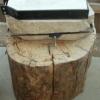
May 11, 201214 yr I just finished making a 130# granite rock anvil that I cut with a 15 amp angle grinder. It has a 1/4 inch thick steel band around the surface edge to help prevent the face from chipping. It took me about 45 minutes to cut the anvil and another hour to add the steel band. I posted a couple of videos of the finished project on youtube at.... I have not forged on the anvil yet, but it does have excellent hammer rebound. I am not the first to think of using granite for an anvil; Wayne Goddard briefly discussed using a granite slab as an anvil in his 2001 book "The $50 Knife Shop." There is also a couple of videos on youtube that show a guy using a granite rock to forge a knife from a railroad spike at... . I still have to build my forge before I can test the anvil. I'm going to use my old Webber barbeque for the forge and use a hair dryer for the blower and plug it into a dimmer switch box. Of course I would love to have a steel anvil but have not been able to find one for $150 or less. The rock was free and the steel band was $7. I can't wait to give it a try! I had initially thought about making a steel anvil using 1 inch thick plates of steel (12" x 12") with a slab of 1/2" thick tool steel welded on top and a horn made of 2" thick round steel bar plates that descend from 4" in diameter down to 1" (with the plates aligned level to one another at the top). Enclosed is a photo of the finished rock anvil product.
May 11, 201214 yr Love it! I wouldn't worry about building a steel anvil now that you have this baby. If you find that you need a harder surface, bury a sledgehammer in the ground and use the face like you would a stump anvil. Can't wait to see how the granite takes to being an anvil!!
May 11, 201214 yr Some folks use them to provide texture to the steel for ornamental use. I recall one fellow doing a picture frame on a granite cobblestone for just that reason. A lot of early smithing was done on stone anvils---the chinese used *jade*! Viking era smiths sometimes used basalt. One thing to remember is that they were working with real wrought iron which is forged at welding heat and so is very soft under the hammer!
May 11, 201214 yr Think about wearing goggles(safety not diving) when using it at first some granite spalls badly were it has been cut. Alternatively flame it- that is gently run a cutting torch over the surface, this will lightly texture the surface but will flake -off any "loose" bits. That anvil sure is a keeper!
May 12, 201214 yr Author I had thought about putting a 1/2 inch thick steel plate on top of the face but I know that if the two surfaces are not completely smoothe and flat it will cause an air space to exist between the two surfaces and dampen the rebound. Since I have two of these stones carved, I think I will experiment with the larger one (160#) by using a ceramic tile mortar to fuse the metal plate to the face of the anvil and see how dampened the rebound is. Of course I will put the mortar on the steel plate and then lay the rock on top of the steel plate so that there is plenty of weight on the mortar to squeeze out excess mortar and air bubbles. This should be fun! I will keep you posted on my results. -mike-
May 13, 201214 yr Hey that anvil rocks! I know, I know but I couldn't resist saying it. Seriously it looks professional.
May 13, 201214 yr Pretty cool anvil, I'm really interested in how it holds up. ALWAYS wear PPE when using this anvil, granite will exfoliate when heated, meaning it will flake in in thin layers. (leaves) The edges will need special attention and maybe making a corner block of steel will preserve your anvil. I've used an ultramafic boulder, possibly a hornblend and it worked very well for some time and it was like glass. I didn't try cutting a flat face though I just adjusted my stock angle, position and such to produce flat surfaces. It's more hassle forging but works well. From what I've read most stone anvils were hard limestone but I'm sure whatever was available was what was used more than the "right" stone was. Frosty The Lucky.
May 13, 201214 yr very cool work it should do well for you , just remember to forge at a good temp to keep from messing up the face . Sam
March 19, 201412 yr Good for you. Even after you find a steel anvil I am sure you will have use for your stone one. Good inspiration for anyone desperately searching for an anvil.
Join the conversation
You can post now and register later. If you have an account, sign in now to post with your account.