Marc1
Members
-
Joined
-
Last visited
Everything posted by Marc1
-
Nice stand. Yes, sand base works. A box full of sand works too. The reason for building my "too small" tripod was to be able to change the position of the anvil outside the workshop. Those logs bolted together are not going anywhere fast. I can't figure out that photo of your anvil, there is something on top of it? Looking forward to see your new hand forged workshop. Remember to make it BIG !
-
Actually I have a couple of run of the mill PW. 280 lb and 480 lb ... They are the right size for what I do, that is all that is required, and a good steady tripod. Have a couple of 40Kg farrier anvils i hardly ever use because they are too small ... and a little Kohlswa kid size for the very small stuff. I have posted a photo further up. Was told my tripod is too small though It seems that size matters after all
-
Wow that vice has some growth on the side ! How do you work with all that stuff around the vice? I like the other vice ... what size is that one?
-
Take as much as you can carry would be my answer, however your question lacks one critical component. What do you want to make? From the list of steel sources you mention, besides bolts if they are high tensile and rebar, the rest is most likely mild steel. If you want to practice forging, nothing better than mild steel. You will need a tool to cut steel into manageable sizes. The cheapest tool for that purpose but also a dangerous one, is a 5" grinder topped by a 1 mm ( 1/32" )cutting disk. Goes through steel like butter and a box of disk is relatively cheap. You will also need a full face mask and some steady strong arms to go with it, not to mention someone who can show you the basics, mainly what not to do with a grinder. There is bound to be a fitter in that factory that can tell you how to cut safely. Best of luck and if you are starting blacksmithing why don't you try to be different and avoid the usual 'making a knife! ', and try your hand at making something else ... how about a lamp?
-
Yep Mr Anvil ... agreed. My journey included many adventures and enterprises, some I try hard to forget, others seem to bring a smile when I remember them. I had the opportunity to apply those pesky formulas and unappreciated theoretical concepts a large number of times with great satisfaction. One that comes to mind is when I took up an opportunity to start a manufacturing plant from scratch. With limited capital and one business partner that was broke but had great practical knowledge of the process involved in making PVC, I took the challenge to make all the machinery from parts I could buy, mainly from discarded food industry stuff. I had to adapt, modify and build from scratch a string of machines, reactors, pumps mixers and boilers and this involved a lot of calculations. From working out the volume of a tank, and the surface of the fire tubes needed to heat up the water inside, the speed of the gases inside them and how to slow them down, the ideal temperature to produce the right chemical reaction, pump position and capacity, speed of reaction, electrical installation, not to mention finances, everything worked out only because of what I was able to apply from my studies. My partner knew how to make the stuff, but had no idea how to build what was required to do it. I had the most satisfaction from proving the suppliers rep wrong. Many had great knowledge of their product but sketchy concepts of how they were supposed to work. However in good salesman fashion they trumpeted the little they knew as gospel and irrefutable set-in-concrete fact. Changing parameters, a bit of calculation and experimentation, lots of failures and some success provided results outside the square the were unknown to our competitors and gave us an edge for a decade. From Trigonometry to Chemistry, from Physics to maths, to understand how things work is a lot of fun. We are a bit off course in relation to the mechanics of collisions, but I blame it on you that got me talking about myself. IFC ... the source of a particular knowledge is irrelevant, it is what you do with it that counts.
-
-
My 480 pounder fits easy 10 beers or 12. But my shop does not fit 10 visitors Funny that hard-face and big-face if translated literary are both insults in Spanish .
-
Ha ha, I like your post Mr Ole Hippy Anvil. A few inaccuracies just for the record. This "new smarty pants smith" has just turned 69 and started working in a commercial smithy at age 15. The examples to 'explain' things are good when they are accurate. When they contain errors, they are no good and need correcting. To correct a concept you need the facts presented in a different way, most of the time it is best to use Mr Newton and some other formularium that may not be very appetising but is required, or you end up with rocks that absorb or reject energy and hammers that are measured in millionth of seconds and resemble bullets, or stands that add mass to the anvil, and many more very amusing but wrong assumptions all there because ... well ... forcryingoutloud intolerance, or similar ailments. And last but not least, a bigger anvil has a bigger face. You are right Mr Thomas, stating the obvious is sometimes important. So practice is more important than theory? Depends what for. If you are good at forge welding, knowing how this happens will not help you much. However if you tell me it is the spirit of Vulcan that talks to you at nights and directs your hammer, I will politely disagree and perhaps come up with a formula or two ... or may be not ... being called names that fit someone 1/3 my age is demoralising PS I did not learn formulating formulations in a smith but in a university. Yes inside, mostly the library where making noise was frown upon.
-
Hydrochloric acid with Phosphoric acid. Hydrochloric on it's own work just as well and is cheaper. Dilute 10:1 ... add acid to water slowly, and not the other way around.
-
My brother in-laws had a coffee table made with a massive bellow in perfect condition. Paid a fortune for it, but they used to pay for everything too much just to show off. That one looks in bad shape. I am sure you could rebuild it to get it to work for a forge. To make it look good for a coffee table ... not really. But that is me.
-
If you are going to teach there should be an insurance to cover you. If they are going to use your equipment and do their own thing, you need a different insurance policy. Sad but that is what it is. Each state / country will have different laws but that is the general idea ... unfortunately. Check with your current insurance to see if you are covered. There a re some in this forum that held smithing classes. They should know.
-
Interesting ... so you are the kid with the bamboo rod in my story. Am I the smarty pants in your story? I am sorry that you feel threatened by a few post that had the only purpose to illustrate what most know intuitively but can not express in a formal way. To the OP if he is still around. Yes, size matters, and this thread is living proof.
-
Just as an example of what happens to anvils ... when I moved to Sydney, I left a nice 88 lb anvil with my brother because he asked for it. Wasn't going to check it in with luggage ... so ... he is an architect and thought my anvil would make a nice decoration sitting on his studio book shelf holding up a row of books. Still there.
-
Ha ha, take it easy guys, it is all in good fun. I couldn't resist talking (writing) a bit about why the size of an anvil matters. In the process I had to google the difference between 'then' and 'than'. If I ever knew the difference I have since forgotten it, mixed up in the melange of 5 language that reside somewhere in my brain. As for the reaction that a couple of formulas and some unfamiliar and perhaps counter intuitive concept can stir up, this is perfectly understandable and a very old bugbear. The kid that goes fishing with an old bamboo rod and can out fish the new boy with his new carbon fibre rod and electronic lure, or the boy that hunts with a 1930 .22 gallery gun with iron sights and brings a bag of rabbits home whilst the rich boy with his Sako 222 and Leopold scope comes home empty. You can write a book about this emotional issues. Experience vs resources, ability vs money ... no need to explain any further. However ... if someone asks about the difference between the triple deuce and the .22 LR a technical response is all that is required, and the arguments about shot placement and hunting experience shouldn't come into the conversation most of the time. A big anvil is usually more expensive. if the conversation steers towards big anvil matters, the concept comes dangerously close to big is better and therefore more money, means better blacksmithing with all it's understandable controversial thought pattern. I have always had a love for physics, chemistry and it's associate mathematics, (not maths by itself that I consider right or wrongly the realm of gigs). So because of such inclination I tend to mistakenly assume that others may also have some sort of interest in why things are or act as they do, just like I find myself explaining enthusiastically the origin of a word in english that means a different thing in another language only to see others' eyes glaze over and turn to an observation about the weather. It is what it is. It so happens that the physics of collisions is that little more complicated and can be that more interesting and generate that bit more of a blacksmithing related conversation. I hope we can do so in the spirit of learning from each other regardless of size ...
-
May be the screw is not bent. Just a guess but that damage to the screw cover must have happened with the screw out, Jaws open ... and when the vice was closed the screw poked a hole in the cover. Not saying that a strong blow to the screw can not bend it, but the damage to the cover would look different. You will find out ... eventually ... It is a nice vice and the jaws don't seem to have any serious marks.
-
In that case buy both, Keep the Fisher in the house with the night working neighbour and the NC in the other.
-
He who loves practice without theory is like the sailor that boards the ship without a rudder and compass and never knows where he may cast ... Leonardo da Vinci
-
There are anvils everywhere, in the most unlikely places. Forget on line. Go low tech. Word of mouth, tell everyone you cross path you are after an anvil and if they know someone who has one. You will find people have them under the garage bench for decades, as garden decoration, door stop or stand for a flower pot. The hunt for an anvil is an interesting one, and there is even a method designed for this hunt you can find on this forum. Start today asking everyone you know plus whoever you don't know you have dealings with. And don't forget the junk yard. Best of luck.
-
Mm ... The kinetic energy of the hammer in both cases, broken or unbroken rock is the same. The collision is mainly elastic so almost all the energy is returned, the hammer bounces up, the rock moves down. The bigger the rock the less it will move down however ... and this is a good way to see why not all the energy goes into the stand in an anvil or the stuntman under the rock ... the big hammer blow that brakes the rock does so because the energy travels inside the rock in all directions and not only down. Just like a bullet hitting a water jug and sending the water in all directions if the speed of the bullet is high enough, the kinetic energy in the rock blows two or more pieces of rock sideways and make the life of the stuntman that much easier. And in relation to those answers that talk about big anvil being better than smaller ones ... As it is the case with other things, to qualify something as better one must specify what for. The question was posed ... why does size matter. Is a Mini Cooper better than a Dodge Ram truck? Or is the truck better? Since no one talked about "what for", the only pertinent answer is why does size actually matter, and not in what situation it does not Sure, if you forge little pen knifes, you only need a small anvil, if you want to forge a ship anchor, you will need a 2000 lb anvil and some more. Does size matter? of course it does! But why was the question. Why? i am sure most people her know that it does, and even why it does, but the answers invariably get mixed up with preferences, personal experience, work performed and many other variables that have no much to do with a simple answer. It does matter, and it matters because ... well we already said it a few times over:)
-
When I was a kid our local circus had an act where one guy laid down between two chairs, the assistant placed a large rock on his belly, easy 40 kilos, and then proceeded to crack it in half with a mighty blow of a sledgehammer. The audience went O! Ah! yet I always failed to be amazed and could intuitively understand that the larger the rock the easier it was to avoid injury from the hammer. Yes, formulas are not for everyone. If we can take something home from this, let it be that a shaking and wandering anvil is telling us it is too small for the job, and that a heavy stand is no substitute for a heavier anvil.
-
I think that the idea of testing an anvil with a ball bearing for rebound sort of muddles up the concept of what the anvil does. You are right in mentioning that rebound will be felt when you strike the steel cold. My first job at age 15 was to texture flat bar and round bar for bed heads cold, using a texturing mallet. I learned about rebound there! However ... if you strike cold steel or hot steel, the anvil does not really care. What matters is how much of the kinetic energy of the hammer is converted into deformation of the steel ( the actual purpose of the exercise) and how much of this energy goes into the anvil ... and then again, how much of this is returned back by the anvil, how much is lost in movement be it vibration, shaking, deformation of the anvil and the stand. In a perfectly elastic collision the coefficient of restitution is one or close to one, in an inelastic collision the coefficient of restitution is zero or close to zero. In the collision between hammer and hot iron, the collision can be called more or less inelastic according to the temperature of the iron. Heat the iron white hot and strike. A lot of the kinetic energy will be used to flatten the iron. very little will go in the anvil ... ( and some will go into burning your apron ) Conversely a dark red iron will deform little and the coefficient of restitution from the steel and the anvil will be higher. So if we qualify an anvil as good, by the amount of rebound, we are using the wrong parameter, since the smith will use hot iron 99% of the time ... and all that time the rebound will not really matter. Hardness of the anvil is required to retain integrity sure, but If we have a 1' cube of tool steel hardened at 54 HRC and 1' cube of mild steel and forge on it the same hot iron bar, providing the temperature is the right one and the hammer is not over the ratio that is ideal, you will probably be hard pressed to notice any difference at all whilst forging. Sure, miss a blow or keep on going on too colder steel and you will mark the anvil. Plenty of mild steel striking anvils testify to this. The other part of your post is also right. if you have an elastic or inelastic collision there is in both cases conservation of momentum and the ratio between hammer and anvil plays it's role here. Why does size matter is the title of this thread ... it matters because the collision on hot iron is not perfectly inelastic and so some of the momentum and some of the kinetic energy still goes into the anvil. What happens next is what makes the blow more or less efficient. I feel that I will start repeating myself if I keep on going. The best is to try to go through both this links if at all possible. I remember another little article that explained the collision on an anvil at molecular level but can not find it anymore. https://www.calsmith.org/Resources/Documents/technical_documents/techdocs_thephysicsofanvils.pdf https://en.wikipedia.org/wiki/Collision
-
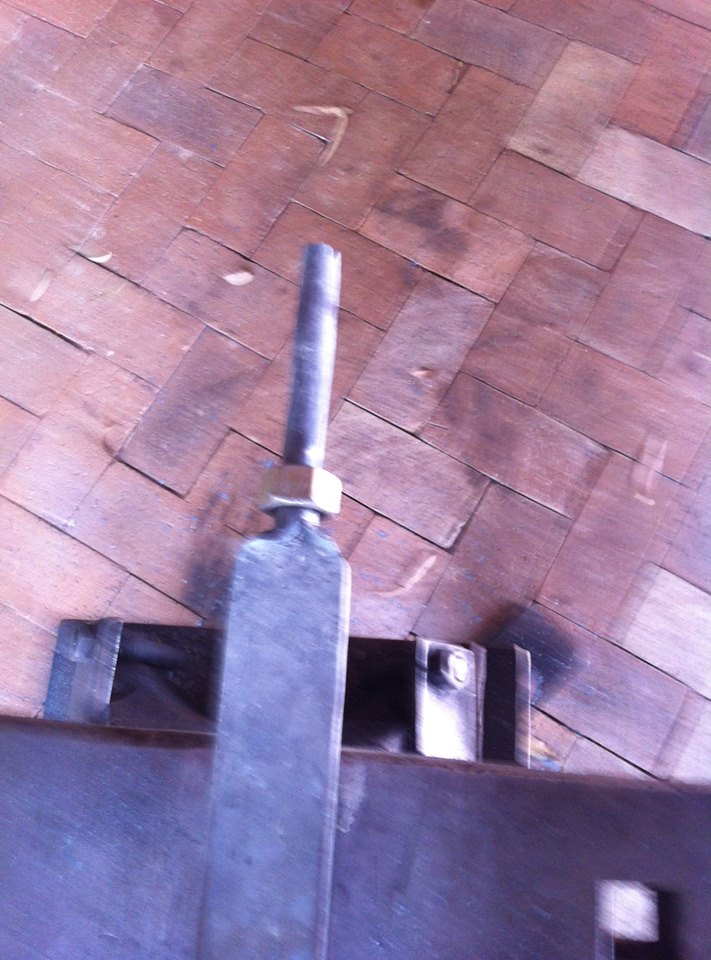
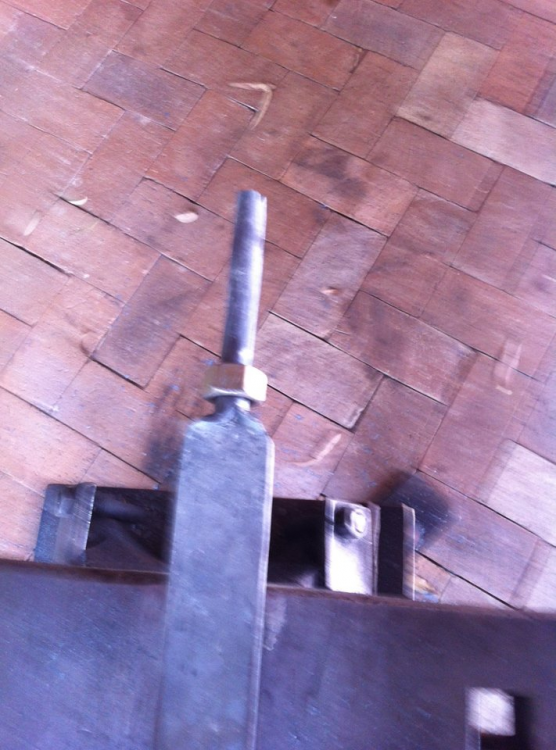
This is a PW 280 lb I made a metal stand for recently. Had the process posted but somehow all the photos are gone. Plate is 1" and legs are RHS 5" x 2.5" x 1/4" filled with sand and oil. Forging the hinge pin for a gate. 50mm x 10mm down to 20mm round. Used a 4 lb hammer the anvil did not move or shake but I should have used the 480 lb that is still stand-less. The nut is just to size the pin My twisted idea for a gate Flatbar is 2"x1/4" New York ... must be a busy place ... I once bought a vintage chainsaw off ebay from NY ... It's a 100 cc Homelite from the sixties. Ha a tag on teh side stating ... this is the property of the NY City Fire department ...
-
Sure there is kinetic energy transferred down into the ground through the stump. And the bigger and heavier the stump or stand, the more that energy that is lost is absorbed by the mass of the stand and not transferred to the ground and to the surroundings. The stand is acting like a secondary anvil, however the amount of energy returned to the anvil from the stand is minimal and the amount of this lets call it secondary energy, returned to the hot steel is even less. Why? Because the anvil/hammer collision is mostly an elastic collision and the anvil stump is mostly an inelastic collision. However that is not the point. If you want an efficient system you want to minimise losses. You want as much as the energy from your arm as possible to go into the hot steel. When two objects collide in an elastic manner, if they are of equal mass they will move away from each other an equal distance at the same speed. If you want to minimise the movement of the anvil you must increase the ratio of hammer anvil mass. An infinite anvil will be unmovable but not practical so a ratio of anvil hammer must be found to make losses acceptable. The indication that there are losses, is the anvil shaking and bouncing, and the stump digging a hole in the ground. A big enough anvil or rather a high enough hammer/anvil ratio, will not require massive stands and bolts and should return most of the kinetic energy of the hammer into the hot work. Not thanks to the stand but thanks to the anvil mass. If you used a 1/2 pound hammer there would be no hole in the ground and your wife wouldn't hear a thing. Actually she may hear some ringing, but that would be an acceptable and unavoidable loss. As explained much better in the article I linked, when you work on your anvil, there shouldn't be any purely elastic collision of hammer and anvil unless you miss your work and strike the anvil directly. So that means an in-between situation and complicates matters somehow. However the end result and the behaviour of the anvil mass is the same and the ratio is still a valid concept. What I mainly wanted to point out is that the way the anvil absorbs the energy and returns it is not in the direction of the force applied but rather in all directions inside the mass, and so only the base of the anvil that is a small area in relation to the rest of the anvil surface will be able to impart some energy down to the stand and an even smaller proportion of that energy may be able to bounce back into the anvil that in turn will absorb it and divide the reaction in two, one down and the other up. How much of the original hammer energy can be returned by the stand to the hot work is beyond my mathematics but I can guess it to be very depending on materials, mass of the stand, and to be rather low. One further observation is that the shape of an anvil, when practical for the purpose it is designed, its not the best shape for the purpose of conservation of energy. A truncated pyramid shape is likely to return more energy back than one that is shaped like a tuning fork and loses a good amount of energy destroying our hearing
-
Many good points guys. Sure, hardened anvil face makes the anvil last a long time. Ball bearing test gives you an idea of the integrity of the anvil, etc. All good points. Big anvil absorbs more energy than small one and therefore allows for big hammer. Makes sense. Big anvil has a larger face so you can work larger pieces. I was more interested in another facet of the anvil debate and one that Buzz touched on. Let's call it "the purpose of the stand" So besides the obvious function of holding the anvil at the right hight for your arm length and all that ... what happens when a poorly secured anvil bounces and walks around? The accepted answer is that there is energy loss so securing it will make the hammer more efficient. Unfortunately, it is not that simple. Sure a solid steel tripod with big 5/8 bolts holding an anvil down is 'better' than a wooden stump with a couple of big nails, but why? It either adds to the mass of the anvil and returns some of the lost energy or it does not. Well the bad news is that very little of the energy can be returned by the stand, tripod or stump and their function is one of convenience. Who wants a bouncing anvil? Or safety, who wants an anvil falling on his toe? Who want's an anvil ringing like a bell? Yet all those unwanted effects that are neutralised by the stand are still a loss. Energy wasted. They are just not as bothersome. So like I mentioned before, the hammer blow when vertical down, will produce a wave that travels in all directions in the mass of the anvil and not just vertical down into the ground. Place a finger on the tip of the horn and give the anvil a tap with the hammer. if the action only goes vertical down you shouldn't feel a thing. However a bouncing anvil is telling us something very important. The anvil is too small for the hammer you are using. And if you bolt the anvil down or set it in concrete it will still be too small. So is building a super tripod a waste of time? No, as blacksmiths we tend to over engineer what we do. It looks better and tends to last a lot longer. What I am saying is that the stand can not make up for the lack of mass in the anvil you are using. If it bounces around it means you need a bigger anvil. By securing it to a tripod on steroids you may think you have overcome the problem but all you have done is cancel the symptom. In my opinion anyway
-
There is much more in the article and in my post than 'rebound does not matter'. That is the funny and controversial part and the quote is from Brian Brazeal and not me. The efficiency of the hammer anvil system is explained using both alternatives of elastic (high rebound) and inelastic (low rebound), where the losses are and what does the bearing test shows. There are many factors at play when trying to explain our own experience, like you do when comparing a smaller ASO with a larger better quality anvil. My original question however, was if the anvil can be made bigger with a big stand, or can the mass of the stand be incorporated to the mass of the anvil making it bigger. The answer is in most cases no. The shape of an anvil with a large body a waste and a smaller footprint precludes most of the force of the hammer blow from traveling into the stand and so precludes the stand from returning the favour. There are also other factors, like gaps and change in material and therefore resonance. The idea that the hammer blow travels vertically into the stand is incorrect.