
Mike BR
Members
-
Joined
-
Last visited
Everything posted by Mike BR
-
You can also temper by gently heating the bit to a purple or blue (or whatever color you're looking for) with a propane plumber's torch or over a hot block of steel. That gives you more control than using retained heat, but still leaves the oven for lasagna.
-
During the week I noticed a puddle under the water heater. I picked up a new one last night, installed it this morning, and spent much of the afternoon scaling off urethane foam and cutting up steel for future use. Interestingly, there is little or no pitting. The leak seems to have been from the threads on the relief valve, or just possibly the inlet nipple. Not sure it would have been worth fixing on a 20-year old unit, but that could be sour grapes. Does anyone know what the strip that hands down in the internal flue/fire tube and does a fair impression of a wind chime might be made of? It must get pretty warm. It's magnetic and looks a lot like stainless, but I haven't tried a spark test yet.
-
One approach that can be helpful is to heat the screw while keeping the nut (or equivalent) as cool as possible. The screw will try to expand, but when it gets hot enough it will yield and reshape itself to fit the space it’s in. Then when it cools, it will contract and (hopefully) create some additional clearance. ( Not sure if I succeed in keeping that PG rated . . . )
-
I'm not sure whether it's due to legal requirements or environmental pledges or what, but used cooking oil hasn't gone away. I was just reading a newspaper article about theft from restaurants. But the most interesting thing is that in some areas used cooking oil now sells for more than virgin. Leading to some folks trying to pass off new oil as used . . .
-
My wife just asked me for help when her usual technique for removing the pit from an avocado half failed. I was at a loss until I opened a drawer and found a corkscrew. Somewhat to my surprise, it threaded right in, and it was almost too easy from there. As you might expect, a quick search revealed that I wasn't the first to "invent" this. But I didn't see any hand-forged avocado pit removers. Maybe an opportunity for someone who sells to the right crowd?
-
To pile on a little, no matter how well the flame is adjusted, oxygen and fuel are both present anywhere there's active combustion. And to an oxygen molecule, your workpiece looks like fuel. At least one thing the pipe does is lengthen the gas path between the burner and your workpiece, helping ensure it's exposed to the products of combustion rather than the ingredients for it.
-
I've never made a knife (worthy of the name) or double tempered, so I may just be displaying my ignorance. But as I understand it, double tempering is about retained austenite. When you quench a piece from critical, when it reaches somewhere in the high black range, the dissolved carbon is trapped and can no longer precipitate out. But the grain structure converts from austenite to martensite only more slowly, as the piece continues to cool. When it reaches room temperature, the structure is mostly martensite, but there's still a small percentage of retained austenite. That's (mildly) bad because (1) the retained austenite is unstable and will continue to convert to martensite over time, and (2) tempering austenite is about as useful as boiling popcorn. So after you temper, the retained austenite gradually turns to untempered martensite, which reduces toughness. I think the theory is that enough new martensite forms as the piece cools from the first temper to make a second temper worthwhile. (If you cool to the piece to 100+ degrees below zero between the tempers, you've cryo-treated it, and taken care of most or all of the retained austenite.)
-
When I got my driver's license my sister was being treated for a minor injury, so my first "job" was taking here to a few orthopedist appointments. The only reading material in the waiting room was a professional journal with an article on degloving injuries. The pictures were still vivid 10 years later when I got married. (When I did get married, I started storing my ring on the temple of my glasses so I don't forget it when I run out in the morning. Now that I'm using prescription safeties, the same habit makes it easy to shed my ring when I'm headed for the shop.)
-
I think it is TEFC. Probably indicated by the "TE" after the HP number. The vents look like the intake for a fan at the end of the motor, outside the working bits. Air would blow out between the shroud and the case to cool the outside. (The "fan" part of TEFC has to get air from somewhere, after all.)
-
A couple of decades ago I signed up for 200# of “zero carbon steel” in 1/4” round (or 6mm?) as part of a group buy. I only realized much later that the challenge with forging 1/4” round rarely lies in hitting it hard enough. . . I’ve finally used up the stock, mostly for projects (largely fabrications) where A-36 would have worked as well or better.
-
Definitely holds a candle.
-
I've always been skeptical about dishwashers damaging stainless steel cutlery. On the other hand, I've seen them strip the finish off wood, and destroy the "patina" on bare aluminum bakeware. So I'm keeping a bit of an open mind. Of course, I learned those lessons before I finally figured out that I could get pods cheaper than powder. The pods have a lot less total volume; I'm guessing they rely less on PH brute force.
-
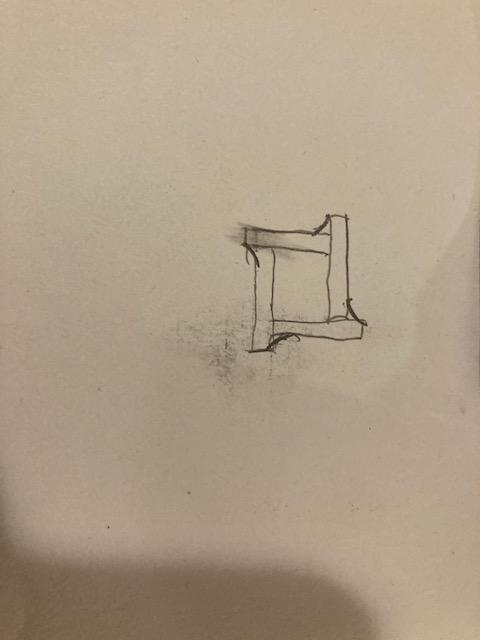
A quick way to fabricate a square monkey tool is to cut four strips of flat bar (e.g. 1/4 X 1) and butt the edge of each one against the side of the next, then weld them up. That way you can adjust the inside dimensions without having to cut (or forge) the bar to adjust the width. Here's a rather weak sketch of the end view.
-
Another tip (if you aren’t doing this already) is to set the hook on a hot chunk of steel before you bury it in the ash — or better, sandwich it between two chunks. The greater thermal mass will slow the rate of heat loss, and might well be enough to get the piece soft.
-
I might try drilling it with a (cheap) HSS bit just as it cools off a red heat.
-
The first (and only) website I checked myself with before I posted seemed to say an eductor could be powered by any fluid. But I may have been all at sea.
-
I could be misreading it, but the photo from below looks like an eductor/venturi. The bullet shaped nozzle seen from above with the concentric space around it also looks something like an eductor, at least if the central nozzle was positioned a little lower. Is it possible that this was originally a two-stage eductor running on shop air, and was later modified to use a blower?
-
The way I was taught is to start with stock maybe twice the width of the hole in the header. Shoulder down from two sides to the size of the hole. Then taper the nail shank down from the base of the shoulder, and cut the stock almost through maybe 1-1/2 times the stock thickness above the shoulder. Insert the tapered part in the header and twist off the remaining stock. Strike at a slight angle to center the head as you upset.
-
I sometimes use my drill press as a jig for TIG welding, with careful thought to ground path. I always unplug it first; the one thing that really scares me is somehow completing the ground path through the house wiring.
-
I'd lay heavy odds that at any reasonable level of blast, the air will change directions and exit through the bottom before it forces it way up through the fire. And of course if you block off the bottom, you'll be trapping hot coals in the plastic pipe. If you're determined to try this, submerging the end of the pipe a few inches deep in a bucket of water might create enough of a seal to force the air upward. In addition to coals falling down the wrong pipe, you'd still need to deal with heat radiated down the steel pipe and conducted through its walls, as well as steam from coals quenching themselves and probably some other factors I haven't thought of. But it might work long enough for you to learn something -- just make sure there's a fire extinguisher handy.
-
Since everything's exhausting the the atmosphere anyway, I suppose you could try a trap with a simple weep hole in the bottom to discharge oil. But that won't help if the issue's oil mist coalescing in the muffler. I remember John Larsen using a bucket full of lathe chips as a muffler.
-
Will it move at all cold before it work hardens? If so, one approach might be to peen until it gets too stiff, heat the whole knuckle assembly in the forge to anneal, and repeat as needed. Another option would be to heat the whole knuckle, then quench everything but the head of the pin. At least assuming it isn't heat treatable stainless.
-
I once confiscated some cadmium-plated aircraft bolts a member brought for our guild raffle.
-
I’m positing that it wasn’t chrome plated. Rather, the chromium oxide layer that naturally forms on the surface of stainless steel (and is crucial to resisting further oxidation) reacted with the acid. Maybe.
-
It could also be a chromium compound. Stainless resists rust because of a chromium oxide layer that forms on the surface. That might have reacted with the acid, even though the base metal didn’t.