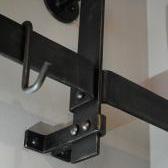
January 15, 201610 yr Here's a couple snap shots of an arched curtain rail made to my client's specification. It's shaped to match the arched door it's going above, a heavy curtain will be permenantly tied to it to reduce heat loss through the gaps in the door. I felt there were 3 options of how to punch the holes & bend the bar (16mm square). In which order would you have done things?
January 15, 201610 yr Greetings Joel, Well done .. Great stand offs. If it was my commission first would be the ends. Next the split and drift and last the arch form . Easier to handle and hold down for the splitting.. Stand off riveting assembly to complete.. Just this old boys 2c .. Forge on and make beautiful things Jim
February 2, 201610 yr I haven't came up with a sequence yet, but I did want to say that your design is wonderful, as is the execution - great work!
February 2, 201610 yr Just out of dumb curiosity, what is the function of the punched holes? I've never seen a curtain rod even similar, can't figure out what the holes are for? If they're for hanging portions of the curtain won't they need matching style hooks?
February 2, 201610 yr I would think form the ends, then form the arch, then slit/drift the holes, then rivet the mounts. I would think trying to bend the arch after the holes were punched would just be asking for trouble with collapsing the holes or kinking them. However you did it, I like the way it turned out.
February 2, 201610 yr As the curtain will be tied to the rod I assume that the holes are to tie it to....Arc and then punch for me too.
February 2, 201610 yr seems mighty small holes to be threading material in and tying it, to me at least.
February 5, 201610 yr For me, forge the ends, slit and drift the holes, scroll the ends and turn the scroll. The holes houldn't be a problem but if so its much easier to rectify the holes than repair your curve after punching the holes. Slit and drift is not an option if you scroll first.
February 5, 201610 yr I would certainly make the holes before bending the rod, as it would be more difficult to balance a long, curved rod on your anvil than a straight one. That's not a strong bend. I suppose you could use a hold-down and/or brace if you punched a curved rod.
February 6, 201610 yr Actually I'd think getting a nice even bend with the holes already punched would be harder as the thin points of the holes will bend easier than the full thickness bar will. The piece on each side doesn't look a lot longer than say 3' in length and that's still fairly manageable in length.
March 19, 201610 yr Author Sorry, I'd forgotten I'd started this thread. The arch was to be fixed above a medieval door with lots of air gaps letting the heat out of the house. The client wanted a way of tieing a heavy curtain to the arch to reduce heat loss as the curtain was going to permenantly left in position, not used as a regular curtain that would be slid. The client was rather an "exact" lady and the curve of the arch had to match the curve of the door to the milliemeter, and the bottom edges of the hook finials (to which she might tie the curtains back on the odd occassion) must line up perfectly with markings on the door. Despite being so precise she left it up to me to decide where the holes should go and how many. Ultimately I decided the best option was to "cheat" and individually arc weld in puched holes (that I had punched in a seperate straight bar) as I didn't want to risk opting for a certain number of holes, then finding it didn't look right and having to start again. I did the same with positioning the hook finials. I opted for these methods as I also felt that bending the bars after punching might not work well as there's a chance the bars would bend awkwardly at the punched hole point, and my tests to calculate bar elongations from punching varied by a few millimeters...and I didn't want to risk the hook finials not landing smack bang in the correct alignment to the door markings.
March 19, 201610 yr you can stop the collapse of punched holes by filling the hole with a bolt and nut or a section of the same sized stock as a spacer while you bend, (drop them in cold to the heated length and work quick) obviously sometimes the bolts get a bit stuck but can be punched back out and you might need to adjust slightly but has worked for me in the past and easier than trying to punch a curved length. and no idea if that's a correct technique it's just what i worked out when faced with that problem before
March 20, 201610 yr Author On 19/03/2016 at 11:32 AM, tzonoqua said: you can stop the collapse of punched holes by filling the hole with a bolt and nut or a section of the same sized stock as a spacer while you bend Same goes for re-centering off centre eyes/loops.
Join the conversation
You can post now and register later. If you have an account, sign in now to post with your account.