patrick
Members
-
Joined
-
Last visited
Everything posted by patrick
-
-
Also, there are some in line designs that are very compact which is nice for small shops.
-
-
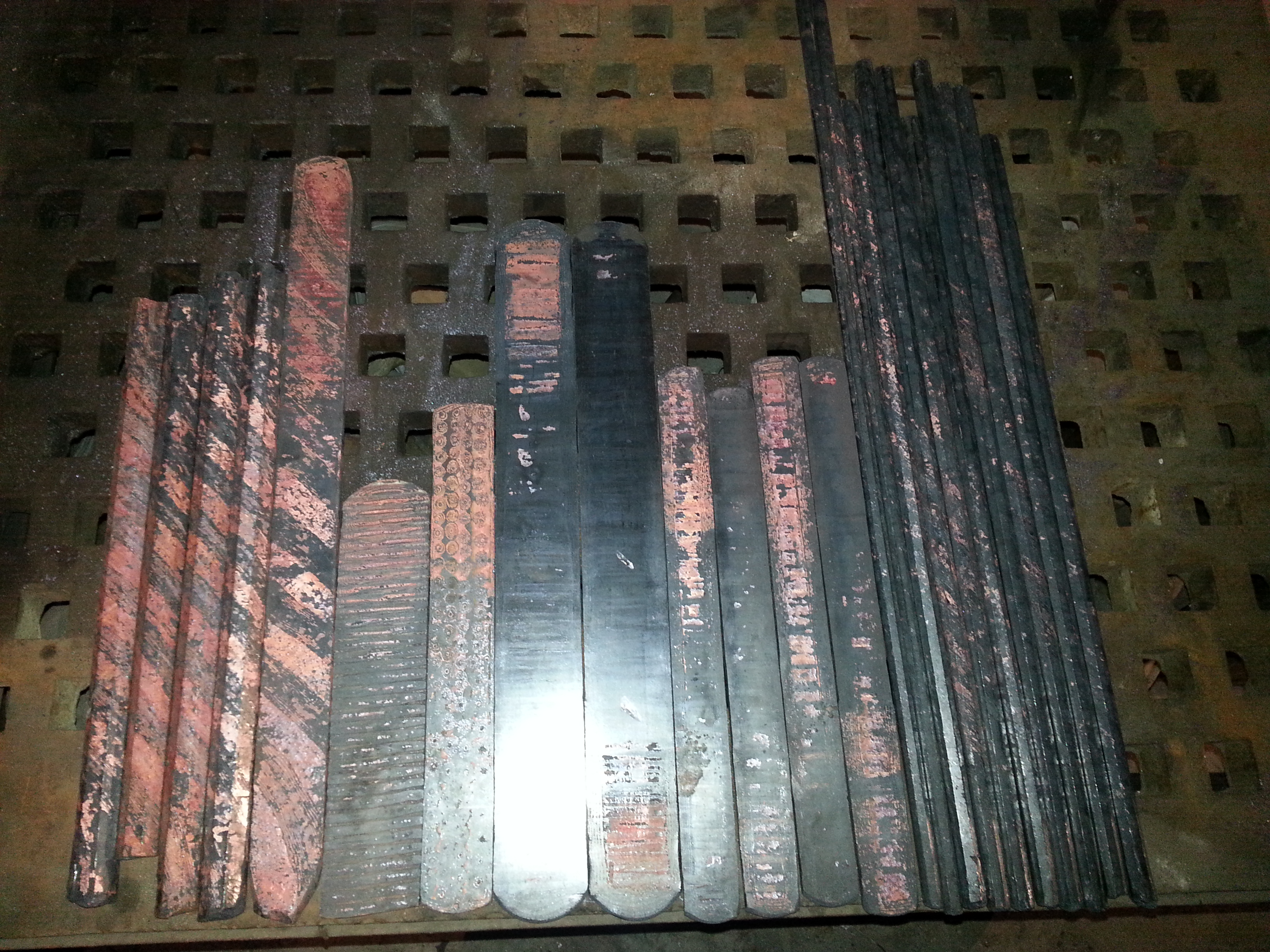
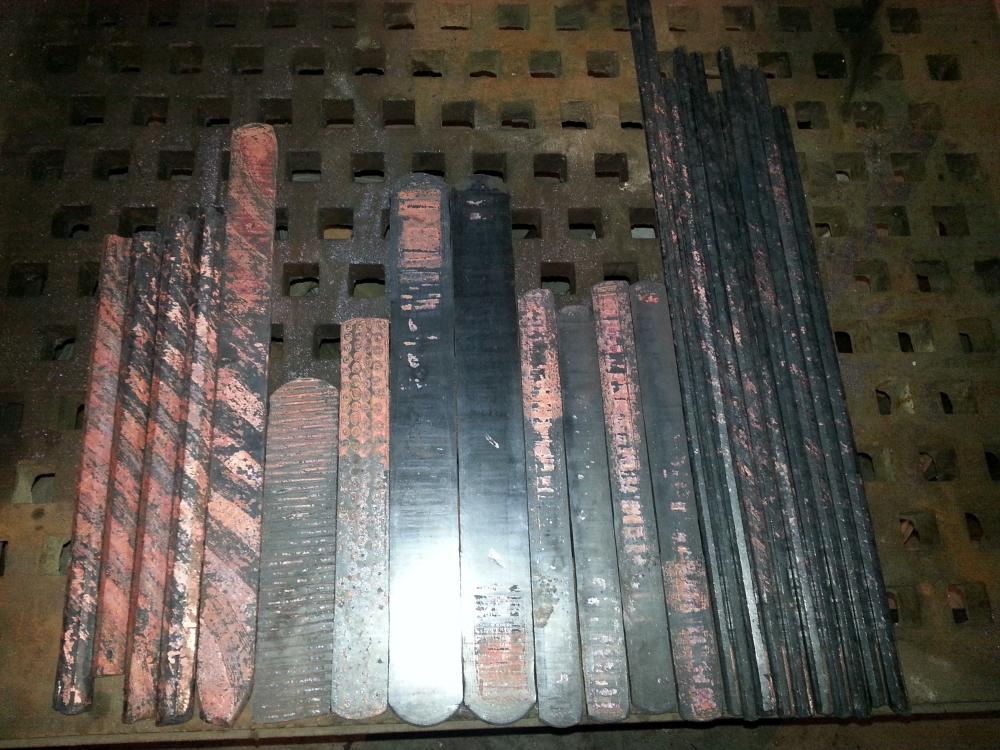
Frosty- I think you got most of the diffusion stuff right. Diffusion rate is temperature dependent. The higher the temperature the faster the diffusion rate. As you already noted, solid state welding can occur with little or no diffusion, as in the case of galling of threaded components. Once the initial atomic bonds have been made across the interface you have solid state weld. That usually will strengthen with time at temperature as diffusion occurs across the interface. However, there are some systems which will form intermetallic compounds which could weaken the interface. In those case, you may want to avoid diffusion. I should point out that in Chad Nichols video on mokume he does use a fairly short time in a gas furnace, less than 30 minutes I think. His furnace temperature was very close to the melting point of copper and his first squeeze on his billet, while still clamped between plates, was done in a hydraulic press. Most of his forging of mokume was done with his presses, which I found to be terribly slow for this kind of work. Attached is a picture of what I forged Sunday afternoon. This is the product of 15 billets originally 2x2x6. about 8 solid hours of twisting and forging.
-
When I was a student I used to go to Research Alloys in Columbus, but that was 15 years ago. Don't know if it even exists by that name anymore. The other place I went a lot was the Welding Engineering department at Ohio State. That was before the moved to the new facility on the east side of the Olentangy River. I'd still check in with them. Ask to speak to Larry Heckadorn. Another place I went was First Street Recycling in Dayton.
-
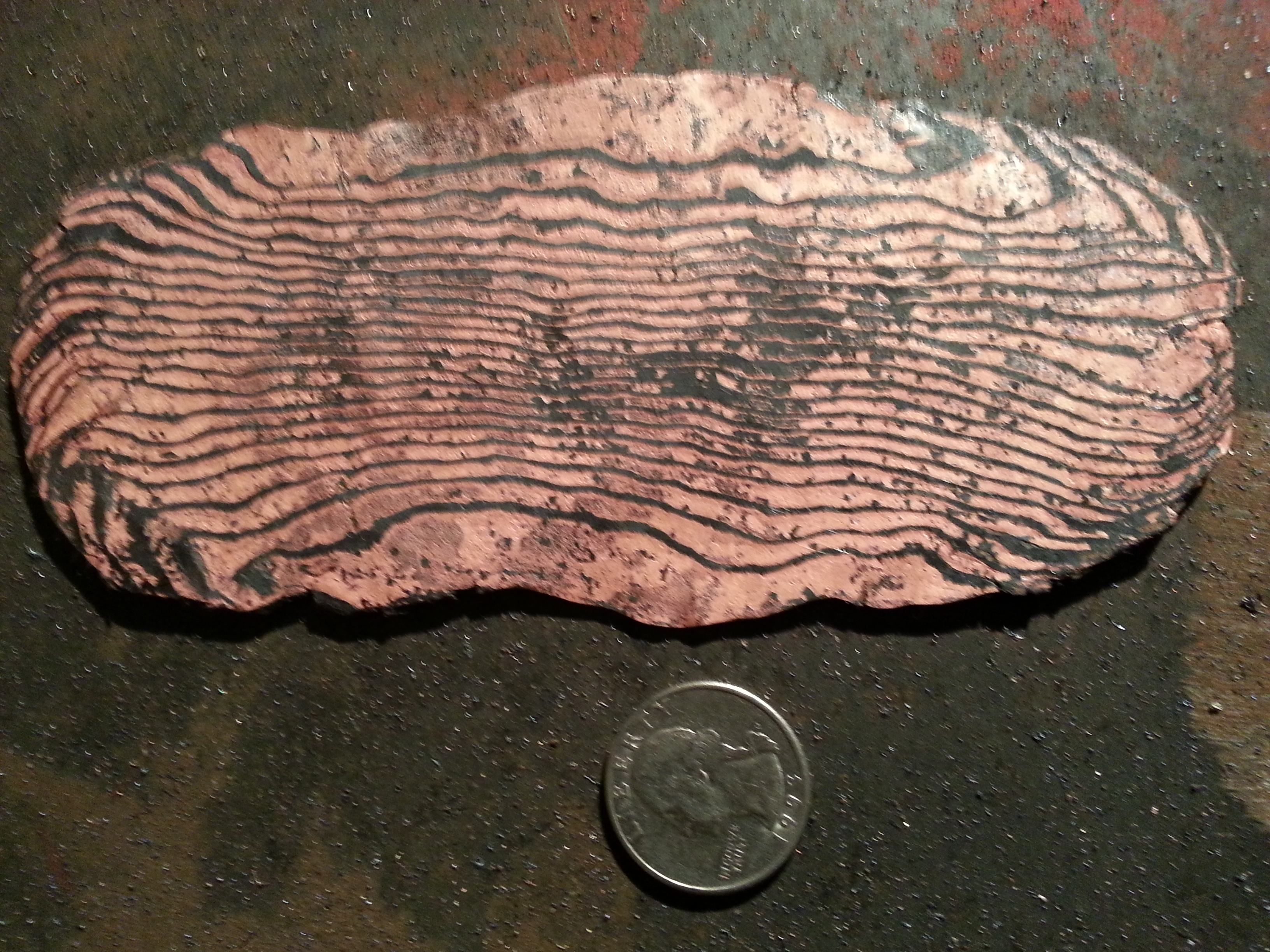
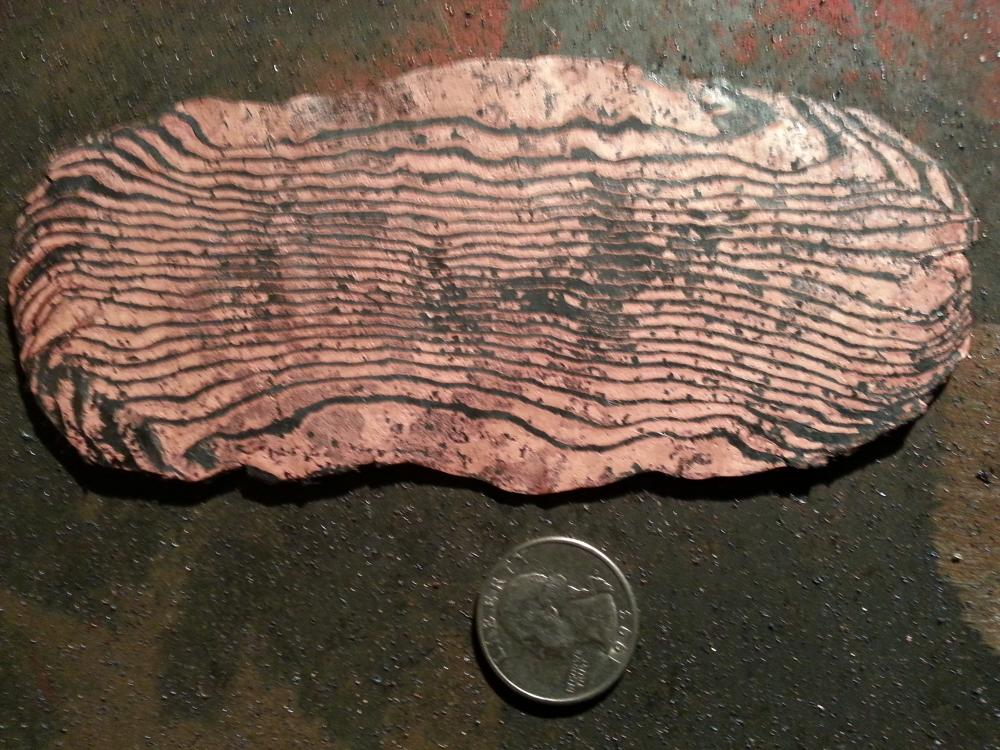
Frosty- If you don't have a copy of Solid Phase Welding by Tylecote I highly recommend it. In the case of solid state bonded mokume, you do actually need a fair amount of time to get a good bond. This is because you don't have intimate contact across the interface to start even when clamped in the torque plates. The high points of the interface will bond first, but then you have to rely on diffusion for that interface to grow across the entire surface. This is some what similar to what happens when you sinter metal powder.Plus, if you do have any contamination on the surface, the diffusion process will help integrate that into the bond. Diffusion is a slow process, especially for metals with large atomic radius. (Side note, look up Fick's Law and use it to calculate the time needed to develop a case depth of 0.050" in carbon steel at 1700 F). I bring that up because carbon is one of the smallest atoms commonly used in diffusion processes. Copper, Nickel and silver are all much larger and will take much longer to diffuse than carbon. As long as you have not developed a liquid phase at the interface, you are dealing with diffusion bonding. To illustrate the strength of mokume made using the diffusion bonding process I described earlier, I did a little experiment. I trimmed a 3/8" thick slice off of a 1.125" octagon bar I forged this afternoon. (Starting cross section was 2" square.) I forged that slice by upsetting perpendicular to the plane of the bonds and got the little sheet shown in the photo. The thickness varied from 0.020" to 0.050" (I don't have a rolling mill to make it uniform and was in the middle of some other work so I didn't try to take it any further). As you can see, the bonds help up fine. There was a little bit of separation near the edges, but nothing severe.
-
For the copper silver billet noted above, you will get a liquid phase, just not with solder. The copper silver forms a eutectic and that does liquify unless you keep very close control on the temp. For the diffusion bonding method, hold times are usually about 2 hours for a billet 2 inches square. Hold temperature depends on the materials in the billets, but you want to get about 25 F below the melting point of the metal with the lowest melting point in the stack. The billets I've been working are either copper/nickel silver or copper/red brass/nickel silver. As to using a gas forge, yes you can but uniformity of temperature can be very difficult to achieve in gas which means you have to frequently flip and rotate the billet. Chad Nichols shows this method in his video on making mokume. If you want try the gas approach I strongly recommend putting some thermocouples in your forge so you know exactly what is happening. I did that recently with mine (for forging purposes) and it has been very helpful.
-
I have forged several thousand pounds of copper based mokume billets, all made with the diffusion bonding method with no additional solder. As long as the surfaces are kept extra super clean, you get a fantastic weld. I have no trouble doing agressive forging, twisting or upsetting with these billets. If you are trying to run a lot of pieces with predicable results every time this is a great method to use. It can be made very simple by the use of an electric kiln with good temperature control.
-
It is highly unlikely they are carbide nodules. It looks like you just got a thick layer of oxide on the your work and your haven't ground it all the way off yet. It looks like you etched it to get the scale off and that left the texture. Ball bearings are usually 52100 thought they don't have to be that grade. Since that is a 1% carbon steel, you need to keep the forging temperature around 2100 F, about 200F cooler than you would for low and medium carbon content steels.
-
Smooth Bore- I did address that a few posts up. The 300 series grades are alloyed with much more nickel than the 400 series. That alloys them to be austenitic to very low temps and keep their ductility bu they are realatively week. The nickel also aid in corrosion resistance. The 400 series lack nickel but are still stainless. Becuase they don't have the nickel they can be heat treated to develop martensite. Good for wear resistance and edge retention. However, they are not as corrosion resistant as the 300 series materials because they lack nickel. But that also makes them cheaper. 17-4 is in a family of stainless steels which are called martensitic precipitaion hardening. They are low carbon, but do form martensite. Instead of tempering them to reduce hardness, you age them to allow copper based precipitates to form and add stress. This improves the hardness and strength. They are also in the low nickel catagory so corrosion resisitance is coming from chrome.
-
The one on the stand has a massive weld right through the waist which is pretty typical of later Trentons.
-
It looks like the repair was not done properly which resulted in the crack. Personally, if machining costs are too high, have the machine shop just make the dove tail section. Then get a flat block and bolt or weld the dove tail in place.I'm not a big fan of combo dies so I would not try to recreate that feature in a new die set.
-
The reason the tubes filled with objects approach is less desirable than a solid block has to due with the fact that those loose objects will not move with the housing when the ram contacts the anvil. Since objects at rest tend t stay at rest when impacted, the mass resisting the force of the ram must move as a single unit. If not, then the filler material will stay at rest while the housing moves. This is the exact same thing that happens when you accelerate rapidly while travelling in a car. You (the filler material) tend to stay at rest while the car (anvil tube) accelerates. The result of this is that you are forced back into your seat during the acceleration stage of travel. In the world of hammers, efficiency is all about resisting the forced exerted by the ram and transfering that motion into the work piece. That is accomplished by the anvil which needs to be large enough to resist moving. Chambersburg Engineering published data showing that maximum efficiency was reached when the anvil wieghed 20x the ram. That was for steam hammers doing industrial work with industrial foundations. For a Rusty style hammer, you may find that the maximum efficiency is reached with a different (likely lower) ratio due to other losses of efficiency within the system.
-
From a metallurgists point of view 304, 316, 410, 420, 422, 440 (A, B, C) S32550, S32205, S32750 etc. are all types of stainless steels. The % of the various elements is widely different in each grade or grade family by they all are both stainless and they are all steel. The difference in scrap value is due primarily to the nickel content. The difference in function is that the 300 series grades are austenitic, which means they have very good ductility, even subzero temperatures. The 400 serials, most of which will transform to martensite, are not nearly as ductile, nor as costly. They can be made much stronger than the austenitc grades but they do not have the same level of corrosion resistance as the austenitic family. The last group are Duplex grades which means they exist as combination of austenite and ferrite. They have very good corrosion resistance and strengths similar or somewhat higher than the 300 series but are less costly due to a lower nickel content.
-
You wont be disappointed. Contact roger degner for dvds of cliftons public demos. I think there are 6 or 7 available.
-
I like big fast hammers so personally I'd go for the bigger one. BUT if your compressor isn't big enough for it you won't be happy with it. I'd definitely defer to John and his expertise. If you have or are willing to get a compressor to run a bigger hammer and your budget will allow for it by all means do it. You will not be disappointed. By the way if your willing to invest in an ironkiss dont make excuses about the cost of cliftons tapes. To get a similar amount of info I took a 3day class with steve parker another industrial smith and invested 10 times that amount in tuition and travel. I have since met Clifton bought his tapes and all the tapes of demos he did for clubs over the years. The quality is often poor but you can still learn a tremendous ammount. In his club demos he often covers things not covered in the more formal tapes.
-
I have many items on wheels, but not all. The vises are mounted to stands bolted to the floor but those bolts can quickly be removed and the vise slid out of the way. I just built a new propane forge and it is on wheels. Probably the best thing I did was to put my welding/layout table on wheels that are retractable. That bench is 5 feet x 8 feet with a 3/4" thick steel top. It is mounted on some old machinery base that is a fair bit smaller in both dimensions, so I put a set of semi truck jacking legs on each end. I shortened those legs and added 8" casters. The table rests on the original base when the wheels are retracted but can easily be moved when needed.
-
Most tools that I use under my hammer are either 5160 (or similar) or mild steel. If 5160 I forge and air cool then use without heat treatment. For hacks I do use H13 but, and this is very important, using a hardened tool steel under the hammer is significantly risky. If you use a hack taller than your work piece you can drive the tool into the bottom die. This will result in damage to either the dies, the tool or both and could involve shard of tools steel flying around your shop. For your size of hammer and the size of work it will handle, I'd suggest sticking with the 5160/car spring/axle suggestions. They will wear out faster, but they are less risky.
-
WOW! I like it! Reminds a bit of the original Bradley design, but without the cushions. Also brings to mind the water powered hammers that predate the mechanical. Very cool!
-
Josh-The one thing I remember from the patents and liturature I reviewed about Fishers when I did my school project was that they designed the metal flow in the mold in such a way as to wash over the plate. I would think that would be extremely important, especially if you are going to preheat the plate. The washing effect will help remove the iron oxide layer that will otherwise make it difficult to get a good bond. Patrick
-
Oil quenching in a plastic bucket with an audience.
-
I think you're going to have to pull that out and have it ground. Depending on the size after that, you may need to have it chrome pated and ground again to get it back to the original size.
-
I attempted to do this as a senior project when I was getting my metallurgical engineering degree, but rather than an anvil, I used a generic square type shape. I used 1" thick S7 tools steel and built a variety of pattern heights. I worked with a local foundary pouring steel. The goal of my project was to see how much metal (height) was needed to bond to a room temperature steel plate. I triied a variety, up to 8" I think. None of mine bonded, but in doing the subsequent metallography I discovered the foundrymen had added a coating to the plates preventing them from bonding. Apparently they mistook them for steel chills that they use to locally cool regions of castings more rapidly and in that application you don't want the block to stick. What I did find out was that at 8" thick using liquid steel you do have enough metal to heat that plate to around 1800F. I know what I did is not exactly how Fisher's were made, but it was still a cool project and I do think you could design a mold system that would allow a room temperature steel face plate to stick to a low allow steel cast anvil.
-
I'd avoid rubber stall mats as I find them a bit too squishy for this application. hardwood planks are a very good choice have a proven track record in this type of service.
-