
evfreek
Members
-
Joined
-
Last visited
Everything posted by evfreek
-
I recently had a few bad experiences with gloves. The big box stores' gloves are getting a little lower in quality. Be careful about chiseling hot with the cheap leather gloves. The cloth backs are thin enough to let enough infrared radiation in to burn the backs of your fingers. It appears that this cost saving measure is recent. Cloth jersey gloves are much better for this kind of protection, but... the cloth jersey gloves sold in the cheap stores often have a little bit of polyester in them. Not enough to make them a fire hazard, but the polyester thread is used to hold together the cotton structure. One little flea (very familiar to those working with BBQ charcoal) will cause one of these gloves to unravel in a line similar to unzipping. A pair of gloves will only last one session . Recently, I fire tested an old 100% cotton glove by putting it next to the forge fire. It caught a lot of fleas and was pockmarked with burn holes, but it did not unravel. Eventually, it flamed up and was half consumed. It took quite a bit of abuse, and I would not be hesitant to wear these when forging. Unfortunately, I can only find these online now, and they are pricey (Made in USA)!
-
I don't know all the details of your situation, but the big thing that parents are worried about in their kids is poor attitude and attention span. Current culture glorifies this as a "virtue", so kids are receiving a mixed message. I recall speaking with a soccer mom at the local elementary school about the virtues of respect, obedience and patience. She blurted back, these aren't virtues, they are backward, outdated weaknesses. But, these virtues pay dividends, and one of the key ones is achievement based on accumulation. Blacksmithing follows this path, in which future learning is built on a strong foundation. So, if you quietly show determination and forward progress (watch the movie "Meet the Robinsons"), minds may change. I was once assisting a young boy. He was able to use the hammer and judge temperature. He even made a usable tool. But, he was too impatient and emotional. I gave him an exercise which helped a lot. "Hit the X." I drew X marks in pen on a 2x4. Then, I asked him to hit them with a hammer and observe the dent. At first, he protested, saying that he wanted to hit hot metal. Eventually, he agreed to do the exercise. Hammer control was secondary, the real goal of the exercise was self-control. Of course, this lesson teaches both, but what he really needed was the second.
-
Hi. I made a simple touchmark. It was not easy, and it took me a few hours. First, I fullered and drew down a piece of 3/4" S-7 to a long taper. I cut off the long taper, and ground it into a lettering chisel. It was severely heat checked and cracked, probably from enthusiastic double striking (which it required to draw down). I then heated up the thick tapered, fullered piece to yellow, and carved the design with the newly made chisel. Then, sanded it and cleaned up the face, and tempered at 1000F in a muffle furnace. It works fairly well, but not as well as the $195 professionally made one. The problem is that the lettering is deep but the accents are shallower. Sometimes, if the tool is cocked, the accents wash out on the high side. I have tried a professionally made tool, and it has similar problems, but not as bad. This tool works a lot better with a striker for just that one blow. I suspect that a treadle hammer, any cobbled design, would work better. Also, I would like to clean up a couple of the accents. The tool is good and hard, so I have not figured out how to do this yet. I am thinking of two harebrained ideas: tooth off a junk carbide table saw blade, or a poor mans EDM (tub of water, and beefy battery charger). C'mon, it can't be all that bad. My homemade thermocouple welder works just great. As for the cost, it's not worth making them for sale, but it is worth making one for yourself. It is that kind of pride of ownership thing. My advice for making your own is do all the engraving in annealed steel. Don't do it hot. Then, heat treat.
-
Hi. Thanks for the replies. I did a few scaling calculations, and agree that 16 ga. is all this thing can cut. The problem is the long end (6") that protrudes past the pivot. This is just too weak. In order to cut thicker stock, it either has to be shorter, or bigger, or made of steel. I think that this is a Popular Mechanics type of article, and I have found these articles to be somewhat spotty in full disclosure. Somebody once told me that you have to be an engineer or scientist to make some of them work, since they require extensive modification. Similar to Harbor Freight "kits".
-
Hi. I saw these plans on the a www site. http://www.blacksmithing.org/projects/SN24BenchShear.pdf What would the capacity of them be? It says that they can cut more than tin snips. About all I can figure out is that bulldog snips can do 16 ga with about 6x2 = 12 compound leverage. This shear has 10.66 X leverage, but it uses arm power rather than hand power. Probably no more than 4 X given the cross-section of the muscles involved? Recently, I needed to cut some sheet metal which was thicker than the capacity of the typical compound aviation snips 15 ga vs 18 ga. There is no way that the snips can cut 5/64" sheet. I used an anvil and cold chisel according to some instructions that I saw on an armoring site. Just score the metal, and it will crack. No jagged edges. It worked just great! Just like a weak cold shut on a forging goof-up. But, it would be nice to have a set of shears with better capacity than tin snips.
-
Hi m brothers. Very cool :cool: ! Thanks for showing what you have. To clarify a little on what Mills said, yes, he is right. That is not a drift. But a lot of people call it a drift. Even I call it a drift, and, that is technically wrong. A drift is shot all the way through the hole, and out the other side. Therefore, it requires a taper on both ends. Here is why I call what you have "a drift". To me, a drift is the tool used to shape the hole to the final size. For example, I would use a torpedo drift to make the hole in a pair of tongs. But for a hammer, I prefer to "drift" the hole from both ends without hammering the tool all the way through. This produces an hourglass cross-section to the hole, and helps the head stay on the handle a lot better. So, I punch, then drift, then heat treat. This is not the only way to make a hammer, though. The Dream Team has a different approach that uses a real drift. When the drift is in the hole, you spread the cheeks with a cross pein hammer. This gives the hammer a "cheeky" look, not a "clubby" look. In my opinion, it looks a lot better, and the Team points out that the cheeks make the hammer grip then handle better, especially when starting with smaller stock. The third step is my second step. Go in with the tapered tool (not "drift") and make that hourglass shape. Although this three step method produces a beautiful and shapely hammer, smiths have warned me not to do this on top tools, since it makes them liable to buckle at the eye. One fellow I know has an 8 pound one hand sledge that he will use to hit a top tool made from 7/8" stock. If you spread the cheeks, you might buckle around the eye . I still call it a "drift" by habit. And I still get corrected. And I still admit they're rignt :)
-
Buying a Miller Thunderbolt (AC buzzbox) off craigslist for $100 spelled the end of the pretty poor efforts to make a homemade welder. That Miller is just great for everything except small stuff. I just saw an AC/DC version for $125. This is a real bargain. craigslist is great for these used buzzboxes. No need to pay full new retail. On the other hand, for a high end welder, it is probably better to buy new. You see Miller Synchrowaves for sale at 70-80% of new price. Too risky. I think that I will resurrect the homemade welder project to make a micro welder. Got the argon and the flowmeter, just need some consumables. But it sure is nice to have a real welder to get that "must-do" fabrication stuff done.
-
Hi Rusty_iron. Thanks for the confirmation. I am glad that I made it sturdier. Making a flimsy tool holder certainly did not help when it came time to get a stuck chisel out of a hot hole. Yes, the chisel was cooked and notched . But I fixed up the tool holder and corrected the slop. That was important. This seems to be less important, but I guess I'll find out when I use it. I have used S-7 for a lot of tools. It seems to work pretty well. Certainly a lot better than mystery hardenable rebar or jackhammer bits. It holds up to the heat a lot better without getting ruined. But, if you get it good and red in use, it can get goofed up, even if it does not seem to move below a bright orange. I still have to fix one punch that I got a little too hot. I hear H-13 or M-2 is better with the heat, but I am afraid of the brittleness. Also, the M-2 needs a pretty high temp for secondary carbide precipitation, and my shop isn't quite set up for that yet. HWooldridge, thanks for the welded handle idea. I was afraid of welding to the tool steel, but if it can be rewelded every year, a little cracked weld can't be that bad of a deal. I don't have a power hammer (yet), so I am not worried about long flexible handles yet. I will give the welding a try, though.
-
Hi. I tried making a hack tool (don't search for this on the web, all the hits will be irrelevant ) according to blueprint BP0492. This looks like a pretty good idea. Instead of leaf spring, I used a slice off the end of a block shaped drop of S-7. Took a while with a hacksaw, but this builds character. The piece needed to be drawn down to a flat which was thinner and longer. Pretty hard work. Then, the tang was set down on the side of the anvil. Not enough spare steel to do any cutting. The tang wasn't so tough, it was the drawing out. Furthermore, the offcut was just a little stub, so I had to make a set of pincer tongs to hold onto it for the initial drawing. At least I have a nice set of pincer tongs now . The fit of the tang into the block of wood "like a file" was a little too much like a file. Good enough for a file, but kind of loose and sloppy for a hack tool. I think it needed a little more substantial of an attachment point. So, I turned down and put an extra long ferrule, and wedged the end with fruitwood wedges and epoxy. It took a lot of time, but it is a lot more solid now. Some top tools are safe to use loose; is the hack tool like this, or does it benefit for a more solid attachment? I feel that the latter is true, but don't have much evidence yet.
-
Pacific Machinery and Tool is offering 25 lb bundles of tool steel (H-13, S-7) on Ebay for $25 plus 24.19 shipping. I was interested in hand tools, but they said that the pieces are big. One piece per order, could be up to 2X3x27. These might make good block anvils or anvil tops. Why does a medium piece of steel bedded in concrete make such a good knifemaker's anvil? Wouldn't the concrete crack? It turns out, for hand hammering, not really. A simple calculation of the impulse force shows it to be below the safe compressive strength for concrete, neglecting side friction. What's a good way of heat treating one of these big pieces for either a block or a hard top? I have heard that dunking causes cracking, primarily due to large vapor pockets, but a spray might work. These tool steels are deep hardening, so the firehose trick may not be necessary.
-
Hi Tim. I saw this advice elsewhere and figured it was a good idea. I tried it out and it worked GREAT! I wore my leather apron, gloves and a face shield, and used a premium knotted cup brush. Very controllable. Keeping out of cracks and using light pressure wore the wires uniformly, and there were no flying wires. I did worry a little about the absence of a guard. :confused: But, the HF variable speed sander is so weak and slow (on the "2" setting) that it is very controllable. Never even came close to getting away from me. But after a few minutes, I did smell that familiar "HF is working too hard" smell. If I take a lot of breaks, this tool will probably last for a good few hours, and that's a lot of safe® wire brushing. Do you think it's worth cobbling up a little guard out of sheet metal? They don't get in my way, but I hear they don't help much when you are going 10000 rpm.
-
Hi Kevin. I haven't looked at the book you referenced, but habu posted a book on the Free Blacksmithing Books ... thread that I really liked: Oxy-acetylene Welding Manual - Google Book Search I especially liked the section on welding cast iron. By the way, these old books predate backflow preventers and flashback arrestors. And, they discuss acetylene generators, which are obsolete (at least in most places). I run a torch without either kind of check valve, and feel quite safe. I just do not do the more risky operations. No acetylene, no welding, no heavy cutting with high oxygen pressure, don't let oxygen go below 25 psi , let the propane tank exhaust itself on the forge (not the torch). If I need any of the above, I borrow a friends set with the combo valves (Victor).
-
Hi Chris. Here is the link to the photo of the tool holder in the gallery http://www.iforgeiron.com/gallery/showphoto.php?photo=4815&cat=500
-
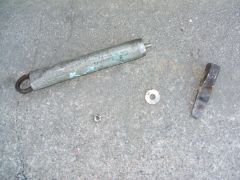 This is a holder for a punch or chisel. Also shown is the chisel. If the tool is too short, like the one shown, it gets knocked loose easily.
 -
I made a tool holder using BP0210. It looked really good, but when it was used, an interesting problem appeared. If the tool is too short, any errant blow of the hammer will cause the tool holder to lose its grip on the tool. This can cause a punch to get stuck in a big piece of steel. Other blueprints point out that the tool should protrude fairly far above the holder (like about 2 inches) to prevent the slipping from happening. It may also be useful to grind a small notch for the nut or eye to grip onto to help prevent slipping. Tightening the draw-bolt may not be enough. For really short tools, a pair of punch tongs and a slotted tool may be useful.
-
Hmmm. These prices look higher than what I remember for Speedy Metals. Especially the prices on tool steel. I recall that you could get better prices on Ebay (from Speedy Metals).
-
Hi texassmith. It all depends. A 30 minute longer drive is not all that much when it comes to buying the right fuel. It is a lot further for me, but I just buy more when I go, and I make sure not to run out. There are lots of different kinds of coke. I have heard that TX has a lot of L-brand forge coke. This is supposed to work well, but might have some popping if you don't know how to warm it up. I tried using some Buckwheat coke in Southern California, and I really did not like it. Huge clinkers, couldn't weld, and if you turned the air blast up too high, it spit molten rock. Got one of my worst burns that way. But others swear by it, and I saw someone do a fluxless weld, so it must be the smith. But, I have been able to get welds with mesquite charcoal, oak charcoal, homemade charcoal, Utah Elkhorn coal and propane. For this reason, I wouldn't drive out of my way for coke, but if I scored a bunch cheap, I'd run off to somebody who could teach me what I'm doing wrong. Try a bit of both, and if it doesn't work, just forge with it or give it away. One sack isn't a tragedy to get stuck with.
-
Hi Hoary. This is a very interesting thought, and I would like to investigate it further. The problem about the acid removal of galvanization is that it releases a fine mist of dilute acid droplets, which is corrosive. It also releases hydrogen, which is explosive. Finally, there is that stupid waste liquor which has zinc chloride in it. As far as pollutants go, zinc chloride is not that bad, but in a low pH waste product like this, it is more toxic and can release other worse heavy metals from the environment due to the acidity. So, I looked into electrolytic methods to remove galvanization. What I found was very interesting. The reaction produces metallic zinc, so it does not have the energy to atomize hydrogen as badly. Most of the electrons emitted at the cathode go into producing metallic zinc, and not hydrogen. Furthermore, zinc does not accumulate in the effluent. The metallic zinc that is produced is usually fluffy and amorphous, more like a gray sludge. If this is bagged, it represents a huge reduction in volume and toxicity. But, can this product be used? Forget about that old Scientific American publication on rocketry. That is too dangerous. Instead, I propose using the sludge, which will be about 95% metallic zinc with the principal contaminant being oxygen, as an additive to blacksmith paint/primer. Finely divided zinc, in the correct base, has beneficial effects in outdoor primers. The main reason that this reclamation process is not used commercially is that the electricity costs money, and it takes up time and space. I would feel better about spending a small amount of money on electricity and reusing my derusting setup to capture some of that zinc into metallic sludge. Any thoughts? :)
-
Whether a repair is successful or now depends a lot on the cleanliness and geometry of the piece that you are trying to repair. Also, it depends on the type of cast iron. Malleable iron is pretty easy to weld. This is what is used to make iron pipe fittings. The welds will stick well, but cannot take any bending. Some cast iron will froth up if you try to arc weld it. This kind requires brazing or maybe the special rod. Oily cast iron which has soaked up contaminants is difficult to weld. I have heard a trick for brazing cast iron with a lot of carbon which involves using copper oxide to oxidize out the carbon, but cannot remember it. I successfully welded a broken cast iron vise I found out in the street. It was cracked in many places, and I didn't notice until I hammered on a hinge in the jaws. The base cracked in two places, and the vise was wobbly. So, it had to be fixed. I tried brazing it, but it did not work. Then, somebody suggested that I just weld it. I used 6013 at low amps and it worked! First, I veed out the cracks with a grinder to get all the junk out. Then, I buried the vise in gravel/sand so that only the weld areas were showing. Then, I gave it a good preheat with a propane torch, all over. Then welded, avoiding blasting an area and causing excessive penetration. Immediately after welding, I peened HARD with a ball peen hammer. Hard enough so I was afraid of breaking the base. No loss anyway. Chalk it up to education. Finally, after it was all welded up, covered it completely and let it cool overnight. The welds looked terrible, but they held! Several years later, I found a real vise at a garage sale, and sold the welded one for $10. It had served me well for filing, drilling, grinding, bending, everything except hammering. I learned my lesson. The post vise is for hammering.
-
Hi. I asked a very similar question to the local blacksmith recently. He recommended against it. He said that a lot of blacksmiths were familiar with the "hide the arc weld" type of collar. These collars are very strong, and will not twist out of line (weakest part of a collar). Usually, these are applied in places which are kind of tricky to put a forge weld in to. His suggestion was to dispense with the idea entirely, and replace the joint with a split leg tenon, with the leg riveted in two places. Collars are more appropriate in locations where the twisting moment is neutralized at the end of the lever (bar).
-
That's a good idea, Thomas. I also have a good relationship with the local welding supply, and I can rent tanks at a pretty good short term rate. That would be good for a cutting "party". But, I don't have a pickup truck or trailer, so hauling those big tanks can be a chore. There is a local arts consortium which always has 5 240's filled up. I can go there to do bigger work. They offered me one of their "restricted bottles". You can only fill at one dealer, and they charge double. That tank almost never gets used, since the deal is so unfavorable. I need a truck ;)
-
Hi. Thanks Irnsrgn and tbrforge for the interesting application stories. I have a coworker whose dad works in a scarfing mill, and he has some interesting experience too. Yes, natural gas is cheap, but it uses more oxygen. I suspect that if the usage rate is high, natural gas-oxygen is the way to go. Especially, if you have a deal on the oxygen. A lot of the big factories use PSA or on-site liquefaction which is much cheaper per cu ft than tanks. I got a quote from the local gas shop on plumbing a natural gas line: $800. I will have to monitor gas usage for a while before considering this. Also, around here, it seems that you cannot have an open gas tap like you see in laboratories. The installation has to be permanent.
-
Hi. I bought a drill from a flea market vendor, and she was also selling a National hand torch with a small oxygen cylinder. She said she'd sell it to me for $65, so I figured it was worth a try. I connected it up to a 20 lb. propane tank, and although adjusting the fuel was kind of tricky, it made a nice blue flame . I tried it out for making some minor adjustments on my plant stand, especially on the hook ends and collared leaves and vines. Wow, this thing is great . It really beats jockying things into the ground forge! I saw something on the web about using forge burners, firebricks and an acorn table to save a factor of 10 over the cost of a torch, but I don't think so. The venturi propane burner is cheap ($1 per 9 cu ft), but you have to run it a lot longer and heat up a lot more stuff. But, this little torch does eat up the oxygen. When using propane, you need more than 4X the oxygen flow rate over the propane flow rate to achieve a neutral flame. The torch had the OX-3 tip, which worked for 1/2", but was great for the 1/8" vines and 1/4" leaves. This meant 3 CFH propane and 12 CFH of oxygen. That's a lot of oxygen for one of those small tanks. So, I started looking into other gases. Acetylene is not allowed near my house, so I looked into MAPP. This requires only 2-2.5X oxygen for about the same heating rate. But, the MAPP is much more costly. It is about $9 per pound (8.7 cu ft) in the disposable tanks, and $29 for a 7.5 lb tank with $55 refills. If one approximates $10 for 40 cu ft oxygen, this is still more expensive than the propane per BTU or per hour. So, I wonder if any of those brazing fuels are better. Especially the ones that are mainly propane. Oddly enough, these advertise lower oxygen ratios and substantially higher flame temperatures than propane. Does this make sense in theory or practice? I am looking at things like propylene, chemtane, flamex, hydroflame, FC-2 or razor gas. Has anybody tried these out for heating, and if so, how good are they?
-
Different rebar can vary in quality. I found a pretty long piece of 5/8" rebar in a construction dump pile when I was just starting out and just had a little railroad track anvil. This turned out to be fairly high carbon, and I just blamed my tools. Later, when I was in a real blacksmith's shop, I needed a punch to make a pair of tongs. The smith would not let me use his punches (beginner ) or his junk coil spring. He gave me a piece of mild steel to make a punch out of. This lasted long enough to make the tongs, but it was in sad shape. I remembered how easy it was to forge, though. Later, I spark tested the rebar, and found it to be moderately high carbon. It hardened well, and made MUCH better punches than the mild steel. This was really an eye opener about the differences between different compositions of steel. I save that piece of rebar for making tools only. Recently, when I went to a conference, a smith pointed out a pouch with Dorothy Stiegler's tools, and said she was nicknamed "Rebar Queen". Well, that sold me .
-
Hi Pam. Yes, this does work. Use two batteries in series, and roll a thin layer of damp newspaper around the coathanger to make ersatz 6010. I think it runs DCEP. I use my car's battery, along with a carbon rod from a cheap Everready cell, to weld my thermocouples. Make sure to wear flash goggles if you do this!