evfreek
Members
-
Joined
-
Last visited
Everything posted by evfreek
-
Hi Dennis. I also took a high school metal shop class. The instructor taught oxy-ac welding in two lessons, which included flame cutting. The most important part is making a neutral flame. He spent a lot of time explaining why this is important and how to merge the inner cone and the acetylene "feather" to achieve it. Second, use the correct tip size. If the tip is too small, the temptation is to go oxidizing to get more heat. That's how you get the slag. To fix this problem, ask an expert or consult a tip chart. We were making puddles the first day and passing bend and break tests on coupons the second day. I skipped the test and made a watering can out of a bean can. No way you can do that with a stick welder, but you can do just about everything else .
-
Hi Ron. In my understanding, brushing with a wire brush while hot is only useful for removing huge buildups of flaky scale so as not to let it get pounded into the work or allowed to abrade the surface of a precious anvil. My striking partner adds that brushing scale off thin flat pieces is like removing an insulating layer and quickens reheats. For the purpose of finishing a piece, a hand wire brush is not really aggressive enough. It is hard to beat a power wire brush, but there are ways to make them safer. There is a great article by Peter Fels in a California Blacksmith magazine about power wire brush safety. He is a super friendly guy and is fun to talk to. His website may be reached through the California Blacksmith Association website. I have heard (and found) that power wire brushes do not really produce as good a finish for painting like pickling, sandblasting or vibratory tumbling. I seldom use a power wire brush, and have had one, fortunately minor, accident. It was due to stupidity, and it is pretty avoidable. I took a high school metalshop class, and although the power wire brush is scary, other tools are responsible for the lion's share of the accidents.
-
I wanted to temper a hammer punch that was forged for me as a demo. It is made of a piece of S-7 rod that I bought on EBay. When I got home, I snap temtered it with a propane torch, and the end still skated a file. So, it certainly was air hardening. Tempering S-7 requires several minutes at at least 1000F. This is difficult to do in the traditional manner (letting the colors run, then quenching). This temperature is well past light blue, and there is a grey sheen oxide coating, but not scale. I tried using an old toaster oven. This was just too scary. To get to 1000F, I disabled the thermostat and filled in both sides with rock wool. This would supposedly protect the plastic sides which held the electrical connections to the quartz tube elements. The connectors on one side of the oven were connected to the hot side with plastic/ceramic insulators, so I added a tin can heat shield inside the oven compartment, and wrapped the whold contraption in a fiberglass blanket and stuck a K thermocouple in the side. It did reach 1000, but it was smoking and popping like popcorn. The sensitive side of the oven was getting so hot that the plastic sizzled water. The front selas around the glass window disintegrated, and the window came loose. But it did get to 1000 for a few minutes. Not good for pratical use, and I feared that the case could become energized. Trying another approach, I decided to throttle down my mini-forge. This is made out of a 1 gal paint can with homemade refractory and a 1/2" naturally aspirated pipe burner. It works great for forging and occasional welding. I figured that I could throttle the flame down enough so that it would do 1000-1150F. I used a piece of 3/8" steel tubing as a thermocouple sheath along with single bead insulators on my K thermocouple and fired it up. There were two problems. First, it was very difficult to maintain 1000F with the regulator. There was a lot of pulastion at the low pressure (single stage regulator). The flame would flash back to burn in the venturi if I turned it down too low. Then, it would have to be reignited, since 1000F is too low to relight. Second, the opening, although scaled approximately to the burner rules (I plugged the back with a piece of refractory), lost too much heat. As a result, the tool, even though it fit completely in the forge, was cold on the end. Probing around with the thermocouple showed a nearly 250F variation in temperature along the tool Furthermore, the steel tubing did not help. Since it transferred appreciable heat down its length, the thermocouple read low by another 100-150 degrees. This made things kind of tough. At this temperature, the steel had a dim but visible dark red glow, so I knew it was in the ballpark. After about 30 minutes, I shut off the gas and let it cool. One nice thing was that ther was no overshoot, but why should there be? I guess I was too used to the heat the other end, let the colors run method. The tool was covered with a fine grey sheen, and a file could mark the tip but not cut.. So, it sort of worked out. Probably the tip did not get much more than 1200F, at least not for long. This was too hard! I think I need one of those heat treating furnaces with a door on lever hinges, like the Johnaon ones. How are the vents sized on these furnaces? 7 X the burner area? There is not much design data on the Internet. Only for the blacksmithing style forges. Maybe a kiln design would be appropriate. There are a couple of books at the library. Also, ithe more targeted configuration might work better. Burner spirals along the floor under a kiln shelf (or tile, if the temperautres are sufficiently low). Vent on the top keeps the cold spot away from the piece. Tile helps spred and make the heat more uniform. Another thing that I read was that at temperatures below 1100F, convection is the dominanant heat transfer mechanism, not radiation. So a fan is required to keep the temperature uniform. With a larger cavity, the burner could be turned up closer to its natural range. Does this sound like its worth the effort?
-
Hi Ron. Thanks for the pictures. The photo you marked as S-7 definitely looks like mine. I am pretty sure now. I need to retry the moly steels with an angle grinder. It has a faster surface speed and throws sparks further. In the old days, spark testers used a handheld cylindrical stone grinder, kind of like an ol' fashion' angle grinder. As for the second sample, I am not sure. It looks higher carbon. The only tungsten alloy steel I am familiar with is M-2, and it has 85 points. But it does not spark like that. It has short, thin reddish sparks near the wheel, with small bursts near the end. I wonder if this is a higher tungsten alloy like the T series. I do not have any of those samples to compare with, though. That S-7 was so hard to work that I don't think that I would make knives out of any hot work steel. I did make a HSS knife, and I have a big dead power hacksaw blade that I could try. The knife is OK, but it dulls rapidly, especially when cutting leather or durock concrete board . The older blades say "tungsten steel". I guess I should try sparking one of those to see what happens. I will take a piece of the S-7 to a blacksmith's shop tomorrow to play around with, and maybe make some tools.
-
Uh oh, not Tix. That stuff is really expensive. I think it costs more than commercial base metal mokume. I did see some other less expensive solders, like the cadmium silver for $159 per pound. That sounds expensive, so I might pass on that. The regular silver bearing solder, the Hi-Force 44 with 96% tin looks more promising. But it costs $73 per pound. Much less than the others, but still not worth it for sticking copper wires together. This does give me an idea, though. Something like fluxed spelter paste or waste drippings from soldering copper pipes. Got lots of that.
-
Hi. I have more information on this question. The short answer: it probably is S-7. I bought a bunch of drops from another company on Ebay. It was a pretty good assortment of various steels: S-7, P-20, 4140, 440 and D-2. Note that the martensitic stainless is impossible to tell by surface appearance or magnet test. Since there is no austenitic phase transition, the magnetic force is within 5% of any other steel. Unfortunately, they failed to mark the last three, but the chunk of S-7 spark tested exactly like the original sample I photographed above. Two different uncorrlated companies. That should be enough. This casts a lot of doubt on the old Blueprint (0020), since the molybdenum arrows are not nearly as obvious, as is the trend with composition. I sent back the other three to be marked, and the 4140 will really highlight the composition effect. Either the Blueprint has some "creative editing", or it uses a faster wheel speed, which accentuates the differences. For due diligence, I will redo the experiments with a faster wheel. One smith asked me why I didn't do a forge test. I couldn't get to the forge. Just yesterday, I did a forge test on the first sample. It shows all the correct signs. Start at low yellow, barely moves at orange, clanks like steel at red (hit carefully ). And, my striker suggested that I stick with simple carbon steels and buy S-7 tools pre-made. Cooled slowly in air, it skated an old file. We estimated it was about 3X tougher than 1060 using a striker.
-
Hi. I have a big coil of romex wire that I bought at a garage sale. It is much cheaper than penny's. It is just cut into segments of a few inches. When it is needed, it is warmed abouve the fire and just pops out of the insulation. Works great, and if you splash it around on dinged steel, it makes interesting accents for jewelery. But, you don't use it up all that fast doing a few little penny welds here and there. Someone posted a neat mokume video, and I wonder if a bunch of twisted copper wire can be consolidated with heat and flux into something like mokume. Or it only works with sheets due to the increased oxidation?
-
Hi Kogatana. I believe that your question is: is this piece wrought iron? Not: "what are the key alloy ingredients in this steel?" If it is the first, I saw a really interesting demo given by Phil Baldwin. It was kind of primitive (in a metalworking sense, not in a quality sense). No spark testing!!!!!!! He was working with two metals. One was wrought iron from a shipwreck, and the other was blister steel, both classic stocks of the old time blacksmith. First, he broke off the end of the wrought iron bar. Very obvious fibers were visible curving toward the break. Then, he heated and quenched both. The scale flew off the steel, leaving bright spots. The difference was *very* obvious. The demo was long (it stretched almost 3 days) but much attention was paid by the audience. As for your photo, it does not look like wrought iron to me. It looks like mild steel. There are experts here who know much better than I how to interpret the first photo. Oh, and of course, you could try a spark test . You also referred to etching and doing a metallurgical analysis. This is possible, but challenging. You will need to anneal and polish the sample, then etch with nital and observe under a special microscope. The magnification is not critical. 100-200X is sufficient, but lighting must come from above the subject. It may be possible to modify a hobbyist or inexpensive childrens microscope for this task. If you have any success at this, please post back as to your findings.
-
Hi Ron. This looks like the second method I listed. Great, glad things worked out. Looks like you are on your way :)
-
Hi Ron. Making your first set of tongs is a pretty abrupt introduction to making and setting rivets. When I made my first set of tongs, it was under the watchful eye of an instructor. He told me that I did not need a nail header, rivet header, bolster, or upset head. All I needed to do was stick a heated mild steel pin through the two tong halves and set both ends on the anvil simultaneously. Of course, it did not work. First you have to push the pin through so that an equal length is protruding on both sides. You do this with the pritchel hole under the tongs so that the pin will go through, else it will upset against the solid face of the anvil. Sounds pretty obvious? Not when you have a hot rivet in the pickup tongs, and you are in a rush :-0. Once I got past this snag, things went well. Refrain from hitting the rivet straight on more than once or twice, since it will only upset in the hole and make the tongs too tight. Instead, spread the head with off center blows delivered with a ball pein hammer. The rivet lesson was eventually successful, but many failures followed when I did this by myself. Obviously, many details were left out which proved to be essential. The failures all were the same general category: the control of the rivet shank was lost when trying to simultaneously put the heads on both sides. In fact, despite my best efforts, I was never able to duplicate the success of the lesson. I have attempted to rivet many tongs and other things from that time until now, and although I have failed on almost every one using this initial method, I have always been successful some other way. Here is why the "double header" method has been so unreliable. First, it is really easy to get the rivet off center. The fit in the hole must be precise. As I think back to the lesson, more time was spent drifting the hole than setting the rivet. The fit had to be perfect, and it had to be perfect when the pin was hot and the tongs were cold. A piece of stock was not adequate. It had to be slightly upset to produce the correct fit. Second, the amount that the pin stuck out on each side was critical. It had to be aligned so that the correct amount protruded on each side. If a little more poked out of one side than another, the method was prone to failure. Third, the length of the pin was critical. I suspect that the old 3X rule did not apply here. 3X or 1.5X the diameter sticking out on both sides was too much and prone to bending over. Once the pin bent over, it was extremely difficult to correct. I suspect that 1X is better. Fourth, any gaps between the tong half's was harmful. Often the pin would choose to bend in this area. If this happened, the job was very difficult, or even responsible to correct. In retrospect, the pair of tongs made using this method, even though initially considered successful, had an inordinate amount of slop between the half's after rivetting. Try this method if you'ld like. It is advisable to start with scrap. It has the advantage that no tools are required. It has the disadvantage that it is prone to failure if you are not really careful/skilled. Here is another method that has worked well for me. Use a pre-made rivet. Do not forget to cut it to the right size with either a hacksaw or the Hofi jig. This is an excellent blueprint. Use a bolster block in the vise with the correct shape for the head. Place a hot rivet with the tongs in the hole. Invert the tongs and nestle the pre-made head in the bolster which will have a matching depression. Quickly seat the appropriately sized monkey tool over the unheaded end of the rivet and give it a smack. This greatly improves the fit of the joint. In fact, when showing off, I compare the tongs done using the first method with a pair done using the second. The quality of the joint fit is unmistakeable. Then, head the rivet as above. One or two hits straight on to upset slightly in the hole, then several off center with a ball pein hammer. This method does a nice job. The bolster is made with a junk malleable iron pipe fitting, plug filled in with an arc welder. A bar is welded onto the back to fit in the vise jaws. There is another way to do this job with a completly different kind of bolster, which I can write up if there is interest. It also has a good track record, but it has two disadvantages. First, a different bolster will be required for each diameter of rivet, and second, the monkey tool does not work as well without modification. But, a commercially made rivet is not required. A third method is to use the split header as shown above in the photo. Good luck.
-
>cheaper to buy new steel with a certificate of analysis. It depends on how much you have. For example, S-7 in useful sizes like 1/2" round is $21.98 a pound from onlinemetals. It doesn't take very many pounds of this to add up to a test, especially if you have a buddy in the biz. I used to work with a guy who had an atomic emission spectrometer, and I would never have asked him to test my steel. The sample prep was just too expensive. But I hear that those scrap testers can do it for $50-70 a shot. I knew a fellow with 1500 lbs of single type scrap, and all he did was give the scrap guy a few pounds when it was found to be valuable. On the other hand, 5160 is a lot less expensive. Riverside Machine advertises it for $4.20 per pound in 5 foot sticks of 1/4x1. I know a smith who makes all his tools out of old coil spring. Some is good, some is bad, and he never buys stuff from the vendor. He can tell the difference between 1080 and 5160 by feel on the hardy as the steel is cooling down. Cracks? He lets the apprentices find those the hard way. Good learning experience. By the way, I doubt that the small vendors will provide you with certs. You really won't get those from the tailgater's either. But, maybe the more relevant information is when some bladesmiths get together and say: watch out, xxxx's 5160 has inclusions.
-
I think that the electricity issue in hardfacing or fabricating anvils is a myth. I fabricated one anvil, and added up the cost of electricity. It was neglibible (about one or two dollars, if I recall). I have a hard reference for this number if anyone is interested. It comes out of an old manufacturing technology book when labor was $12 per hour and electricity was 6 cents per kilowatt hour. I can provide it if there is interest. You probably guessed it. Labor is the main cost, especially if you use cheap (expired or wet?) rod. It is difficult to measure how much people value their time, but the best estimates I have seen are based on bridge toll avoidance. As for me, I would rather weld than drive.;)
-
X-Ray fluorescence is overkill for steel alloy identification. Niton will rent you a unit for as little as $1000/week. Anybody in? .... I didn't think so. Spark ablation spectroscopy is more appropriate for the blacksmith's requirements. For the cheap blacksmith, spark testing with a set of test coupons. Probably good for carbon, molybdenum, tungsten, but not vanadium or chromium. I decided to put together a little kit. Any interest or suggestions?:)
-
Hi Woody. If you look at BP0020 http://www.iforgeiron.com/index.php?categoryid=13&p2_articleid=350 it has some tips about recognizing molybdenum in the spark pattern. Especially informative are the pictures for 4130 (a standard chrome moly steel used for structural tubing), 4615 and 4640. So it should be possible to see. As for jackhammer bits, there is this phrase on the Internet called YMMV. It means "your mileage may vary". We have a similar expression at the office: "the data has noise". It basically means the same thing. There is a reason for the difference, but nobody knows what it is. And people use this expression with a straight face. I picked up a couple of bits from different sources, and they spark test very differently. The first, from a blacksmith shop which does bit sharpening, tests like 1070 with no distinguishing alloy features. But it is not 1070, and requires the services of my striker. The other one has a strange pattern where the main stream is almost completely suppressed, and all you see are reddish arrow tips. If this is S-5, there is no mistaking it for any carbon steel, no matter what the content. I need to fire up the forge and do a "moving metal" test. Does anybody have a small sample of known S-7 that they can send to me? I would be very grateful and post a picture of the spark test. Thanks, Eric
-
Hi Vernon. That would be great if you could! Focus on the ends of the sparks. They should disappear, then reappear as little arrows or spears at the ends. I think I see that in the second photo. Unfortunately, I let the opportunity to fire up the forge slip this weekend, so I will not be able to try hitting it hot until next week. There weren't too many replies to my initial question. One person sent me a comment asking if I could post more spark photographs for other known steels to make a blueprint. I would be glad to do this, but these two samples are the only known steels that I have. Of course, I have old files, grade 2 and 5 bolts, railroad steel and HSS drill bits. These are kind of known, and have been "forge tested". Color spark snapshots are not all that popular on the WWW. Tai Goo had a tutorial which featured the difference between sparks from "useful" and "less useful" spikes, but it seems to have disappeared.
-
Hi. I bought some steel off Ebay which was sold as S-7. I spark tested it, and it looks like it has the molybdenum arrows or bud breaks in the spark pattern. I am attaching two pictures. The first is a base image of A36 mild steel from the steel supply store. The A36 really cuts and forges like mild steel, but I have not tried the S-7 sample yet. Oops, the system will not allow images over 200 odd K to be uploaded. I will try to load to the gallery and insert a link: http://www.iforgeiron.com/gallery/showphoto.php?photo=2983&cat=500 http://www.iforgeiron.com/gallery/showphoto.php?photo=2984&cat=500 Does this look right?:confused:
-
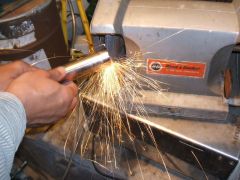 Spark test for a rod that was bought from Ebay advertised as S-7. The arrow tips of the sparks indeed do look like molybdenum arrows. This photo was taken with a Fuji Finepix camera using the "nite shot" mode.
 -
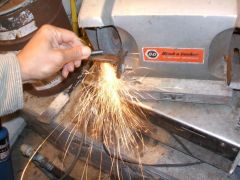 This is a spark test for a known sample of mild steel from the local steel supply store. It forges like mild steel. It was taken with a Fuji Finepix camera with the "night shot" mode.
 -
Thanks. It is this one: DeWALT 3/4" 375rpm Drill/Power Unit (DeWalt-DW138) - PriceGrabber.com The funny thing is that 1/4" bit drilled very well on some mild steel angle iron with a smaller 1/4" hand drill. The 3/8" bit was new. The psi figure for the drill point is useful for calculating forces. Maybe these D-handled drills are more oriented towards drilling wood.
-
Hi. I just bought a large hand drill off craigslist. It is 10 amps, with a 3/4" chuck, and the data on it says that it can drill a 3/4" hole in steel. I also bought a whole tray of fat S&D drill bits. I just tried the drill out, and it really required some hard pushing. I tried to make a rivet bolster out of a junk end of a steering rod. Not mild steel, but not really hard either. Spark tested intermediate, and could be cut easily with a Starrett bi-metal hacksaw blade. I needed to sit on the drill to make the 1/4" hole. There was no way any chips were going to come out for a 3/8" hole. So, I rigged up a "blacksmith's drill" according to the Blueprints and went to work. That big drill just flew through the steel, kicking out a bunch of cutting oil smoke and brown chips. By the way, the rivet bolster performed well at the forge, but it requires careful measurement of the rivet before setting, else the heads will come out asymmetric. So, I looked around for a feed pressure chart, and surprisingly, it was pretty hard. One thing that I noticed was that magnetic drill spec's listing 3/4" hole capacity have about 1000 pounds of feed pressure rating. Then, I found this: http://www.aaaproducts.com/downloads/bulletin/jcat2/J2pg6_27.pdf Wow. So what do I do with those 1" plus S&D bits? Drill magnesium? :D
-
Hi Nick. This works just fine. It is cheap, easy, and you don't have to breathe the zinc fumes. Dilute the acid, and let it sit a long time. The less it froths, the less collateral rust damage you will have caused by aerosolized HCl. How much to use? Here is a quick calculation: A 1/2" schedule 40 galvanized pipe will have about 1.8 oz/sq ft of zinc. For 1 ft of pipe with id 5/8" and od 7/8", this is 7/8/12*3.1416*1.8 + 5/8/12*3.1416*1.8 = .7061 oz/ft assuming the inner layer is intact. For most cheap blacksmiths, however, the inner layer will be almost missing due to corrosion, else why was the pipe free in the first place. Pool hydrochloric acid is about 30% by weight HCl. The density is 1.149. HCl has a molar weight of 36.14, so one gram of pool acid has: .3/36.14 = 0.0083 moles of H+, two of which are required to dissolve one mole of divalent zinc with a molar weight of 63.4. (.3/36.14)*63.4/2 = .2631 grams of zinc dissolved by one gram of pool acid, or the same number of ounces of zinc dissolved by one (weight) ounce of acid. This must be debited to convert to fluid ounces, since pool acid is slightly denser than water: .7061/.2631/1.149 = 2.3356 fluid ounces of acid per foot of 1/2" sch 40 pipe. Use more to make sure its all gone in a reasonable time, or use less if the pipe is heavily corroded. I have noticed that even if a lot more is used, not all the zinc is dissolved. It can flare up when you hit the hot metal with a hammer dislodging a piece of rust (remember, cheap pipe has lumps of rust inside) which protected some zinc. Do not inhale. I hope the numbers are correct. Disposing of the acid? Evaporate to make cheap killed acid soldering flux, or neutralize with baking soda, or pour on concrete, and it will slowly neutralize by itself. Does zinc disposed of in this manner create more water pollution than it would create air pollution from burning it off? I don't know.
-
Looks good, Don. Careful about the intermittent rating (check case temperature). It will probably be more flimsy than the blowers from the blacksmith supply, but I have seen cheaper and worse. For example, I use a really cheap hair dryer that I picked up during Salvation Army half price day. I have seen people stuff computer fans into a computer case, and duct the exhaust into the forge. You have to cut holes in the case, but that shouldn't be too bad. By the way, an air gate will help take the load off the blower during low demand (most of the time) periods, and may make "intermittent duty" less of a worry.
-
Hi. I just saw an interesting homemade anvil in the California Blacksmith Association's magazine (current issue). It is called "Easy Smith" and was designed by the Brazeal Brothers. It consists of several 2x2" steel bars aligned vertically in a fabricated frame. I tried out their orginal block anvil design, and found it to be a satisfactory substitute for a London Pattern anvil. I did miss the horn for spreading out heart hooks. Has anybody tried out this design? How is the efficiency? There could be some bouncing and loss of efficiency due to the loose fit of the bars, but I was wondering if anybody had any practical experience. The Brazeal's have some really cool tools and demo's. Haven't seen anything I did not like.
-
Hi blkbear. I have heard that RR spikes make mediocre knives. But, my buddy made one for his daughter, and it looks real nice. I bet it would deliver a nasty cut or open a lot of envelopes. I made a leaf veining die out of a spike marked HC on the top. I used BBQ briquettes to anneal it, and filed the veins in. Then, heated to critical and quenched with no tempering. It worked just great. A year or two later when I was showing it off, I noticed that I had left a bit of the "HC" mark, and it was dinging my leaves. Couldn't touch it with a file! Of course, this doesn't necessarily mean that RR spikes will make a decent knife, but they are hardenable. Also, they are much more difficult to work than mild steel, and people at open forge will look at you funny if you are drawing out reins on RR spike tongs.
-
Hi fellas. Thanks for the advice. It's very helpful. I disassembled one of the valves and found out that it has an interesting configuration for a needle valve. There is the usual needle, the usual driving thread, packing, and a top thread on the packing nut. The last one is where it is corroded and binding. There should be no oxygen up here, and I would be a huge slob if I left one milligram of flake graphite up there. A microgram would probably suffice, and the hazard of that at 6 psi oxygen in the lower part of the valve is very small. I found out that Black Swan is not really silicone grease (it is silicone bearing) and is therefore not safe for oxygen service.