evfreek
Members
-
Joined
-
Last visited
Everything posted by evfreek
-
Bob, often evenness is more important than speed. That is why some people favor brine over plain water. Brine is faster, but more uniform. The compressed air quench sounds interesting. I have waved pieces of air-hardening steel and gotten good hard quenches, even in fairly thick sections. I would be a little scared of using a blowgun, since it might just quench one spot well. Thanks, Bruce, the suggestion of the oil floating on water sounds like it would save oil, but there still would be the stench and the fire risk. One would think that the diaper quench would smell bad, but it doesn't. The amount of diaper filler dissolved in a liter of water is fairly small. About 1 gram each of fluffed cellulose and sodium polyacrylate or polyacrylic acid and 20 or so grams of baby waste product. It is not even slightly tinged yellow, but I try not to touch it. Thomas, I did a search on Smith's text that you referred to. Saw some posts on a "rainworm quench" but no diaper quench. It was actually something like this rainworm quench which gave me the inspiration. A bunch of snails and slugs got into my quench bucket. The effect on moderating the quenching vapor film was remarkable. I did not realize at the time whether it was surface tension alteration or viscosity, but after some reading, it is due to high temperature precipitation of the polymer. Snail and slug slime, and I would guess, chopped rainworm, would have some pretty high molecular weight components with interesting properties. I suspect that the ancient smiths did not realize what was going on. The interesting thing about the diaper quench is that it does not harden plain high carbon steel completely. It does not even cause the scale to blast off. I can't wait to try it on something more discriminating, like 5160 or deep hardening 4140, or even D-2.
-
This is a fantastic blueprint and I would heartily recommend it to anybody. In fact, there is someone on Ebay chopping hammers and selling them at 10 times the price. One tiny suggestion for a modification. By making the angle on the peen wider, you can speed up the grinding task. I don't know if there is a disadvantage because then you might not see what you are doing. When one of the other smiths saw my hammer, he made this comment, and the next time I saw him, he had a diagonal peen hammer made according to his modification. I tried it out and it seemed to work fine.
-
Hi. As I promised, I will post an idea for saving oil. Unfortunately, a doggie ate my longer post last night, so I will just post the outline:( Recently, when quenching some handled top tools in oil (to protect the eye), I experienced a fire . The stench was also disgusting. I decided to try a polymer quench: o did not want to buy the minimum quantity of Dow UCON A o try to find an easier to source alternative o do not use antifreeze: this is ethylene glycol, not PAG, and it is toxic o ideas: CMC, psyllium seed powder (Metamucil), snails and slugs, shampoo o settled on used disposable diapers from the local baby (cheap or free) o each diaper contains about 12 grams of sodium polyacrylate ladder copolymer, with excess sodium ions o MW is in the MD range, so only a small amount is required to boost viscosity o slows down quench in the critical convection dominated martensite region o enhancement must be at least an order of magnitude because oil is 10X and heat cap x density of water is about 3 x. o simple experiment at a few ppt by weight shows promise I am always reminded that anything I ever thought of has been discovered by another earlier blacksmith. Any experiences ? I checked De Re Metallica (Hoovers translation) but came up with nothing. There is some controversy, however with the interpretation.
-
Someone was talking on talk radio this morning. Said it is just supply and demand. If the demand goes down, the price will go down. Picking a day not to buy gas does not make the demand go down if the usage is still the same. But I read the original post, and, since this is "Bike to Work Week", I will bike to work tomorrow. To get things warmed up a bit, I carpooled two days this week. And, yes, I did not buy gas on Tuesday Obligatory blacksmith content :cool: : I came up with another way to cut down on oil usage. I posted it in the formulas forum.
-
Hi Apprenticeman. Good point. Most hammers are pretty hard. I tried out a 10 lb sledge hammer sitting on the concrete floor. Got 70%. I think that one can get carried away doing this sort of testing, since mass matters a lot, since a hammer is much more massive than a ball bearing. I would much rather use the railroad track section than a sledge hammer head. The hardness of the surface is important, though, in preserving the rebound energy. It only takes a thin layer of hard face, though, to get the effect, since the deformation is probably something like inverse square or less.
-
I just picked up a 1" diameter ball bearing at a garage sale. Just one ball, presumably made out of hardened steel. It is amazing what a rebound test tells when tried on various grades of anvils: concrete floor 20% railroad plate turned over 20% cast iron vise anvil 40% railroad track anvil 40% railroad track anvil (vertical) 70% good 150 lb. anvil in blacksmith shop 90% large unmarked 220 lb. anvil, weld repaired spot 70%, off the spot, 80% So, this gives results that would be reasonably expected. Strength of material matters, weight matters, and mass in line with the impact matters. The weld was ground flat but the color showed striations. Also, it dinged with the edge of a hammer. Possibly interesting to those who wish to weld on the tops of their anvils. There was also a much duller sound over the discolored area. The difference in rebound is real, but the welded surface is still much better than cast iron. The railroad track experiment shows the importance of mass below the blow. Some say that a 120 lb. railroad track set on end is like a 200 lb anvil. According to my test, it is (as long as the anvil is welded). Otherwise, it is not even up to a 150 lb. anvil. So it is not entirely mass under the hammer, but the hardness of the surface as well. Surprising :D
-
This does not look like a good anvil. But it does look like a good backbone for a belt grinder. A lot of homebuilders use a big piece of channel. That's what I'd use if for. Second choice might be some kind of vertical tool holder.
-
We have these in our neighborhood twice a year. I have found them to be a mediocre resource for smithing. A lot of junk washers, dryers and water heaters. The sheet metal on these things is hard to reuse into new shapes, since it releases shrapnel if you try to bend it. I thought of making an auto gas shutoff with a thermostat valve from a water heater, but the response time and pressure handling capacity looks unsuitable. There is a lot of chrome plated, painted and galvanized stock. I'd rather have clean stuff. Since the scroungers tear stuff up, people like to put things out at the last minute. That means that the night before, there are a lot of really junky trucks cruising for stuff. Once, I asked one of the fellows what he was grabbing, and he replied, aluminum to sell to the scrap dealer. These guys dig pretty hard and scatter trash and break glass. My striking partner has a good idea. He makes psuedo-traditional gates, but incorporates junk bicycles welded into them. Oddly enough, these gates are a hit. I have been hoping to score a big piece of steel or some new OEM leaf springs or something like that. I did get a disposable helium balloon tank, but ended up giving it to a student for a gas forge.
-
OK, then if it was a different conference, it may be different stuff. For photos, check out my gallery: http://www.iforgeiron.com/gallery/showgallery.php/ppuser/716/cat/500 It is easy to tell the 41xx apart from the other steels, and if you know what to look for, you can tell it apart from plain carbon steel. There is a paper on the WWW where a bunch of researchers collected some folks off the street and offered them a few bucks for each right answer. The test subjects made something like 97% correct guesses. But, there is a Japanese paper detailing the experiences of trying to train an expert system. The computer was awful. The 4140 photo is poor in quality, so it will not help you tell the difference between that and 4130. But it is still more realistic than BP0020. ;)
-
Hi Regional Chaos. Eugene, OR? I met a fellow at the California Blacksmith Association Spring Conference from Eugene named Conrad. Know him? Anyway, if you are talking about those 3/4" rods in the buckets that were being passed out for the toolmaking workshop, I don't think they are 4140. If this is what you have, I can elaborate. Also, take a look at my gallery photos. I just posted a photo of sparks from 4140 prehard drop and one of the pieces of steel I mentioned above. Because of a poor quality picture, it is hard to get much out of them. Also, it is hard to tell the difference between the two. But it is clear that neither of them is S-7 or mild steel :rolleyes:
-
Hi woodtick. Those dies that are in the picture look like butcher or tenon dies and would not be appropriate. I just use a spring fuller for my tapered candle cups and it turned out fine. Might work better with a little radiused diamond hole. Another project . This is where the guillotine tool shines, which by the way, you have a nice example of. My spring fuller has about a 3/16" for 3/8" wrapping rod around the candle cup.
-
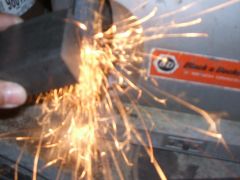 This image is a little blurry probably due to camera shake while taking it, but I will post it anyway. It is from a spark test of a 4130 pre-hard drop from Speedy Metals. Note the higher carbon content than the sucker rod photo, as well as some signs of molybdenum arrows, though not as evident as the diagrams (not photos) in BP0020.
 -
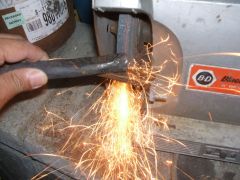 This is a spark test from a piece of sucker rod passed out at a CBA tool workshop. It was qualified as 4130, which seems plausible from the application (many sucker rods are made of 4130). Also, the head instructor spark tested, forge tested, and hardened and tempered and file tested it. Molybdenum arrows are visible, but maybe not to as great an extent as shown in BP0020.
 -
Thanks guys! This helps a lot. So, they're good for gripping short things and staying out of the way. Well, I guess that will be up on the project list :)
-
Hi. I have occasionally seen short-nosed tongs such as those from the following Ebay auctions: 230118797130 200102029757 Are these tongs called pincer tongs? Probably not, since I did a search on that name and did not find much. What are they used for? Holding short pieces of flat stock? It seems that they would grip hard due to the leverage, but since they only grip a short length of the piece, it would be suceptible to levering free. They do seem useful for short pieces which do not lever much but require more room to hit with the hammer, such as a 2 inch long stub. Does this sound right? Thanks! :)
-
Like this? Marco/Krieger Armory I've got one just like it, but I did the welding myself, and the horn is ground conical. These are just great, and you can do a lot with them if you have a stake plate for your hardy tools nearby. I only have three complaints about this kind of anvil: punching on the top, hefting it into the trunk of the car, rings loudly due to the long shank. Otherwise, it has certain other advantages for moving metal, and it is unlikely to get stolen. And, the price is usually less than $1/pound , unless you are in $ilicon Valley.
-
Hi Thomas. As you can see from my location, there are a lot of people around my neck of the woods, but I am not as skillful as you at finding anvils . These stories I told are my most recent close calls, and they occurred in the last few months. This is about equal to my long term close call rate. Of course, a funny story is not the only response to such a query. There are several others: weirdo (most common), I want to meet you for blacksmithing, can you do a commission for me, can you teach me to forge weld better, my grandfather was a blacksmith, wanna buy this expensive "antique" anvil, doesn't work keep you busy enough, blacksmithing is low class...you should paint or woodwork, forges get pretty hot--do you have any idea how hot burning jet fuel in a tall structure assisted by natural convection gets and how much weaker is steel at this temperature, etc, etc, yada, yada, yada. I don't consider this type of response a close call. In gambling, these close calls are called "scares" and are used to create a Baysian model null hypothesis for the likeliehood of a fair game (i.e. this game is biased with a 97% probability). My estimate is that I have a fairly high probability of acquiring an anvil by inquiring in this way in 5-10 years, but a fairly low one within the next year. That is why I advise the use of a substitute field expedient at least while the priors are being estimated. Who knows, the searcher may be better than me, and even almost as good as you. But, in any case, he will be able to make some progress at getting better at blacksmithing rather then just fiddling around wishing he had an anvil .
-
Hi Hoary. Good luck at finding an anvil. Make sure to get something to start pounding on while you are looking for one, especially if you select the path of just asking around and looking at garage sales and auctions. I started looking four years ago, and would still be looking today if I had just relied on "lookin' around". If you decide to just look around, pay no heed to the detractors who advise against certain ASO's. I started on concrete blocks. The edges don't work, so no edge techniques like setting down will work, but I still have my first set of tools made on concrete blocks. A cheap cast iron boat anchor, or even a real boat anchor would work. People often advise you not to fabricate your own anvil. They say that you should go to a fast food restaurant and work part time, then you will get your anvil a lot sooner. That did not work for me either. I would pay good money (and I have) to breathe 7018 fumes rather than french fry fat. They smell so much better . And, the gas spent driving to garage sales and auctions adds up fast, especially after a few years. One of the things that I have had the worst luck at is asking around, especially with ol' timers. Example: "Ahhhh, yeah, I got this huge anvil, and it's jes sittin' by the door. Never use it these days. Wish I could give it to some young'un who can do it justice." (eyes widen... "I'm interested, and I am a beginning blacksmith.") "Maybe not...I got tired of having it just sitting there, and I gave it to my son-in-law." (long pause, sighs) "He never uses it, though. Jes leaves it sittin' by the door. Suppose he might want to get rid of it since it's just takin' up space." ("Wow, I could take it off his hands. Can I get in touch with him?") "Umm, nope." ..... wait several months for another "conversation" with an ol'timer. I've got nothing against ol'timers. Come to think of it, I'm one myself Here's another conversation with an ol'timer. ("Hi, you seem like the kind of ol'timer that I keep hearing about on the Internet. Do you know where there is an old anvil that is available.") "Ummm, no, don't suppose I do, but if you are interested in blacksmithing, I can show you something more interesting." ("Aha, paydirt! A power hammer? Lessons from an old master? I'm listening!") "Do you know about Highway 49, the historical gold road in Eastern California." ("Yes, I do. That place has a real great blacksmithing history, with the mining and all.") "Well, boy, there is this little town called Columbia, and there is a blacksmith demonstrating there." ... pauses, licks his lips a little ... "and she is mighty fine lookin'. You'ld best pay her a visit. Might be able to 'strike up sumpn'. Heh, heh, heh. You young whippersnappers." (What is this old coot thinking?? I am not that young, and my whipper doesn't snapper any more. Hmmm, gotta ask what kind of meds he's on; I want some too.) What a waste of time . Hmmmm, wait a second. Anybody been to Columbia? Errr, is she really like he says ? Just curious.
-
The problem with the cheap temp guns (they are actually optical pyrometers;) ) is that they do not have an interesting range. For example, the one currently on sale in the Harbor Freight catalog limits out at 110C, hardly useful for even tempering. It is not worthwhile to try tricks like extending the range with a filter, since the detector's wavelength is too long, and since radiance at long wavelengths does not change as markedly as at shorter wavelengths, there will be an accuracy problem. You can get optical pyrometers that go up pretty high, but they will be costly. It is also possible to build a disappearing filament pyrometer with a light bulb, but it will require calibration. The temperature will go approximately as the power input to the 1/4th power, so that can be used to interpolate the calibration. The eye is not very sensitive to differences in brightness above 1900F, so this method pretty much gives out and you have to do tricky things like using red filters.
-
It is hard to use the charts, since they subjectively assume how much ambient sunlight is mixed in. See, for example, the following links http://www.tempil.com/PDF/Basic_Guide.pdf die block, alloy steel bar, steel die block, exporters of die block, hot & cold work tool steel, forging die steel block Using the Fire Heat & Temperature HEAT COLORS The viratsteels link seems a little too white at the high end. The others look kind of dark at the low end. The blksmth link has colors that are inconsistent with the text descriptions. But it looks close in the 1900 F range. I think that you have to calibrate your eyes. The tricks of melting aluminum and copper are well-known, and may be enough to do the job (unless color blind). Here are some other links: kiln cigarette orange cone argentium permanent marker These aren't really links, they are mnemonics which can be used as Yahoo search keys. Edit: dead link removed
-
Hi Don. I would not worry so much about using 7018 electrodes that have been left out. I do it all the time. If I can get them cheap in bulk, there often is a bunch left over after a real job that can be used for non-critical applications. See the Lincoln book "New Lessons in Arc Welding" for definition of "non-critical". The problem about damp rods is that they lose their low hydrogen properties, and the weld deposit becomes subject to underbead cracking in the HAZ. There are lots of times that non lo-hy rods are perfectly appropriate. The typical case is for welding mild steel under low restraining stresses, in thinner sections. Your forge is almost certainly in this category. I have welded up a lot of frames and brackets with mild steel for building gas forges. You can use 6013, 6011, or 7018 that is not dry. They all are non lo-hy electrodes. The only drawback is that the wet 7018 is harder to start, and it needs clean surfaces and good fit-up. You may also experience a little bit of porosity at the start of the weld. Again, not a disaster when welding up a forge. The only thing you may need to be careful about is the firepot, if you are welding 1" plate. There is more opportunity to trap hydrogen, but on the other hand, this is not a strength critical application. Welding bridges often specifies dry 7018, since the structural steel alloys are crack sensitive. When I do a critical weld on HSLA steel, such as welding a horn onto an anvil, I use dry rod. Or welding a cracked impact tool. These are crack and porosity sensitive applications, and it pays not to skimp. But, mild steel, 3/8" or less, and non-structural (no power hammers or hydraulic presses) is a non-critical application. So, what are you welding on your forge? A pan for holding firebrick, or flange for the brakedrum, or legs? Should be OK. Alright already, I'm a bit cheap . But, I don't actively seek out old junk rod. If it got really wet, the flux can flake off and then the rod is unusable. False economy.
-
Hi Jim. Here's a link I found when browsing. I think that they are forgeable, but with a lot of extra effort. I have some D-2. Heat treat may be tricky, especially on those steels which suffer from temper embrittlement. A very good idea that is by no means original is to get stock/uses that is close to shape so it requires little grinding. Also, people report some success with fabrication techniques involving brazing or stainless filler. http://www.cashenblades.com/Info/Steel%20selection/Steel%20selection.html
-
Hi. Although the link between hot fires and cataracts is well established, there is not much on the Internet which is not tinted by sales hype. There really is a risk. I went to the local public library, and, again, there are only vague references. The seminal text is: Title: Ocular effects of non-ionizing radiation / Myron L. Wolbarsht, David H. Sliney, editors ; presented in cooperation with the American Conference of Gover nmental Industrial Hygienists. It is available in many university libraries. At least it is in the local one here. According to the calculations given, you have about one safe second for viewing a hot, large welding fire. So, I bought a set of shade 3 goggles. And, although it is a lot more comfortable, I miss more welds because of the color perception problem. Also, I burn stuff up. There is a warning on the manufacturer's website that colors are distorted. I need to learn another way of judging temperature, like the one Sam (apprenticeman) uses.
-
AAARGH :mad: Now you tell me! I did hear about the Menards hammers, but there are no stores near me. I will need to proof before modifying, and this is the last time I will buy one of these Harbor Freight hammers. But, it was cheap Thanks, Glenn, for the pointer!
-
Hi. I bought a couple of Harbor Freight 3 lb double face sledge hammers. They require a lot of work for the price, but like most of that cheap stuff, one has to think of them more as a kit than as a finished product. It seemed to be a decent hammer. A bit heavy, but that is probably technique. The steel is not bad. It is not like my old G&G, which is 1095. It spark tests more like 1070. It will ding a railroad track with its initially poorly dressed face. The reason I bought the hammers is that I saw a blueprint on how to make a diagonal peen hammer out of a double face sledge. Unfortunately, that BP seems to have disappeared and I cannot find it with the search engine. First, I chopped two diagonal cheeks off with a Home Depot cutting disk in my angle grinder. Yes, I did end up shattering the disk . I was ready, though. Face shield, side shield safety glasses, leather apron and heavy gloves. Yes, I wear gloves when I do high risk grinding. I heard a story about someone cutting off his third leg after foolishly grinding in a notch with a name brand type 24 wheel. I just keep the gloves far away from the action area. Anyway, the cutting saves a lot of grinding, but in retrospect, it is risky and probably not worth it. One diagonal peen eats one thin cutting disk. The good point is that after you're done, there is minimal grinding left. The Harbor Freight steel is easy to grind, even though it is too hard to file. This hammer works pretty well at drawing down stock such as tong reins. Unfortunately, it only lasted for about two sessions. The epoxy or plastic top that looks like it is gluing the handle on popped off. Once it pops off, you are anti-social. The hammer head will be next, in a fairly short while. The fellow who bought these hammers for us said he already had one let loose. So, as soon as that plastic top pops off, you'ld better back off. Stay away from others when hitting, and fix that handle! Just a few more blows will loosen the handle to the point at which it may be removed by tugging on it. The method of attachment is completely dangerous and wrong, since the wood handle is seated only about halfway up the eye of the hammer head. Plus, there is a lot of junk flash that has to be ground out. The handle is not hickory, but rather some kind of tropical hardwood. It is not soft, and is fairly durable, but it stinks if you try to work it. Hopefully, it is non-toxic, unlike some tropical woods. Rehandle in the typical way. Rasp down the handle until it fits ALL the way through the eye. Use a hardwood wedge and saw down the handle along the direction of the head. Initially, the hammer comes with only one junk steel wedge. This is no good. Remove the steel wedge and drive in a decent wood one. The steel wedge can be reused and driven perpendicularly, but it needs to be notched. Or, just make another one with hammer, chisel and anvil. This will hold the head on in the time-honored way. Still not quite right. The other face is not dressed, so the edges will mark your work severely. Use the angle grinder to get these out. You can do a better job with a belt grinder, but it is so bad that the angle grinder will be a huge improvement. The handle is still the wrong shape. Not enough thinning at the grip, and if you follow Ron Reil's advice, this deficiency must be corrected. This can be done with a hobby rasp. At this point, the hammer is decent, possibly even a favorite. It is a lot of work (a few hours). There is someone on EBay who alters these $3.99 hammers and gets bitd in the $50 range for them. Maybe it is worth it.