civilwarblacksmith
Members
-
Joined
-
Last visited
Everything posted by civilwarblacksmith
-
Nice presentation
-
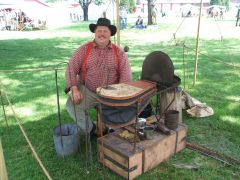 This is a reproduction of a Civil War Artillery Mountain Forge made by Dwight Neely. The entire forge fits into the box it is sitting on.
 -
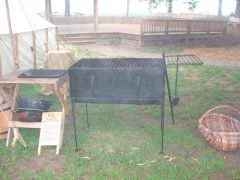 Replica of one in Civil War Museum
 -
The Blacksmith Primer by Randy McDaniel has a fire pot blueprint in it.
-
I am part-time blacksmith, using blacksmithing as a second job. All my work usually goes to re-enactments except for and orders I get from spectators at the events. Once I get my shop up and running at my house I will have some time to play around with forging items for fun to give away and learn from.
-
If you are making cooking grates for over a campfire. All you really need to do is paint it with a high temp black paint. The grates will be used to cooking pans to do the cooking and most chances will not have the food cooking on the iron itself. The one I have used for years has been rained on and has yet to rust. It seems to have something to do with the heat from the fire. This is the normal grate that I make for re-enactor in different sizes. This grate is was made for a living history area that could have open fire but not on the ground.
-
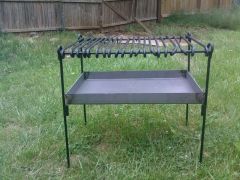 fire grate made for a living history area that cannot have open fire on the ground.
 -
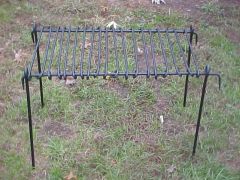 fire grate normally made for re-enactors
 -
I have two that I use. My wife thought of the second. "Forging History One Iron at a Time" " Forging the Past into the Present"
-
When you go to use the cut off hardy, I would use a brass hammer just to be sure the hardy doesn't break.
-
That is a really nice gate. Great work.
-
I have a 13" dia. 3/4" thick round coke pot at the homestead. I haven't found any problem in working the sizes of metal that I use. the bottom of mine has a clinker breaker setup in it.
-
Instead of splitting it, you can also do a faggot weld by bending it back on to itself and forge half wayup the bend.
-
Looks great.
-
Where on their web-site did you find the CD's? I couldn't find them.
-
You can also find tongs in antique shops where vendors rent spaces. Look for the tool guys.
-
The shovel looks great. Now take it to a boyscout and tell him to untie the knot.
-
I was always told it was easier to hook and flip it instead of trying to stab it, turn it over and try to get the fork out without the steak dropping through the tines of the grate.
-
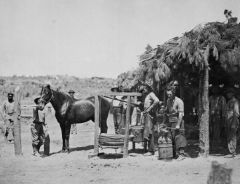
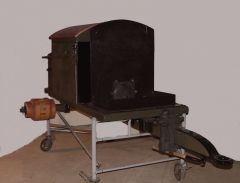
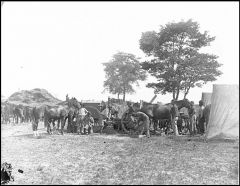
Here is a bit of info on the Civil War Traveling forge that was used by both sides. I pulled this from Our Blacksmithing WIKI that the Blacksmith Guild of Central Maryland has on the web. All info there is public domain and I know Dave Einhorn, who is constructing his own traveling forge won't mind the posting. You'll notice that it carried a coal box with 250 pounds of coal and it's air source was a bellows. The artillery mountain forge, also used by both sides, was also bellows operated. Also at the bottom is a picture of a forge, air supplied by a bellow that was a Petersburg, Va. during the war. Civil War Period Traveling Forge By David Einhorn The Traveling Forge combined with a Battery Wagon, and Limbers, formed a complete blacksmith shop on wheels. These wagons contained all the necessary tools and supplies to shoe horses, and repair wood, iron, and leather equipment used by both northern and southern American armies during the mid-19th century. Whether it was a horse needing new shoes, a broken leather harness or saddle strap, a smashed 190 pound cannon wheel, or a damaged or destroyed cannon carriage, these smiths had the necessary skills and tools to provide quality repairs and/or replacement parts as needed. Around the 1850's Captain Albert Mordecai was commissioned to go to Europe, research the military equipment being used at the time there, and then to create measured drawings and specifications, such as those drawings reproduced within Field Artillery Traveling Forge Book No. 61, that could then be given to manufactures. The intent was to have standard equipment that had interchangeable parts that could be readily replaced, stored, stacked when not needed, and maintained. Captain Mordecai's version of the Traveling Forge evolved from those used in Europe at that time. Fortunately, drawings of equipment used by the British Service circa 1845 were documented in a six volume set of books, and included valuable information and drawings of the British 1840's period Traveling Forge. The Traveling Forge and the Battery Wagon were designed to use the same limber as No.1 cannon carriages, and to have the same turning radius as the No.1 carriage. The intent was that all equipment would be able to travel where the No. 1 carriage could travel. The Traveling Forge was painted with the same Liquid Olive Paint as the No. 1 cannon carriage. According to the Ordnance Manual of 1863, in use the Traveling Forge contained a bellows, small vise, coal box containing 250 pounds of coal, as well as horse shoes, iron bars, and the tools to care for the the carriages, horses and tack assigned to it. One Traveling Forge, and Battery Wagon, with their permanently attached limbers were assigned to each cannon battery. Other Traveling Forges were provided to support the horses and equipment of the army. The tools most commonly used by the smiths were stored in boxes within the Traveling Forge's limber chest. The 100 pound anvil, during travel, rode in the fireplace. The Traveling Forge carried approximately 1200 pound of tools, coal and supplies, and the Battery Wagon carried an additional 1300 pounds of tools and supplies used by the blacksmiths. Equipment and supplies used by the smith/artisans were stored in the quantity and manner described in the Ordnance Manual of 1863. Due to the nature and quantity of tools and supplies used by the blacksmiths, it would have been extremely impractical to carry those supplies except within the numerous Traveling Forges and Battery Wagons that accompanied each army, specifically designed and constructed for that purpose. According to the Authentic Campaigner web site, Steen Cannons and Historical Ordnance Works provided around March 2008 the following prices if you would rather purchase equipment from them that is already made: Traveling Forge $19,000 each Limber for the Traveling Forge or Battery Wagon $6,500 each Limber chest for a Limber $2,800 each Battery Wagon $20,000 each Harness, 6 Per vehicle, a battery wagon and forge, the calculation is 12 horses X a rough $1500 per horse equaling $18,000 Horses ....12 horses @ $1500 ea would tack on $18,000 Based upon the information and calculations provided by the the Authentic Campaigner web site, an authentically correct historical presentation of a blacksmith during the War Between the States would cost around $93,600, plus the cost of anvil, tools, period clothing, trailers and trucks to transport the equipment and horses, food and other expenses for the event. A full battery would cost, according to their calculations over $700,000, plus trailers, trucks, etc. Thus a smith who wants to do an authentic Civil War historical presentation is an easy person to find Christmas and birthday presents for, as the list of stuff he/she needs is a long one. Shown below is a Civil War period Traveling Forge nearing completion, only the wheels, bellows and pipes need to be finished before it is a working Traveling Forge. It is being constructed by David Einhorn, a member of the Blacksmith Guild of Central Maryland, Pennsylvania Artist Blacksmith Association and Life Member of Blacksmith Guild of the Potomac. The progress of constructing many of the parts used in constructing the forge shown below has been documented and explained on this website and discussed on the Civil War Period Traveling Forge Discussion Forum. * Further Information on Constructing a Civil War Period Traveling Forge Next is a photograph was taken by Alexander Gardner showing smiths at work at Antietam, MD between September and October of 1862 shoeing horses at headquarters, Army of the Potomac. The wagon behind the four aproned smiths is a Traveling Forge attached to a limber. Note: The photograph is directly referenced/displayed from the U.S. Library of Congress web site, which contains many high quality historical images worth viewing.
-
-
-
-
I have a crank blower that is supposed to be circa 1850. It is having new bearings put in it and runs on 2 leather belts to turn the blower. Once I get it back, I'll put up a picture and see what everyone thinks.
-
Incredible movie. The Avengers are now in the works of filming.
-
Civilwarblacksmith I'm a civil war re-enactor that portrays a period blacksmith.