HWooldridge
Members
-
Joined
-
Last visited
Everything posted by HWooldridge
-
African or European?
-
I can't answer the Earth's core question but this trait is useful to blacksmiths because that is when the carbon in a piece of steel goes into solution and the closed lattice molecule opens. In other words, loss of magnetism in a piece of steel signifies transformation to austenite with a minimum of grain growth. Raising the temperature further does not make for a harder better tool/blade - on the contrary, it increases grain growth. Quenching from this temperature will convert a great deal of the austenite to martensite, which is desireable for edgeholding, hardness and strength. Tempering is then required to properly finish the item but those temps is nowhere near the non-magnetic range.
-
Don't plug in the stereo barefooted while standing on concrete. A related lesson is don't grab a live welding stinger with your bare left hand while leaning on an anvil with your bare right hand.
-
Interesting points of view and they apply to most types of business. Two of my sons want to be tattoo artists. Both are gifted at drawing and have done tattoos on living people, plus have a lot of their own ink. One of them recently began an email conversation with a nationally known artist who runs within that social circle. In a very limited exchange, he told my son pretty much the same thing that Jr posted - but of course, with regard to tattooing. There is no easy road to any learned craft if you want to stand above the pack. It's fine if you want it as a hobby and can dedicate some time and money - there is nothing wrong with that. Some of the finest gunmakers, knifemakers, potters, glassblowers, etc. etc., alive today started as hobbyists. However, every one of these pursuits were once trades that a man or woman did daily to put food on the table, but for the past several hundred years (at least since "wealth" has existed), there have been also been people who could pursue hobbies without having to worry about income from the effort. This is where the division still occurs today. If you live at home, eat at your folks' table and walk to work, you might be able to live on a couple thousand bucks a year, maybe less. In that case, you can practice {insert desired craft here} fulltime and truthfully call yourself a professional. On the other hand, if you employ a dozen people and want to eventually retire without having to work all your life, the annual take would probably top $1,000,000. In the latter case, you'd need most of what JR listed and maybe more. A person who creates one really excellent work per year using only hand tools might be admired more for his level of commitment than someone who puts in 60 hours every week making more affordable items with a power hammer - but neither one is wrong. I personally put in about 50 hours a week at an unrelated day job and then another 20-30 in the shop - am I a professional or hobbyist? It doesn't really matter to me because I am simply enjoying the ride...
-
Francis Whitaker's Blacksmith's Cookbook has a good plan for a hand shear. He said he had built his several decades before and it still worked fine.
-
We have Alamo Iron Works - one of the biggest distributors in South Texas. Prices are usually better than anyone else in the area, although there are a few things they are not competitive on. One is CRS sheet, which I buy from Pyndus. I usually buy what I need for a job and don't keep a wide selection in stock, maybe a stick or two of common sizes, like 3/8" or 1/2" square. At the rate I've been going lately, I probably spent about $750 this past year in steel.
-
Several years ago, I found a leg vise which had heavily damaged jaw faces. Not wanting to spend a lot of time on it, I clamped two old files between the faces and MIG welded all around the edges - top, bottom and sides. That much welding drew the high hardness out of the files. I sanded most of the teeth off with a right angle grinder and put it to work. The jaw faces are parallel at full closed position and hold as well as any other leg vise with factory jaws.
-
The little BBQ tanks just can't vaporize fast enough for some forges - I had the same problem, which is why I went over to a couple of 25 gallon tanks.
-
With oxygen, you can run until there is no pressure in the regulator. I have been told not to do the same with acetylene but I know I've had it down to 4-5 lbs and no acetone got into the lines. At that point, you're wasting time trying to extract that last little bit. I usually change tanks when I have a project coming up and will refill even if there is something left so I don't run out in the middle.
-
These big ones were designed to run several forges. It was common for a large shop with jackshafts to set up a blower on one end of the shop and plumb to all of the forges. Each work station would have a damper to regulate the blast but the blower was big enough to run multiple forges all at once. There is nothing wrong with driving it full speed with a motor and using a damper to choke the blast. Just use a 120v motor and an On/Off switch.
-
This question is more for those who have mechanical power hammers since I don't think this applies to air hammers but - what gap do you have between the dies? I have my 100 lb Beaudry set to barely kiss the dies at full speed and they don't bang together. I did this because I figured that I always have something between the dies, either hot stock or swages and the hammer would be most efficient if it's not choked. Therefore, I get very hard hammer action from a minimum of about 1/2" die height up to a maximum of around 3-1/2". The hammer will touch but not do much to a piece of 1/8" flat so I have to use a "slick" tool to move the material.
-
Interesting responses...my anvils all have pretty sharp horns. Comes in handy when doing small stuff and I have never walked into one. Maybe I'm lucky or they are set up in a nice feng shui pattern. I use MIG wire with shielding gas for buildup - I think it's plain old ERS70-5 or something similar, can't remember sitting here at the keyboard. Faces can be dressed pretty well with a right angle grinder and a few sanding discs. A dead flat face is not really as useful as a very slight radius from side to side. In other words, try for straight as possible down the centerline but a little dome across the face helps with drawing and straightening.
-
I've had two bad ones...#1. I was cutting some pipe with the torch and had a piece of slag about as big as a dime go into my boot. This happened 25 years ago but I still have the scar on top of my foot. #2 happened this year - was working on a large scroll and it flipped in my hands while I was adjusting it in a bending fork. That one branded me pretty good but it didn't scar (the miracle of aloe vera). I've had numerous burns from scale and bumping into hot stuff but these two were the worst. In general, grease burns while cooking are worse than burns in the shop, IMHO. The oil sticks and won't come off easily. I may actually have more scars from the frying pan than the forge.
-
Something small - maybe make some nails from 3/16 or 1/4 stock.
-
In general, I butcher (side set) the shoulders, forge the tenon close on the power hammer and finish in swages.
-
OK - I'm gonna pull a "Glenn" here and start a thread adjacent to the one on gloves. What are the ground rules for when to use tongs? Are there other ways to hold stuff? What are the best all around tongs? Etc... From my perspective, I try to have a wide selection of general sizes to fit 90% of the work and put a permanent ring on the reins. This makes sure it fits properly and is always there when I need it. In addition, I almost never hold the tong reins closed - preferring to always use a ring or a loop of some sort. In a pinch, I'll use baling wire. There is nothing wrong with my off-hand, but I developed this habit back when I worked very long days doing wholesale stuff, sometimes 12 hours straight. Although I was young and reasonably strong then, I still tried to remove as much labor from the process to conserve energy. I quickly discovered that simply holding the tongs and not having to squeeze them shut at every heat was a noticeably more efficient way to keep from getting tired. I also do not use flat jawed tongs very much. I may be influenced by Clifton Ralph, but I don't want hot pieces of steel flying around the shop so have concluded a "bolt" jaw design that more or less surrounds the piece is best for most of my work. What say ye, brethern and sistern?
-
I wear cotton mill gloves only when necessary but never on the swinging arm when I'm hammering - too easy to lose the grip on the handle. Cotton really seems better than most any leather glove I've tried. Most of the time, I work bare handed - when you develop a habit with gloves, it's easier to burn yourself in that moment of being absent minded as your subconscious mind gets lazy.
-
McNICHOLS Products: Wire Mesh McNichols has all types...I usually buy the minimum and it build 3-4 screens, depending on size.
-
My rollers also had flat spots. I used H13 to make new ones and had a machinist friend simply trace the contour of the old parts. He hardened them to 48 Rc and they have held up for many years. Anything hard will work including some of the softer grades of steel if a deep carburization is performed. If the elliptical opening is not uniform, the hammer will bobble during the stroke due to the change in spring tension. Doesn't have to be perfect but you should try to minimize the problem.
-
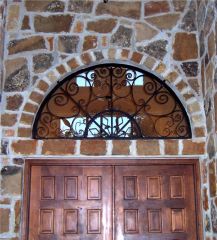 Same window installed.
 -
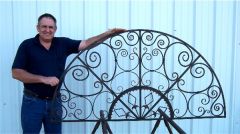 A recent window insert for a client. Her design on most of it with regard to scroll selection - I gave her some examples and she moved them around to her satisfaction.
 -
Outstanding - I wish I had the patience to produce a work of art like that. Please keep posting pics of your work.
-
I agree - probably a couple of hacksaw cuts to remove the unwanted material.
-
There are a couple of threads herein. Re the anvil tiedown - that's a personal thing, I have my 250 PW tied to a block of concrete that weighs about 300 lbs. I have not been able to move it with any sort of hammering, including two 12 lb sledges - and I prefer it that way. I know a fellow who has several 400 lb anvils sitting in 55 gallon drums, which are cut in half and filled with sand. If one shifts or sinks, he simply picks the anvil up with the bridge crane, levels the sand and sets it back down. Re the shop layout - my equipment list is as follows: 3 – Coal Forges 2 – Propane Forges 2 – Shop Anvils 6 – Post and/or Machinist Vises 1 – Sheldon 10x36 Lathe 1 – Clausing 15x48 Lathe 1 – Bridgeport 9x42 Vertical Mill 1 - 10hp 3 phase converter 1 - 2"x72" Belt Grinder 1 – 100 pound Beaudry Power Hammer 1 – 50 ton Dake Manual Hydraulic Press 1 – 36x24 Blast Cabinet 1 – Miller 150 MIG Welder 1 – Miller Synchrowave 250 TIG/SMAW Welder 1 - 2 ton electric hoist on a rail trolley 1 - Oxy-acetylene Torch 1 – Ingersoll Rand 175 psi Air Compressor with 120 gallon tank (this is in the barn and piped over to the shop) 2 – 4x8 Steel Layout Tables Tongs, hammers, chisels, punches, set tools, power hammer tools, etc. This is in a 24x36 shop and it's packed pretty tight - it also took 25 plus years to collect. I used to host workshops for our local blacksmith group but it would be tough to get more than 3 or 4 people in there now. However, it's a good size for me and I can build most anything I can handle. The largest things I've made are 4x8, 6x5, etc. - much bigger and I can't get it out of the shop and installed. I suppose anything could be designed to piece together but I stay away from large gates and stuff the local fabricators can beat me on price. Subsequently, I make odd-sized fireplace screens and unusual projects that no one else will touch. It's a good niche for me and has served as a consistent part time business for many years. There are only two things I want for the shop at this point in my life - a fly press, because I think it would be a very useful addition and a plasma arc. The latter is a luxury and I may never buy one, but it would be nice to have.
-
Briquettes have a little coal in them and some other stuff that acts as a binder (doesn't sound too appetizing to cook over, does it?) so they may burn just a bit hotter. I'd suggest you try busting the hardwood charcoal into pieces about at big as ping pong ball or a little smaller. More surface area spells more available heat. If you ever watch the Japanese smiths work on a sword in a charcoal forge, you'll notice the fuel is very consistent in size and fairly small.