Mike BR
Members
-
Joined
-
Last visited
Everything posted by Mike BR
-
That’s true. But I keep seeing the description on consumer products that don’t need any particular strength. And I bought at least one that turned out to be noticeably softer than 6061-T6.
-
Only if it's "aircraft aluminum."
-
I like mixing 2700K and 5000K bulbs. But putting them that far apart in a shop would probably drive you nuts when you tried to read temper colors.
-
I'm also stuck at the "A place for everything" part. (And I don't see much hope of getting unstuck until I've learned the difference between a tool and a piece of stock I put a couple of bends in so I could do X.)
-
If Friend 2 asks Friend 1 if Mike's shop is clean, and Friend 1 says "No, it's messier than yours," that seems like a completely ordinary conversation about a shop. What does seem a little odd is Friend 2 telling me what Friend 1 said. Unless it's something like "Oh! what a neat shop! Friend 1 said it was messier than mine." (But rest assured, no one would ever react that way on seeing my shop!)
-
They could probably find buyers who would believe the Roman numerals meant it was made in 2026 BC.
-
I clear chips/swarf off my little Harbor Freight lathe with a magnet tool. It’s a piece of 3/4” copper tube with a cap at one end (actually a copper disc soldered into the end — why pay for a cap if you don’t need one). Inside is a stack of 3 or 4 button-type rare earth magnets stuck to a little flat coil forged on the end of a piece of 1/4” round. I cut a collar from a bleach bottle to slip over the tube and stop chips from sliding up the outside when I withdraw the magnet. I sometimes turn some non-ferrous, but generally I end up making enough steel chips that the magnet will pick up the mixture.
-
How do you keep swarf from following the magnet up the sides of the box?
-
If you aren’t doing it already, keep the tip of a taper even with the far edge of the anvil That lets the part of the hammer face that extends beyond the tip hit air instead of anvil.
-
For me it’s fish and chips. This is the second I’ve been in Sweden on Christmas Eve. Both times I failed to book dinner at one of the few restaurants that’s open, and wound up eating at the “English Pub” attached to my hotel. At least at a restaurant though, it’s a big buffet. I had a scaled-back version at a local place last night, and there was a variety of sliced meats, three or four kinds of pickled herring, gravlax, baked salmon, and, of course Jansson’s temptation. One Christmas-specific food is “Christmas ham,” which is cooked, then sliced and grilled with mustard. There’s also a Christmas soft drink called “julmust.” I bought a bottle at a grocery store last time and wanted to add some sugar to cut the sweetness.
-
I’m in Kiruna, Sweden. Sadly, though, I wasn’t able to swing a mine tour.
-
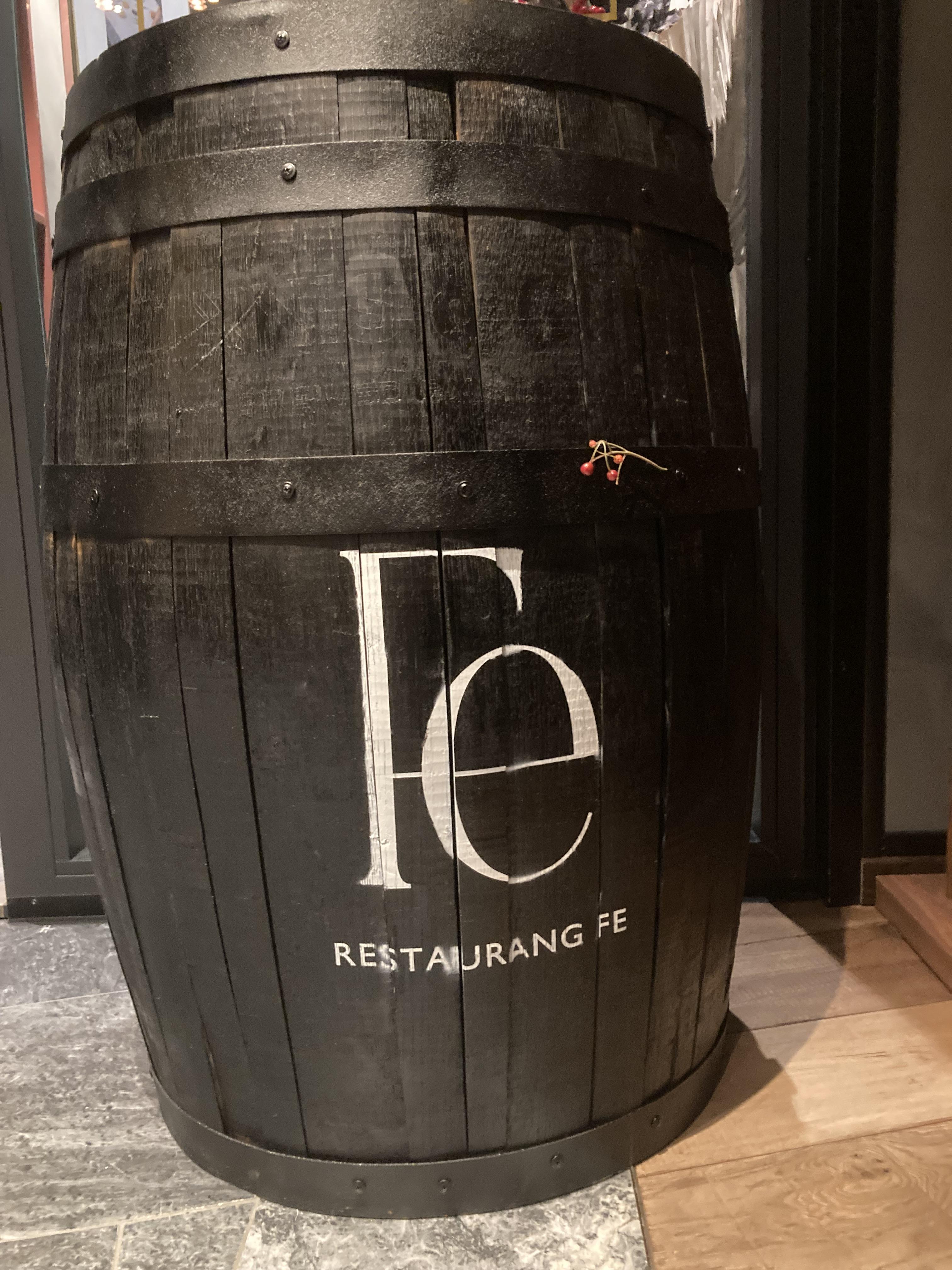
Had breakfast at the Fe Restaurant.

-
I can’t see how you have the cutting edges set up. Is there a stop so you don’t separate the nail from the bar entirely?
-
I think I remember someone (perhaps Thomas) saying that they had cut and punched bandsaw blades to fit bowsaw frames. I think that was for metal cutting, but perhaps you can find a suitable wood cutting blade. Or maybe someone north of the border with a Grainger account would be willing to help?
-
I have a wooden stand with a piece of cable and a turnbuckle holding the anvil down. I was just imagining how I'd go about doing what tractorguy seemed to have in mind.
-
I have a cheap set of transfer punches (not a very good investment, since some are too soft to be much use). But I was thinking more about horsing things around. I guess if you drilled the top plate of the stand, then transferred the holes to the anvil, and then welded to the top plate to the stand, it might be workable. Then I'd probably want tap holes that are too big to hand drill, and an anvil would tax the table on my drill press (assuming I could get it up there and secured somewhat level . . .)
-
Getting the holes aligned would be a challenge for me.
-
I’ve forged some glass-lined water heater steel, and the glass is viscous enough that I’d worry about it getting trapped in a weld. And come to think of it, that’s exactly what does happen with wrought iron.
-
Thermal stress occurs whenever a piece changes temperature unevenly. So quenching only part of a blade increases stress. Of course, it's impossible to get a perfectly even quench -- the outside of a piece cools faster than the inside, and thinner sections cool faster than thick ones. That's why it's important to use the slowest quench that will harden the piece (and not quench air hardening steel in oil, or oil hardening steel in water, for example). With that said, there are specific reasons to quench only the edge of a blade, but doing so is riskier than using a full quench.
-
Also, while I'm no knifemaker, I usually hear "banana blade" used to refer to the curving effect that occurs when you forge the taper from the thick back to the thin edge. It looks like you successfully countered that in the forge. Quenching half of the blade is something of an advanced technique, and can potentially contribute to cracking. It's probably better to start out quenching the whole blade, and then tempering the back softer (you can put the whole thing in the oven, and then temper the soft part further with a propane torch or over a hot piece of steel). My recollection is that steel expands slightly when it goes from austenite to martensite, so quenching only the edge would actually make a banana effect slightly worse.
-
Switching to an induction forge when possible would make air conditioning more feasible. I also read an article a couple of years ago about radiant cooling. The system I read about used panels in the ceiling that circulated cold water or brine. Between the coils and the room was a sheet of polyethylene (IIRC). The idea was that radiant heat from the room would pass through the clear plastic and be absorbed by the coils (or a surface they cooled), while the plastic would isolate the coils from the room air and prevent condensation. I think the article mentioned applications like bus shelters, but it struck me that it could be effective in a shop that required a high level of air exchange.
-
These days, I try to start every project with an expectation of success or failure. I'm out of space to store the ones that end up in between.
-
Could also depend on whether there's positive or negative pressure in your shop. If you added an exhaust fan, for example.
-
The actual voltage of a battery depends on the chemistry; the labeled voltage is a nominal value. So for example, a fully charged car battery is around 12.6 volts. And no-load voltage isn't the best measure anyway -- some batteries can show a decent voltage with no load, but not maintain a sufficient voltage under load. With that said, it looks like 3.03V would be at the low end of no-load the range for CR2450s. So it might be worth trying another battery before shelling out for a new module, but no guarantees. You might try polishing up the contacts in the helmet also, if you haven't.
-
A few years ago, I was forging on (rare) snowy night when the neighbor's cat came across my backyard and into the shop. I bent down to pet it. After a couple minutes of seeming contentment, it suddenly spun and nipped me. When I finished forging and went inside to wash up, I found a blister on the back of my hand. After a few seconds of panic, I remembered the piece of scale that had landed there.