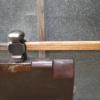
July 18, 201015 yr Here's some hammers Lyle, LDW, and I forged yesterday, 2 rounding hammers and 2 fullering hammers. Lyle gets his pick of the fullering hammers and the other will go to rapula in Columbia for 3 mini anvils that we traded while he was in the states working with my brother. The big rounding hammer is mine. The smaller one goes to "Tim the toolman" from Mississippi. Tim traded a 20 pound set hammer in brand new shape while we were at Fire in the Swamp last month for a hammer, and we finally got around to forging it. I still have to grind, heat treat, and handle them.
July 18, 201015 yr Author I don't know, Clinton, I don't have a scale, but Lyle just showed up and said "let's go get a scale". I guess we're going to get a scale. We'll be back in a bit.
July 18, 201015 yr Author We are back. The big hammer weighs 4 pounds 11 ounces. It started as 4 1/2 inches of 2 1/4 inch round 1045 which weighed 5 pounds, so we lost 5 ounces to scale minus the plug which weighed .15 ounces.
July 18, 201015 yr Here's some hammers Lyle, LDW, and I forged yesterday, 2 rounding hammers and 2 fullering hammers. Lyle gets his pick of the fullering hammers and the other will go to rapula in Columbia for 3 mini anvils that we traded while he was in the states working with my brother. The big rounding hammer is mine. The smaller one goes to "Tim the toolman" from Mississippi. Tim traded a 20 pound set hammer in brand new shape while we were at Fire in the Swamp last month for a hammer, and we finally got around to forging it. I still have to grind, heat treat, and handle them. Nice hammers Brian, looking forward to working with one of those. I will not come to the states again till next year but, maybe you come down to see me before that time??...
July 18, 201015 yr We are back. The big hammer weighs 4 pounds 11 ounces. It started as 4 1/2 inches of 2 1/4 inch round 1045 which weighed 5 pounds, so we lost 5 ounces to scale minus the plug which weighed .15 ounces. wow that is big indeed, so the other hammers are in the 3 1/2 lb range?
July 18, 201015 yr Excellent work Brian, I'm always amazed and I especially love the touch mark that puts your hammers in a class of their own.
July 18, 201015 yr Author Thanks, guys! Clinton, the other hammers weigh 3 pounds 4 ounces, 3 pounds 5.5 ounces, and the small one which is out of 1 3/4 inch round weighs 2 1/2 pounds. rapula, I'd love to come to South America, but I don't leave home unless I have work and can afford to. If you give me your address, I'll mail it to you.
July 23, 201015 yr Author I temper them by heating my drifts up and putting them in the hammer eye alternating sides each time. The middle of the hammer will show blue, and the faces straw after about three drifts.
July 23, 201015 yr Hi, Brian. Those are fantastic looking hammers! Thanks for sharing. Being somewhat new to this I am having a hard time figuring out the difference between the rounding and fullering hammers. Which is which and when would you choose one over the other? I am thinking that a rounding hammer has a round domed face and is used for dishing? A fullering hammer would be more like a peen? Sorry, a little confused. Great hammers, though! Also, seems like the hammer would work well with those using Hofi's method in terms of balance of the head and type of handle. Is that the case? Thanks! Eric
July 23, 201015 yr Author Hi, Brian. Those are fantastic looking hammers! Thanks for sharing. Being somewhat new to this I am having a hard time figuring out the difference between the rounding and fullering hammers. Which is which and when would you choose one over the other? I am thinking that a rounding hammer has a round domed face and is used for dishing? A fullering hammer would be more like a peen? Sorry, a little confused. Great hammers, though! Also, seems like the hammer would work well with those using Hofi's method in terms of balance of the head and type of handle. Is that the case? Thanks! Eric Hey, Eric. The rounding hammer has the ball fuller, and the fullering hammer has the straight fuller. I use a hand hammer for most of my work, and different sized fullers or peens are my choices of dies to use. The rounding hammer has the largest selection of different sized fullers availiable, and the degree at which I tilt it determines the size of fuller I choose, since the ball end is not a true half sphere. The center of the ball has about a 4" radius, and when tilted the radius changes all the way to under 1/2" radius. I can also hit smaller spots with the rounding hammer. The fullering hammer has a 3" radius all the way across, and that is my most common choice of die for drawing and isolating material with half hammer faced blows over the edges of the anvil. The rounding hammer works like a true fuller on smaller stock, but when I am striking across 1" or more I need to switch to the fullering hammer. The cross peen hammer is not as versitile as the rounding and fullering hammer because all it has is a flat face and a straight fuller of a given size. I have that on my flat face when I tilt it or not. I do use a cross peen when making things like calla lilies, spatulas, and shovels where I am doing an extreme lateral draw. Anyone can shape their handles to what they prefer. I personally prefer my handles rectangular all the way. Most of my work is done by tilting my hammer to some degree, and the flat sides of the handle make this easy to control.
July 23, 201015 yr Brian, Thanks for the great explanation. It's pretty amazing what you can accomplish with the rounding hammer! Thanks again.
July 25, 201015 yr I temper them by heating my drifts up and putting them in the hammer eye alternating sides each time. The middle of the hammer will show blue, and the faces straw after about three drifts. what about the striking end of the fullering hammer...seems to me it should be softer so as not to chip when hit with another hammer
July 25, 201015 yr A hammer is not a top tool even though they look similar and and have handles. Hammers should not be struck with other hammers. I think what Brian was saying is his hammers have a fuller on them instead of a cross peen and he explained the difference and how he uses them. Rob
July 25, 201015 yr what about the striking end of the fullering hammer...seems to me it should be softer so as not to chip when hit with another hammer From what I gather this hammer can be used to make fullers, kind of like pein on a cross-pein hammer. It's not actually a handled top-tool meant to be struck. That's just my impression, though.
July 25, 201015 yr Brian has such accuracy with his hammers that he tends to use them as top tools and strikes with his swing... that's what he is trying to say. He is NOT using them as traditional top tools struck with another hammer. Looking at his work it should be obvious that the man has outstanding if not astonishing hammer control! Even my own hammer accuracy amazes me and it's nowhere NEAR Brian's level. People have some incredible physical potentials! The AVERAGE human being has stunning hand/eye control... I would suggest that Brian is pretty far from average! At least as applicable to smithing skills.
July 25, 201015 yr Brian: Are your hammer eyes punched straight through,tapered from one side,or do they have a waist in the middle(tapered from both ends)? thanks, Eric S.
July 25, 201015 yr what about the striking end of the fullering hammer...seems to me it should be softer so as not to chip when hit with another hammer I think we are getting hung up on terminology and descriptions here. I interpret Brians definitions as rounding hammers and fullering hammers, and Brian also refers to dies, his dies are the hammer heads and their shapes, and uses The rounding hammers have various radiussed faces from small to large(Nearly flat) and can be used to concentrate blows as required, or to apply a finish and are the general purpose forging tool The fullering hammers are used FOR making a fullering blow on the stock being forged, not AS fullers, it is describing the action not the tool. I don't know if this helps or not, getting you head round descriptions can be quite difficult, and I may well have got my perception wrong, perhaps Brian will clarify.
July 25, 201015 yr I'm talking about his fullering hammers like the ones he uses in class to make the groove around each face of the hammer he has several different sizes and they are struck with a hammer ...
July 25, 201015 yr I'm talking about his fullering hammers like the ones he uses in class to make the groove around each face of the hammer he has several different sizes and they are struck with a hammer ... Like I said, its in the description, what you are defining here is a wood handled fuller (Used in combination with the corresponding bottom tool,) which could also be a rodded fuller, or just a hand held fuller. I agree that you do not strike the face of any hammer which is why they are just called fullers, or fullering tools, and are used to spread metal, or used in pairs to introduce grooves or waistings or other shapes used in forging like on the hammer heads Brian makes, and come in many sizes and sometimes specialist types, eg Cheese fullers for making heel bar tenons. Does not Brian have a tool under neath the hammer head he is forging when he uses this fuller? A fullering hammer is a hand hammer one end of which is used to fuller or spread the metal, and a business end on the other to your required shape, and is used as a hand hammer, as opposed to a fuller which is used with the help of a sledge hammer or some other means of imparting extra weight to the blow,
July 25, 201015 yr the other to your required shape, and is used as a hand hammer,of a sledge hammer or some other means of imparting extra weight to the blow,
Join the conversation
You can post now and register later. If you have an account, sign in now to post with your account.