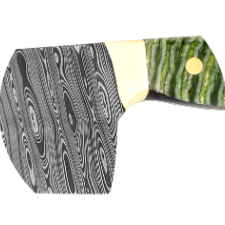
September 29, 201015 yr Hi all, I forge welded a billet of low carbon construction steel and toolsteel. Now i'm at 16 layers, i want to continue till 64 or 256 layers. But I need an etching acid. What do you recommend? Greetz Johan
September 29, 201015 yr hmm, looks like a tool, and i was made from steel. yep that would be tool steel. lol
September 30, 201015 yr One part muriatic acid + two parts 3% Hydrogen Peroxide. Test on scrap and dilute as needed.
September 30, 201015 yr If you play with muriatic be careful, use in a well ventilated area and not around anything you dont want rusted when your done. I've had the fumes alone rust metal. Oh and you can find it for a few bucks at any lowes/homedepot
September 30, 201015 yr Author thnx here in Holland we have kitchen vinegar. I think i'll use that. It's a slow process? How long? /Johan
September 30, 201015 yr Ed Caffrey uses 3 parts distilled water to 1 part ferric chloride (which BTW can be purchased at Radio Shack where its called PCB etchant). Try all these suggestions..I've also heard that vinegar + table salt does a good job. I would for sure try Randy's formula. I'm sure he knows what he's talking about. If you've ever seen any of his knives you'll understand ! Gene
September 30, 201015 yr Vinegar works. It works faster if it's hot. Of course it also works faster at higher concentrations. Just about any acid will do the job. As mentioned by others, ferric chloride (printed circuit board etchant) is perhaps the most common etchant for this, and it works very well. Most folks dilute it between 3:1 and 5:1 distilled water:vinegar. For some reason it works better when it's diluted.
September 30, 201015 yr Unfortunately hand tools are generally a medium carbon steel and not "tool steel" (generally being higher carbon and higher alloy content steels). Files are generally an exception and often run about 1% carbon and so can "juice up" a billet. If you plan to make a blade from your current billet I'd add a section of file every time you fold it or between each layer if you cut and stack it to get the carbon content higher. Hot vinegar and salt makes a great contrast etch on my favorite billets but does not do much in the way of providing topography for those who like that in an etch.
September 30, 201015 yr Author thanks thomas. What is topography? Exually I don't really care about the quality of this first blade. What I want to archieve are succesfull welds, and I want to see the damascus pattern on the blade. For the next one i'll be using better steel. Does the fact that i used a wrench at medium carbon percentage, disadvantage the clarity of the pattern?
September 30, 201015 yr When people speak of topography in this context, they mean that the etchant eats into the steel sufficiently that you can actually feel the different layers. In other words, the difference between the layers isn't just a matter of color. There's nothing wrong with using medium or even low carbon steels in a pattern welded billet, as long as the final carbon content of the billet is appropriate for the intended purpose of the steel. If you're just making knife fittings, some kind of sculpture, etc., then low carbon is probably just fine. If you want to make a knife, you'll need more carbon. The contrast in PW billets mainly has to do with the alloy content of the different steels. Manganese etches gray or black. Nickel etches silvery. Etc. So without knowing what exactly kinds of steel you started with, it's hard to know how your pattern will look.
September 30, 201015 yr Author thanks! today i assembled the new billet, now it is as following: construction steel 8 layers - wrench 8 layers file construction steel 8 layers - wrench 8 layers file the four pieces are equall thickness i'm pretty sure the file contains more carbon then the wrench, because i wanted to bent one piece a little bit, and it broke very vast. kinda brittle I think the whole billet contains pretty much carbon, perhabs a bit to much, but afer welding it 4 times, the carbon percentage will drop to a reasonable percentage. What is a good knive percentage? Somewhere around 0.7% ?
September 30, 201015 yr Author and there is another thing i don't understand. Knives are high carbon. But to me, it looks like high carbon steels are easy to break when you bend them. But a really good knive (kitchen knive) should be able to bend 90 degrees. The thing with damast is, that you combine the two steels, and should that give them the advantage of both types of steel?.. Of course i need to read a good kive making book, any suggestions?
October 1, 201015 yr The greater the difference in carbon content between layers the greater the contrast in the etch. Also, if the wrench is chrome plated it will release toxic/carcinogenic vapors when heated to welding temps. Search "hexavalent chrome" for the real info. Don't grind the chrome off either, there's NO good way to breath chrome. Single metal hack saw or better still metal bandsaw blades have enough nickle in the alloy to make nice contrast in the billet. Frosty the Lucky.
October 1, 201015 yr and there is another thing i don't understand. Knives are high carbon. But to me, it looks like high carbon steels are easy to break when you bend them. But a really good knive (kitchen knive) should be able to bend 90 degrees. The thing with damast is, that you combine the two steels, and should that give them the advantage of both types of steel?.. Files are brittle because they're barely tempered. You wouldn't leave a knife -- or at least most knives -- nearly that hard. I'm not sure who told you that a good kitchen knife should be able to bend 90 degrees. I, for one, have never needed to do anything in the kitchen that required my knife to bend anywhere close to a right angle, and I can't say that I know anyone who has. I would much rather have a kitchen knife that's hard enough to cut all day with no or minimal resharpening, and without the edge chipping. Generally speaking, no, pattern welded steel does not combine the qualities of the component steels. That's an old myth. Carbon migrates very readily at welding temps. After a few folds and welds, the billet's carbon content is close to homogeneous. Pattern welding is not a functionality thing. When's the last time you saw a jet landing gear or an industrial shear blade made from PW steel? Pattern welding is about aesthetics, plain and simple.
October 1, 201015 yr Author yeah, i can agree with that. About the 90 degree's, indeed, i don't think it's a kitchen knives thing, but i thought there are several tests for someone who becomes a member of the american bladesmith society? I saw a movie from bob kramer, who bent his knive 90 degrees. At least, i think a bit flexibility in a blade is great. Another question, when i'm done with my billet, what is the correct sequence? - Shape / grind/ forge the from of the knive - Temper the blade (should i even do that?) - Harden the blade? - Sharpen it - Etching
October 1, 201015 yr Author frosty, the wrench was rusty, so no chrome. Chrome is not good for breathing indeed ;-)
October 1, 201015 yr yeah, i can agree with that. About the 90 degree's, indeed, i don't think it's a kitchen knives thing, but i thought there are several tests for someone who becomes a member of the american bladesmith society? I saw a movie from bob kramer, who bent his knive 90 degrees. At least, i think a bit flexibility in a blade is great. Another question, when i'm done with my billet, what is the correct sequence? - Shape / grind/ forge the from of the knive - Temper the blade (should i even do that?) - Harden the blade? - Sharpen it - Etching You have your order of things mixed up a bit. Yes any steel that is hardened needs to be tempered or it will break due to stress and you temper after you harden the blade. Start your tempering cycle at 350f or 175c in your oven for min. one hour if it needs to be brought a little softer put it back in for another hour at 200c or 400f. And this should be done as soon as the blade is quenched. Then clean it up then etch the blade then sharpen. Bob
October 1, 201015 yr Author thanks. What is the best harden proces? Bring it up to 850degrees C and then pull it into the water, wait for the blue color to go up, and then completely cool it down?
October 1, 201015 yr About the 90 degree's, indeed, i don't think it's a kitchen knives thing, but i thought there are several tests for someone who becomes a member of the american bladesmith society? I saw a movie from bob kramer, who bent his knive 90 degrees. At least, i think a bit flexibility in a blade is great. I thought so. The ABS tests are designed to test the smith's ability to perform a specific heat treat. This does not mean that the particular heat treat required for the test is ideal for any given knife. Two pieces of steel having the same geometry will bend the same amount under a given force, at any point less than the yield point. (Yield point is basically the amount of deformation the steel can take before it takes a permanent bend, or breaks.) Hardening moves back the yield point. That is, hardened steel will require considerably more force to bend permanently than its soft brother. However, the hard steel will fail totally somewhere near the (high) yield point, whereas the soft will bend at the (low) yield point, and keep bending a long way. So the "flexibility" you're talking about can be explained in a slightly different way. What you're really saying is "I like a knife that bends fairly easily." Really?
October 1, 201015 yr thanks. What is the best harden proces? Bring it up to 850degrees C and then pull it into the water, wait for the blue color to go up, and then completely cool it down? If it were me i would quench in oil first and only attempt a water quench if it did not harden in oil. Canola or peanut oil will work heat the oil to 50c first. Not realy knowing what type of steel it is i would go to non magnetic and hold for a few seconds then quench. Bob
October 1, 201015 yr - Shape / grind/ forge the from of the knive - Temper the blade (should i even do that?) - Harden the blade? - Sharpen it - Etching No.Shape, rough finish to at least 120 grit, 220 would be better Harden Temper Finish (sand/stone/polish/buff) Clean (to remove all traces of grease, etc., which if left on will interfere with etching) Etch Sand lightly with very fine abrasive to increase contrast between the layers Sharpen (This is just for the blade. For most knives, a comprehensive list would also need some steps related to the handle, guard, pommel, etc.) As to the hardening process, that's the problem with mystery steel. Who knows? In your place I would start my experiments by normalizing the steel three times, at 870, 845 and 815 C. (By "normalize" I simply mean heat the steel evenly to the desired temperature, then remove it from the heat and allow it to air cool. "Air cool" does not mean set it down on an anvil or some other solid mass that is going to suck heat out of the steel. It means hold the blade by the end of the tang with tongs until it has cooled well into the black range.) Then, on the hardening heat I'd take it back up to 815 C, slowly and evenly, for a minute or two (without overheating the thin parts) and quench in heated vegetable oil as Robert suggested. This is all much easier to say than to do, if you don't have a heat treating oven or some other way of getting precise temperature control. I use Tempilaq and Tempilstiks to help me. For reference, steel becomes non-magnetic at around 768 C. You want to go a bit beyond that for hardening. For most relatively simple steels the recommended hardening temp is in between 802 and 873 C. Unfortunately many of them can also benefit from soaking at that temperature for five or ten minutes, which is hard to do in a forge without overheating parts of the blade.
October 1, 201015 yr Author what means soaking at that themperature? Keeping it in the forge on the same temperature without burning it? Wich tempilstick do you use? Is it hard to read the temperature from the color of the steel? I have a color chart...
Join the conversation
You can post now and register later. If you have an account, sign in now to post with your account.