
Chris Waldon
Members
-
Joined
-
Last visited
Everything posted by Chris Waldon
-
You didn't, perchance, get your inspiration for that design for http://www.maddwarfworkshop.com/ did you? They have a sword, Eal Gyd, or something like that, with a pommel and cross-guard nearly identical to this one.
-
Despite what ever "welding flaws" it may have, it's a beautiful blade, and one to be proud of. Nicely done.
-
"Ladies and gentlemen, we have here, newly excavated from Israel, Goliath's kitchen knife from his childhood. This has been confirmed by various DNA tests and carbon dating, so we now offer it to you for a mere 10 million dollars. Do I have 10,000,000.00 Dollars?...." That thing is huge.
-
Hmmm... Well, living in the USA, our hardware stores don't seem to carry it under that name. I've tried all the mainstream ones, they just return kinds of clay. (which might be what I want, but I'm not sure)
-
I've been wanting to try and create a hamon myself, but since I'm not really sure what sort of clay to use, I haven't. Oh well, I'm sure I'll find it somewhere. Thanks.
-
Stock removal is not cheating, it's just not as satisfying either. Very nice knives though, especially the top one.
-
Stick it in your oven for a few hours at at least 350 degrees Fahrenheit, or maybe 150 Celsius. You need to do it quickly after hardening, I've heard stories of blades randomly shattering from internal stress because the smith waited too long to temper them. Ask someone else for the exact temperatures though, I've only done this once.
-
I like how the handle wraps around itself. You're right, the hamon doesn't show very well, but it's there if you look for it. What kind of clay did you use for that?
-
I love the shape, and I'm pretty sure that you could use that as a small axe, if nothing else. Well done!
-
"Well as far as i know wetting the hammer and anvil dose help reduce scale or remove scale from the metal surface." - Dean O Riordan on this thread: I've also gotten that same advice from several other people. I know that in steel producing/recycling plants, they hose off the steel ingots to remove the scale and prevent it from forming. When I first heard about it, I thought it didn't make since too, but I've heard it so many times now, I'm beginning to think that it's true. Here's a bladesmith on youtube doing it: If you watch closely, you can see him dip his hammer into water before beginning to strike. Again, if anyone has anything contrary to this, please correct me.
-
I once annealed a file simply by building a large fire and burying the file in the center. Then I kept feeding the fire for hours, until it was so hot I couldn't approach it to add more wood. Then I let it burn itself out and I removed the file the next day. It seems to have worked.
-
Go and edit your profile (upper right) to show your location.
-
Ok, I'm no expert, I've only been doing this for a little while, but I advise you to take it slow. I know that when I first started making blades, I didn't have any hammer control, resulting in crescent-shaped hammer-marks on my blades that were too deep to grind out. Go carefully, make sure you don't beat the metal in anger because it's not changing shape fast enough. After that, I had to learn to keep my work straight. It's difficult at first, you have to constantly check so that the blade doesn't bend. Also keep in mind that you want the smoothest surface possible. You have a great shape on that blade, I'd advise you to try and polish it up a bit. I made some truly awful blades out of RR spikes at first, but when I polished them I learned an incredible amount about that process, so that when I did start to work on a real blade, I didn't marr it as badly. My nearly-finished belt knife (which I named "Lune", for whatever reason) isn't perfectly straight, and the blade has imperfections that were too deep to remove. But I learned so much from making it that I don't think I'll ever get rid of it. I'd also advise you to be careful not to let scale build up on your anvil or your blade. You can remove it from the piece easily with a wirebrush. I've also heard that keeping your hammer and anvil wet while you work prevents it from building up badly. It looks like you had some scale built up on your anvil and it got driven into the finished piece. Be extra careful not to let that happen. Sorry for being so long-winded, this is just some things I've picked up and wanted to pass on. If I'm wrong in any way, please correct me. Just my 32cents worth Regards, Chris
-
I really like the style these have. You have skills my friend.
-
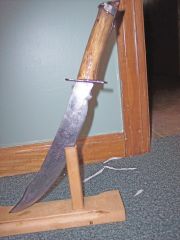 Which knife? The one he had in the beginning of Fellowship or the one the elves gave him?
 -
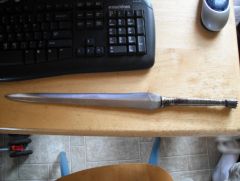 I like it. Elegant, yet simple
 -
By not using the same solvent for each stone, do you mean one actually has to switch whatever oil he is using, or just to completely clean the blade of said solvent before moving to the next stone. Also, I have two stones (though one has two different grits, one on each side) and I don't know what grit they are. Is there any good way to find out? (I got them from my dad, so I don't even know the manufacturer)
-
I've never heard about vinegar before either. So, you just leave it in vinegar overnight or for a few days and the scale goes away? That just feels way too easy. I've had to struggle SO hard to get scale off with sandpaper...
-
How thick is the large knife? I like the shape a lot, but you might have been able to grind/polish out some of those marks without making it too thin. On the snakeskin thing, I have to say: that is one cool pattern. I think I understand the principle: either grind the teeth off after forging the blade, or hammer them into the blade. Please correct me if I'm wrong though, I'm just guessing.
-
What exactly is the composition of brine? I know its salt and water, but what's the ratio?
-
Not to bash the japanese, but I like the handle style used here more than the original. Tradition more often hinders progress than helps it. Anyway, that's a beautiful knife, and if I had understood the explanation of how you polished it, I would mimic you. However, I'm a novice, so I've just learned to deal with my ineptitude.
-
I've heard that using things other than oil can cause the blade to crack or even shatter when immersed. I'll wait for someone to back me up on that, but I'm pretty sure.
-
For the heat treats I've done, I use old frying oil. it seems to work ok, though it does leave some undesirable crud on the blade.
-
I don't have a problem with video games (seeing how I may make my living off of making them) but I must admit that making knives is far more educational, intuitive, creative, and entertaining than any simulation ever could be.
-
That's not a small pic if you click on it. Anyway, lookin' good.