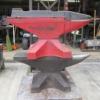
July 22, 201015 yr I let the monster out of the cage...I found out the location of the big Fisher anvil back in 1999. It was sitting in a basement vault of the NJ State Museum. How it got there will be in my book. Long story short, after budget problems, rotating curators, a museum shutdown for a few years, I finally made contact with a curator who seems to be staying around. I made an appeal to borrow the anvil to get it to Blacksmithing events, ABANA shows, and the like. In-between I would keep it at my museum collection. Well, now there is interest in it, so they decided to put it in a display of items made in NJ. The exhibit just opened a few weeks ago. Today, I went to visit. They did a nice job of placing the anvil as the first item you see as you enter the exhibit. I had forgotten how big it is. Dimensions, roughly are 60" long, 22" tall, and about 9" face. This is the anvil that was made for the Centenial Exhibit of 1876 in Philadelphia. A picture of the anvil on the top of the Fisher & Norris exhibit is in Postman's book. The 1400 lb weight has never been confirmed by a certified scale. Someday, that will have to be done. The exhibit is on indefinately. Hopefully, they will let me borrow it once the exhibit closes. Who knows. I have included one photo with a dollar bill for scale. The guard took the photo while I held the bill. He would not let me put the bill against the base.
July 22, 201015 yr Very nice. It looks like a coffee table. I've heard that they won't allow anyone to handle it without the white gloves. Is that true?
July 22, 201015 yr I'm looking at the 1st picture, and I don't see a pritchel hole. Is there one there?
July 22, 201015 yr Author Very nice. It looks like a coffee table. I've heard that they won't allow anyone to handle it without the white gloves. Is that true? The anvil sat outside of the original foundry for about 80 years. Then it sat outside on the owners farm for 15 years. When I found it in 1999, it was white gloves or no touch. I guess they figured that I have the "rust" touch or something. I wore the gloves to measure it and to move it for photos. If you visit my museum, you all have permission to touch, hug or inspect any of my anvils all you want.
July 22, 201015 yr If you visit my museum, you all have permission to touch, hug or inspect any of my anvils all you want. I hope you don't have to pat people down for trying to "hug" an anvil out under their jacket! Phil
July 22, 201015 yr Josh, I remember Bob telling me that as a kid they would use it as a seating bench when it was on the back porch of the house. Nice pictures, thanks for sharing them. I have to get down there and see the exhibit one of these days. I just recently got the check for making all of the stands for the didactic panels in that exhibition but I haven't seen it installed. Steve G
July 23, 201015 yr Author That is a beautiful anvil I love the trade mark. I find it interesting that the logo on the 1400 is totally different from any of their other logos. And on the "wrong" side. And no FISHER on the anvil. I have the exact dimensions in my notes in the museum, but I believe the hardy hole is 2 1/2", and the pritchel hole is 1". There are no hammer marks on the face. I do not believe it was ever used for anything except to sit on.
July 23, 201015 yr How did they shape the face plates on Fisher anvils? Were they forged to shape, cast or machined?
July 23, 201015 yr Author How did they shape the face plates on Fisher anvils? Were they forged to shape, cast or machined? The face plates were cut from 0-1 steel of the appropriate width and thickness for the size anvil being made. The horn plates were cast steel, made from patterns supplied by FN. I have never found out who made the horn castings for them, in any era of their existance. The early Fisher anvils used English 'Jasper' steel on the top. I guess the quality of steel available in US was not of a high enough quality.
July 23, 201015 yr From memory cause I don't have the book w/ me: Didn't Mr. Postman speculate that this piece was all cast with no steel face, as a promo piece?
July 23, 201015 yr Author From memory cause I don't have the book w/ me: Didn't Mr. Postman speculate that this piece was all cast with no steel face, as a promo piece? We both believe that it is a fully functioning anvil, with steel faces. The rust dimples are different on the faces than on the sides.
July 23, 201015 yr The face plates were cut from 0-1 steel of the appropriate width and thickness for the size anvil being made. The horn plates were cast steel, made from patterns supplied by FN. I have never found out who made the horn castings for them, in any era of their existance. The early Fisher anvils used English 'Jasper' steel on the top. I guess the quality of steel available in US was not of a high enough quality. So I guess O1 steel has been around for wile.
October 28, 201213 yr does anyone else hear angels singing when they look at this anvil???makes the 500lber i use to work on ,lok like a baby!!!! amazing!!!
Join the conversation
You can post now and register later. If you have an account, sign in now to post with your account.