September 18, 20169 yr Recently aquired this great bellows. My plan is to restore it and put it to use in my proposed shop. The wood is pretty much sound but of course all the leather will need replaced. I frequently get the opportunity to work a forge with a bellows similar to this one. I love them, and much prefer to a crank blower. Love to hear the soft clack of the valves and the natural rhythm. Anyone using bellows for forge work? Any tips on restoration?
September 19, 20169 yr Yes. That big or more. New leather? You generally want to take it to a leather shop. Or buy leather and DIY.
September 19, 20169 yr This is not from personal experience, but I hear tell that mounting the bellows above the height of the firepot keeps coal gas from sinking down into the bellows and causing a blow-out when they're pumped. More discussion on this thread.
September 19, 20169 yr I can and have a pretty good pop. An explosion? Maybe so. It sends the counterweight airborn. No damage so far. Three in six years time. If I knew what caused it I'd be more careful. But when it did; I had just added water to forge fire. You don't need water anyhow. I stopped using it years ago. Never an explosion since then.
September 19, 20169 yr At a demo the bellows *POPED* and sounded like a black powder riffle going off. Definitely got my attention. The same thing can happen on a hand crank blower but that is usually a pop, or whoomp.
September 19, 20169 yr Adding too much water to a forge fire can make a nice explosion, I mean big bang and big flames, I'm not a chemist but it's something to do with the hydrogen and the oxygen and the flames, not a good mix. Dont ask how I know.
September 19, 20169 yr Hahaha it's a long story mate, but a trap for new players is a side-draft forge, a good bed of coke and a good dipper full of water, sounds like a shot-gun, shots flames back down beside the tuyere and a ball of flames 2' round above the forge, ohh and nearly a soiled pair of jeans. Dont try it at home.
September 19, 20169 yr 7 hours ago, turbo7 said: Adding too much water to a forge fire can make a nice explosion, I mean big bang and big flames, I'm not a chemist but it's something to do with the hydrogen and the oxygen and the flames, not a good mix. Dont ask how I know. Coal gasification: coal + water + heat = methane (CH4), carbon monoxide (CO), free hydrogen (H2), carbon dioxide (CO2), and water vapor (H2O). This mixture (often called "town gas") was the primary gas used for heating and lighting before the development of technology for natural gas drilling and transportation. Most towns had a gasworks where coal could be processed locally; my town actually has one of the few remaining round gashouses in Ohio, currently being converted into a museum of the Underground Railroad. On the practical side, any coal gas produced when we water our forge fires usually gets burned up in the fire, and we don't even notice. If we turn off the blast (stop pumping the bellows, cranking the hand blower, or shut off the electric one) and water the forge, the resulting gas settles in the lowest point it can reach. If that's in the blower or the bellows, when we start the blast up again, we're injecting an explosive gas/air mixture into the hot fire, which then go boom.
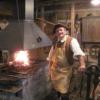
September 19, 20169 yr The best method to counteract the pop with the bellows is to have a head of air when water is applied (lightly sprinkled) and continue for 30 seconds or more. Same may be true for a crank blower? I only use the crank blowers on factory or home built forges, never with the large hearth forge. Below is the coal gas house in Oberlin and the hearth forge with bellows My father informed me that a fellow had died inside. He apparently could not locate a corner to take a leak in.
September 19, 20169 yr Author My plan is to locate the belows overhead to save floorspace. This should help prevent heavier than air gas migrating to bellows and hopefully discourage rodents as well. The museum shop I forge in has a set up similar to the one pictured above. We seldom use much water, but what you said is true, keep the blast going while adding it. We had one incident a while back that was similar to a "town gas" explosion. The smith put a paper bag with some burned out candle stubs in the tuyre to start the fire. What we asumed must of happenend is all the parifin did not burn, but some of it melted into the bottom of the pot and then gassified. He had his back to the fire at his anvil and when I begin to pump we had a pretty good explosion with the prettiest blue halo of flame rolling up the chimney. He thought someone had fired a cannon. Luckily no damage was done.
Join the conversation
You can post now and register later. If you have an account, sign in now to post with your account.