March 13, 201610 yr In order to shoulder the shank on a hardy hole tool, you sometimes have to upset the boundary between the shank and the business end. This should be done at a yellow-white heat, and can be done using the hardy hole of the anvil, albeit carefully!!!! We had a meeting yesterday of the Philadelphia Blacksmiths Guild, in which I showed people how to forge hardies. The meeting took place at the shop o hwned by Lincoln Wolfe at his Hay Budden Museum. The anvil we used was a 330 pound Hay Budden, sporting a 1 3/8" hardy hole. All five anvils in my shop have 1 3/8" hardy holes, because I HATE making excess tools for five different hardy hole sizes. The Guild member needed a hardy to fit his identical 1 3/8 hardy on his own personal anvil. With the hot shank dropped into the hardy hole at a yellow heat, using a humongous axle shaft as stock, we upset the shoulder using ten pound sledges. The INSTANT the tool cooled down to orange heat, we removed it from the hardy hole to reheat. Why????? Because it is catastrophic to get the shank stuck in the hot hardy hole, so it gets removed from the BOTTOM OF THE HARDY HOLE to be reheated, using a punch from UNDERNEATH. If you do not remove the shank thusly, you risk busting the heel off your anvil. Reheat, and upset again, until you have a pronounced shoulder on your tool!
March 13, 201610 yr Interesting. Can using steel that large remove the temper of the anvil? Well I know this is a 330 pound anvil, but what about say a 150 pound anvil?
March 13, 201610 yr I've always used a striking anvil or a sort of bolster block and upseted my anvil hardies. I have a peddinghaus and they put the hardy hole in the front of the anvil instead on the heel and this seems to be a much beefier area for it. I dont think it would hurt a 330 lb. Anvil but a 150 or under your asking for trouble beating on it with a sledge. It may take a while but when that time comes (snap). Ive actually made a tool for my hydraulic press that you can upset a hardie in seconds.
March 14, 201610 yr Mark Aspery describes creating a "portable Hole" for use in creating shouldered anvil tools. Chapter 16 : Anvil Bottom Tools The Skills of a Blacksmith, Volume I, Mastering the Fundamentals of Blacksmithing WWW.markaspery.net
March 14, 201610 yr 4 hours ago, Charlotte said: 4 hours ago, Charlotte said: Mark Aspery describes creating a "portable Hole" for use in creating shouldered anvil tools. Chapter 16 : Anvil Bottom Tools The Skills of a Blacksmith, Volume I, Mastering the Fundamentals of Blacksmithing WWW.markaspery.net Mark Aspery describes creating a "portable Hole" for use in creating shouldered anvil tools. Chapter 16 : Anvil Bottom Tools The Skills of a Blacksmith, Volume I, Mastering the Fundamentals of Blacksmithing WWW.markaspery.net Yep, that's what I plan to make. Especially because my hardy hole is messed up.
March 17, 201610 yr Is there a picture or drawing of a "portable hole" somewhere. On the net or in a book? I checked out the Aspery site, that you indicated, and did not see it. Mister. Stuart Smith, what weight do the Big anvil size category start at? I thank you all for, any answers to my questions. Cheers SLAG.
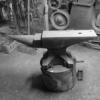
March 17, 201610 yr 3 minutes ago, SLAG said: Is there a picture or drawing of a "portable hole" somewhere. On the net or in a book? I checked out the Aspery site, that you indicated, and did not see it. Mister. Stuart Smith, what weight do the Big anvil size category start at? I thank you all for, any answers to my questions. Cheers SLAG. From DSW: Sorry, about the confusion. Frosty coined this my "portable hole" and I've posted it fairly regularly lately to new guys who have "anvils" with no hardy hole. It's simply a piece of 3/8" wall 4x4 square tube on a 6x6" 1/4" thick base with a piece of 1" thick steel welded to the top with a square hole in it matching the 1" hardy hole in my smaller anvil ( bigger anvil has a 1 1/2" hole). Not shown in these picts are the hole in the base underneath in case you need to drive a tool back out if it gets stuck, and the 4 mounting holes in the base I drilled after taking these picts.
March 17, 201610 yr I didn't say THAT was y portable hole did I? I think I described one I'd cobbled together some years before I had an anvil in a long ago post but I can't imagine I ever claimed that beauty as mine. Unless I committed a typo I guess. Frosty The Lucky.
March 17, 201610 yr Buzz, Thank you for your recent answer. It is much appreciated. I know that reposting your "portable hole answer with pictures could become tiresome. My excuse is that my library will be coming out of storage shortly. (I had a nine year hiatous from smithing, due to a messy divorce, costly settlement & international move). Mr. Frosty please do not apologize, your input here is invaluable for me and many others at I.F.I. If had to pay a dollar for every mistake I have made, I would need three incarnations to pay it off. ( a little like some of the debt load many college students owe). Cheers. SLAG.
March 17, 201610 yr No prob. Just to clarify though - that portable hole was posted by DSW. It was his design and his pics. I just found it and reposted it.
March 18, 201610 yr That portable Hardy was shown in Mark Aspery's first book and a video on YouTube called ring project 4 swage or something like that.
March 28, 201610 yr I like my striking anvil for upsetting hardies. It's two layers of forklift tine welded together 4140 steel. Does a wonderful job and has two size hardy holes to choose from . I welded in tubes in this case because I didn't have anybody to waterjet the holes for a good price.
March 28, 201610 yr that's a first, Ive never seen one with two hardy hole sizes. very smart, especially if you have two different anvils with two different sized hardy holes. Littleblacksmith
March 28, 201610 yr We just do it under the power hammer thanks to some tooling and have never had a shank get stuck as the metal contracts as it cools. J
April 10, 201610 yr Lots of good ideas here to avoid breaking the heel off of your anvil. I will be making one of these soon. I have a 2' piece of 2" sch 160 pipe with a 1500 ansi flange welded on the end used it already to upset the face of a flatter out of 1 1/2" pump shaft should be able to mount a hardie hole plate on top of that. Like the forklift fork idea. You could probably blow a hole in that with a torch, would ruin the temper but still be a lot tougher than mild steel, is that what you did forgeman32 to fit the square tubing through? If I can find a fork that is. Thanks
Join the conversation
You can post now and register later. If you have an account, sign in now to post with your account.