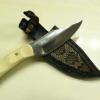
August 27, 201213 yr Hey all, I make knives from a large sawblade that I acquired from a sawmill. Blanks are cut with plasma and I am very careful not to overheat while dunking in water in between each pass on the sander while shaping. I then go straight to polishing. These knives seem to hold a fairly good edge. Can anyone give me feedback on wether or not I should be taking an extra step to heat treat? I've been told this steel should hard as is as long as I don't heat to much. Also I have another issue. I was cutting a hot steak on the grill on Saturday and my knife turned colors. Like a mother of pearl swirl almost like it was overheated. Looks like it has to be re-buffed to remove. Anyone ever have this happen? Can anyone help on these 2 questions? Thank you, Lance
August 27, 201213 yr Lance any of the normal methods to check youir heat treat process will give yoiu the answers you ae looking for. The colors you see on your bladee are normal oxidation signs that shiny steel displays. The colors are a good sign as to how much heat was applied and how long it was there. yoiu did nto mention the colors so I will refer you to the heat treat stickies so youi can research. In late October we will have a knife chat on this site that will include heat treat and testing for makers. More information on that is on the home page, under keeping you informed.
August 27, 201213 yr If it's hard enough for *you* then it's the correct hardness. Why do you care that other people may prefer a harder or a softer blade? If you are making them for other people then make them to suit *their* preferences! Look up "temper colors" sounds like you were getting to the peacock stage. As long as the temperature was *below* the original tempering temp you have done no damage. If it was above the tempering temp than the blade is now softer than it was and will remain that way unless you totally redo the heat treat. It is generally a good idea not to heat blades up in use as temps that do not affect the hardness can still destroy handle materials.
August 27, 201213 yr Author Thank you both for your replies. Rich, It is like a swirling blue-purple. What is most peculiar to me is that steak on a grill is roughly 150-160 degrees when done. That shouldn't discolor under a low temp like that correct? I have used a 25 yr old Schrade Uncle Henry as my steak knife on many hunting trips and it's still shiny. Thomas, I guess I prefer a harder knife because I like a knife that holds an edge rather than a knife that is easier to sharpen. Most of my knives are gifts but if I start selling them, I'd like to know that they will hold up and that the method I use is effective. You are absolutely right though in building to suit their needs. Thank you for the info on the chart.
August 27, 201213 yr It's not 100% decernable as to what you will get out of used either sawmill circular or band saw blades. You do not know if the blade got jambed in one spot and got hot which will make that spot brittle. Sometimes you will have a blank heat treated and a fracture will develope that you could not detect before. In my experience circular sawmill blades are generaly good so long as there were not overheated. Sawmill band saw blades have about 30% of the used blade that is still usable for knives and will heat treat well enough. Otherwise you have to forge weld that steel to ensure that there are no stress fractures and even structure. I tend to heat treat scrap steel a little less intensely and use thicker than normal quenching oil. Also saw blade steels such as M2 and M4 (most common for those applications) are rust magnets. It is fairly easy to get about 56-58RCH and have the blade with some flexability.
August 27, 201213 yr Author I actually use circular only but never thought about what possible abuses the blade could have been through before winding up in my hands. Thank you for this info as it is quite helpful.
August 27, 201213 yr I actually use circular only but never thought about what possible abuses the blade could have been through before winding up in my hands. Thank you for this info as it is quite helpful. You can clean the knife blank and stick it in a mason jar filled with boiling vinegar. A patena will form and the fractures and uneven heat sections will come out. Works well for small thiner knives, but not so much on larger & thicker blades. It will save you time and resources before you heat treat or start forming the blade.
August 27, 201213 yr I have avoided M2 steel, one of the reasons is if youi fully harden and temper at over one thouisand degrees they say it is going to test between 60 to 65 Rockwell c Scale, to get that dowon to a useable knfe hardness is going to be touigh for someone without a heat controllable oven. Might cn use temp;il sticks but a bit hit and miss for me.. http://www.suppliersonline.com/propertypages/M2.asp#General
August 27, 201213 yr I have had limited experience with M-2 but I was able to determine that the M is for Miserable and the 2 is for Squared.
August 27, 201213 yr Author Thank you for the comments. Is there a better machinable steel for someone not set up to heat treat? Blades are all I have ever used.
August 27, 201213 yr try M2 with A2 and D2 for a pattern welded billet, My teacher that assigned me this is a demented man....
August 28, 201213 yr Thank you for the comments. Is there a better machinable steel for someone not set up to heat treat? Blades are all I have ever used. The easiest most forgiving steel i know of is aisi-1080 / 1084 and it can be air quenched . The cold steel bushman knife is made with this steel, so you can look that up on youtube if you want to see how it reacts.http://www.knivesby....ating-1084.html You could also try one of the lower 10 series steel such as 1040 or 1045. You won't get a high hardness but it will be easy to sharpen.
August 28, 201213 yr In the link you posted it actually says to harden 1084 to use an oil quench, I had to check youir link as I have never had 1084 air harden. But i really like it for knives after oil quench and proper temper.
August 28, 201213 yr There's one unmentioned possibility that may well have happened. I find it hard to accept that a blade slicing a steak on a grill would get hot enough to draw it's temper. There is the possibility the steak juices plus a little heat caused some weird oxidization. If you ribbed, spiced or marinated the steak this is a LOT more likely and in fact where I'd lay my money. I have an old Buck sheath knife my Father bought me as a kid, back when buck steel was ash grey and harder than the hubs of . . . purgatory. (fooled ya Glenn! <Grin>) Anyway, we were camping and I cut into a hot but not cooked potato and it stained/ patinaed the blade with black bands that will NOT come out. I haven't tried polishing them out but have tried vinegar, etc. Anyhow, the staining on your blade may be chemical rather than temper colors. Frosty The Lucky.
August 28, 201213 yr Frosty; potato water makes a decent pickle. It has a similar effect to sparex. IME Buck knife steel has seemed pretty soft. I think it needs to be tempered way back to hammer through those bolts cold, the way they advertise it!
August 28, 201213 yr Author All good info. Frosty, I believe you hit it on the head. I thought this could be a possible chemical reaction rather than heat. It was some fillet mignons wrapped in bacon and very juicy. Rich said oxidation also. Thanks again for al the help.
August 28, 201213 yr Author Speaking of knife hardness, I have never had a harder knife than my Uncle Henry. It is stamped LB7 and was difficult to resharpen back when I was new to knives. Now it's sharp and it stays sharp.
August 29, 201213 yr I have a question about your first post. The sawmill blades you are cutting out, you say they are cut out with plasma do you mean a plasma cutter? Surely if the saw blade is heat treated already, the plasma cutter will definately ruin the heat treat. I am just confused. Do you heat treat them at some point, or are you relying on the heat treat that the saw blade has when you get it? -Adam
Join the conversation
You can post now and register later. If you have an account, sign in now to post with your account.