maddog
Members
-
Joined
-
Last visited
Everything posted by maddog
-
I use stick, oxy acetylene , & forge welding. Stick and acetylene are both very versatile and the equipment is comparatively cheap as compared to a decent mig setup. Stick will do very heavy welds, its easy to change out and theres a wide variety of rods. Mig is definitely cleaner, easier to master and superior in production mode. For the small stuff I use the oxy acetylene. The torch is useful for a whole lot of other things too. For cutting and heating I have an Allstates propane torch.
-
magnetic slag!! excellent tip. Of course it would be magnetic from the iron in the coating. I will run a few beads and test for that. I use mostly 6010 and 7018. I got over 100# of 7014 in various sizes for next to nothing and I have been running that too. The mystery rods came with the 7014. They definitely are not 6010. Soft arc, heavy slag and easy to get a pretty bead. Thankyou Follow up: Well I tested it. The slag is magnetic. I am going to assume the one rod is 7018 and the other 7024. That will be good enough. I wont use the "7018" for HC steel just in case Thanks for all the advice
-
Hot filing is usually done with a very coarse file or a farrier's rasp. It has to be done fast while the steel is hot enough - yellow to orange. The result is much coarser than cold filing but like woody says, it hogs a lot of material. If you are good enough, cold filing can produce surfaces accurate to a machinist prescision. A common use of hot filing is to remove the rag left by a chisel cut. Finally if you do cold file a forged piece, its best to remove some of the scale first because the scale is very abrasive and wears the file.
-
I have about 60# and 30# each of two kinds of unlabeled mystery rod. One is grey 1/8" with a blue dot on the grip end of the rod. No other markings. It runs a lot like 7108, nice bead, heavy slag that comes off easy. It does vertical up with no problem. Dont really need to whip. my guess is 7018. The other is orangey brown with a yellow dot at the end and again no other markings. This runs similar to the grey rod but more liquid. It can go uphill but its like herding cats and the result is ugly. I am guessing 7014 on this one. Ive looked in the Lincoln book for the color codes but it seems I need at least one more color. I would appreciate any tips on identifying these rods Thanks
-
Thx for the advice. I do have some 308L which I picked up very cheaply. And yes, I definitely plan to preheat. I hate to keep asking but doesn anyone have a good method for putting a collar around the 1" stem so it sits on the hardy? I was thinking of notching 3/8" bar at one inch intervals, welding it on to the stem and welding in the corners to fill them. Thank you.
-
I have a collection of large and small ball bearings that I want to make into forming stakes by welding into a mild steel stem. I am thinking of using either 7018 or SS 309. Please advise. Thank you
-
I suggest one of those little wire feeds that lincoln & hobart/miller make. They run off 110v and they are very easy to use. They can do up to 1/4" Even larger if you preheat though the welds are not the best. I think they run about $150. Even if you do later upgrade to a bigger rig, its always nice to have something light that runs on a regular wall outlet. If you have $550 you can get a mig version which is very nice. Definitely go for a quality name brand. Avoid all the cheap stuff. I would stay away from stick until you can get 220v. Stick is much tougher to learn and very tricky with low currents. The fatter the rod the higher the current which means a more stable arc. AC is trickier too. If you do get a stick box, get DC if you can. Theres also a wider range of rods for DC and smiths often weld funny metals together. Any kind of welding takes practice. Its not a glue gun. The wire feeds are easiest but you still need to spend some time running beads and evaluating. I used to run beads for 20 mins every evening.
-
Thats too cute! I like the blacksmith sledgehammer grip. He'll be striking soon :)
-
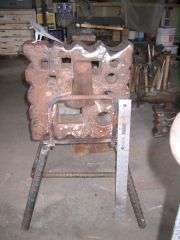
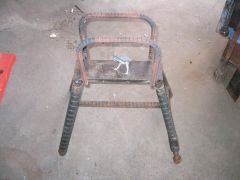
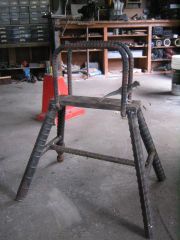
I am a bit surprised this project wasn't better recieved. Let me address some of the comments. I wanted a very sturdy stand. I mostly use the edge forms of this block as an adjunct to my anvil so that I dont need so many hardy tools. Also, this project is a pilot for the stand I plan to make for my 355# HB. The swedge stand works better than I hoped. Its very steady, no rock, no bouncing. I do sometimes use the face of the block, but right nearby I have a massive table weighing 1000# with 1" plate for its top. This table will support work under a sledge hammer without bouncing. Space is limited in my shop and I didnt want the extra footprint for a stand that holds the block face up. Also, I looked over all the designs I could find and decided that when trying to switch a 200# block from face to edge, or edge to edge, they would be awkward and finger pinchers. Certainly no better than using my table. Rebar is uncertain material. However, it is not to be dismissed out of hand. We depend on rebar to hold our buildings together and it doesnt often fail. Our industrial civilization would be impossible without reinforced concrete. Buying 2" hot rolled for the legs would have been prohibitively expensive and without rebar the stand would have b een flimsier. The piece is so overbuilt that I doubt any of the members would fail. The main concern was welding where one might encounter a high carbon region. I used 7104 rod which is similar 7018 suitable for HC steel and I designed the stand so that no single weld failure would be catastrophic. After all blacksmithing has a long tradition of scavenging and using things in creative ways. There is always some risk in this (whats in the guardrail posts that Frosty used?) but done with some thought and common sense its worthwhile.
-
I have plenty of pipe too though its mostly chopsaw cut w/o nipples. You are welcome to as much as you need if you pay the shipping. Id be happy to cut to lengths if you need.
-
Sorry. I am inexperienced. See other version of this thread
-
I finally mounted this block. Construction notes are in my gallery with the pix. T-Rex included for scale. IMG_3136 - Blacksmith Photo Gallery IMG_3135 - Blacksmith Photo Gallery IMG_3134 - Blacksmith Photo Gallery A bit of history: This block has some sentimental meaning to me. Old Lee used to run a machine/welding shop. He would always spend too much time on my small nuisance jobs and charge too little. He had started getting involved in blacksmithing in his shop. The last time I went by I found he had died and a welder was taking over the premises. I picked up this block and a few tools he had made. I make a point of keeping them all in service. I feel thats what he would have wanted.
-
-
If you hammer on a machinists vise all the force is transmitted to the ways and the screw. A blacksmith vise is constructed so that most of the force of the hammer blow is taken up by the fixed leg with very little on the hinge and none at all on the screw.
-
If you open up a discarded hard drive, at the base of the swing arm are two small very powerful rare earth magnets. If you let them click together they are hard to separate w/o a tool. Caution opening up a hard drive will almost surely ruin it for computer use. In old microwaves you can find a pair of nice ring magnets about 3" dia inside the klystron which looks like a tin can with fins on in usually mounted at the top and back. Pull the can apart to find the magnets. There is also a big high voltage cap usually at the back which looks like a flat tin bottle with terminals. I like to short this out first by putting a screwdriver across the terminals just in case its still holding a charge. I have never seen a spark but its a simple precaution.
-
I bought a Lincoln Tombstone AC only and could not run a decent bead. I took a community college class but that was mostly a lightweight survey of all welding processes and didnt really help much. I got a DC weldor and just practiced for 15 mins every day running beads. Filled many plates of scrap with stringers trying to get a nice bead with 6010. I also hung out on the welding forums where I learned a lot. Finally after about 50# of rod, I got the hang of it. I doubt I could get certified but I can do a decent job on the stuff I make for my shop. Stick is best suited to my shop. Its versatile, cheap, will weld heavy stuff and its very easy to switch from one kind of rod to another. For sheet metal I use oxy acet.
-
This sounds like a difficult project to me and not worth the trouble for the results. Of course if you wanna do it for the sake of doing it thats something else. Working with CI is tricky and best left to experts. You cant just bond the edges. You will have to get a join across the entire surface of the face. To get a good braze you need to mate the two surfaces close enough that the brazing material flows by capillary action. You will then need to heat the whole anvil & plate up to brazing temp. Phosphor bronze is often used with CI. Even brazing can induce stresses in CI when it cools. In this case you have two different metals with different coefficients of expansion bonded together and that also might cause problems. Then when you start working on it and the metal wants to spread the CI may not be willing to follow. Sounds like $1000 of work for a $10 payoff but if you are going to do it for fun it would be very interesting to hear how it turns out.
-
This is how I learned to weld rings from Frank Turley. Forget about round until it's welded. Scarf the ends at an angle. Bend into a U. Bend the arms of the U at 45 deg so the scarfs overlap properly (this is why the scarfs are angled). Flux heat and weld on the face of the anvil. Clean up the weld on the horn. Then work the welded piece into a ring and true up on a cone if you have one.
-
It is usually best not to weld on an anvil unless a. you really know what you are doing ( I make no assumptions about j@j's expertise) b. The anvil absolutely positively has to be repaired. Usually rounded edges are just fine and chips can be ground out to a smooth round. If you must have a square edge you can make a hardy tool. That said. Many smiths recondition their anvils with 7018 (I dunno the MIG equivalent) which is soft but workhardens some. It can also be rewelded easily when it wears. You can also use a high impact crush resistant hardfacing rod. Irnsrgn has a BP on this and I have used his method successfully on my Hay Budden. Its a bit soft but it wears very well with no tendency to spread or deform. Too soft is better than too hard. Finally be aware that any welding on the plate will detemper the plate at the boundaries of the weld.
-
Looks like a very good anvil and ready to go to work. IMO the only concern is the crack. I would wait and see what happens with that. The plate too can be repaired with 7018 which work hardens over time. Mild steel on the face works fine save that it wears faster and mushrooms faster. But then you can always reweld it later. I wouldnt touch the welded section for the moment. If the edge chips off you can fix that with one of the high impact crush resistant rods. Irnsrgn has a BP for that. I also wouldnt do much to the face and horn save knock off the worst of the rust.
-
I am sure this is a top tool. Mine shows evidence of being struck. Hammers always have two useful working faces. This is not in great condition but its clear the face was intended to have sq edges. Thank you all for your comments
-
I have a similar top tool that I got in a bucket of rusty stuff. An oval shaped face with square edges. I thought maybe some kind of set hammer? VINTAGE BLACKSMITH HAMMER VERY OLD UNIQUE TOOL ANVIL - eBay (item 350081320943 end time Jul-27-08 07:50:54 PDT)
-
That piece of heavy plate will make a great anvil. Personally I would stand it on edge not on end. On end it will tend to vibrate more as you have noticed when you reported the ring. In either case, I would definitely round the edges with radiuses (radii?) varying from 5/16" to 1/2" or larger. The nice thing about a block of mild steel is that if you do ding or wear it in one spot, you can easily just weld it up and grind it. This means you can be relaxed about learning and making mistakes.
-
I have the czech hammer, a hofi hammer and several Tom Clark - The finish and the quality on Clarks hammer is far superior to the Hofi, the czech is several steps below that. You can always rehandle a hammer
-
Gas forges do a poor job of mixing and burning the air and propane . You can often dramatically improve the performance of your forge by putting some firebrick or refractory rubble on the floor of the forge.