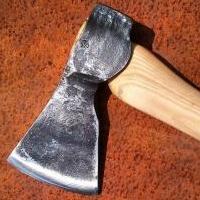
December 7, 201510 yr Here is something a little different. I have always been curious about the tanged axes used in Africa. I believe this design came about as a result of the scarcity of iron in this part of the world. The authentic axes use a heavy forked branch or tree root, and set the head in the strong knotted portion which is not not likely to split. The head can also be turned sideways and used as an adze. I made one so that I could experience how an axe of this variety 'feels'. It feels very good in the hand. The weight of the wood behind the head balances the whole thing well, it does not feel clumsy, as I suspected it would. This axe will not be used because the handle, being made from board wood, would split fairly easily. Total weight is around 1lb12oz. The head weights 8oz and is made from a truck leafspring. The handle is 20" long. It was made form scrap sugar maple pallet wood, hence the splits. https://www.youtube.com/watch?v=Mq9JOO2iOFM
December 8, 201510 yr As Africa has a long history of indigenous iron production I doubt that was the main reason. It wasn't any easer for Gauls, Romans, Vikings, Persians or any one else with bumidary furnaces. Just their salution to the problem. Nice work, nice Axe and thank you for sharing it.
December 8, 201510 yr It would be interesting to see some of the tools used by native craftsman use for their carpentry and carving. What I've seen in films and photographs has been tantalizing but not really detailed enough for reproduction. Your reproduction is fascinating and resembles some of the photographs I've seen
December 8, 201510 yr Author You can see some of the native tools in use in this documentary. One of the, if not the last iron smelt recorded in Africa.https://www.youtube.com/watch?v=RuCnZClWwpQ
December 8, 201510 yr Thanks for posting this! When I was there in 2006 I saw quite a few locally produced tools (mostly hoes but also axes, adzes, and weapons such as javelins and arrows) made by local smiths. This despite the fact that there was scrap available and of course western style tools with eyes. Unfortunately I was not a smith then and didn't document the tools while there. maybe next time. One thing I noticed is that it was easier to put a new handle on the local tools with material from the woods, and I also noticed that people would break down their tools by removing the blade for long treks when carrying an assembled tool was inconvenient. Additionally Japanese adze's have a construction where a tang is fitted to the handle without an eye, though not close enough that I would call it similar to the African version. Obviously I am very curious about the African style tools and will be making some as soon as I get the handle material.
December 9, 201510 yr Author I just saw this alternative to using knotted branch. To prevent the wood from splitting you can either bolt, or rivet the wood above and below where the tang enters.
December 10, 201510 yr Cool work Paul! and as an African ironwork enthusiast I'm very glad to see a tanged axe here. Without trying to hijack your topic I'd share my interpretation of the same object. I aimed for a prestige weapon which has no actual military or utilitarian function, but is still sturdy enough to take some abuse. These kind of artifacts were not uncommon in the Central-African area, the ironwork of which I like the best. Although my work is totally my own design and no replica of any existing one. (At least I think so.) I can't remember the actual measurements. It's about 1,5' long and the length of the head is around 8". The blade is car leaf spring forge welded to WI. The haft is mulberry root, extremly lightweight and surprisingly sturdy. The wiring is copper and did not went as well as I hoped. It has no stabilizing role, the burnt in tang holds quite well. (Done some testing ) Bests to all of you: Gergely
December 11, 201510 yr On December 7, 2015 at 10:48:05 PM, PaulKrzysz said: You can see some of the native tools in use in this documentary. One of the, if not the last iron smelt recorded in Africa.https://www.youtube.com/watch?v=RuCnZClWwpQ Thanks for that link. It's something else to see how it's done with year one technology instead of using electricity and a 'proper' anvil. Btw that's a good lookin axe, I like it.
December 11, 201510 yr Author On 12/10/2015 at 0:41 PM, Gergely said: Cool work Paul! and as an African ironwork enthusiast I'm very glad to see a tanged axe here. Without trying to hijack your topic I'd share my interpretation of the same object. I aimed for a prestige weapon which has no actual military or utilitarian function, but is still sturdy enough to take some abuse. These kind of artifacts were not uncommon in the Central-African area, the ironwork of which I like the best. Although my work is totally my own design and no replica of any existing one. (At least I think so.) I can't remember the actual measurements. It's about 1,5' long and the length of the head is around 8". The blade is car leaf spring forge welded to WI. The haft is mulberry root, extremly lightweight and surprisingly sturdy. The wiring is copper and did not went as well as I hoped. It has no stabilizing role, the burnt in tang holds quite well. (Done some testing ) Bests to all of you: Gergely Nice work
Join the conversation
You can post now and register later. If you have an account, sign in now to post with your account.