Paul_Lake_Echo
Members
-
Joined
-
Last visited
-
I hope this is an OK place to post this. I'm trying to make a few chisels from an old truck coil spring. I annealed sections, and they softened up nicely. They were easy to work on, and I got the shapes I wanted (curved, a couple of eye punches, and a butcher hand punch). I quenched them in old transmission fluid and then tempered them at 450 F for a couple of hours in a toaster oven. The problem is they are too soft. My guess is because I only had a small amount of transmission fluid, probably 2/3rds or a quart, it was too hot for the quench. It flashed a lot of flames on the surface, especially with the 2nd, 3rd and 4th quench. I can't easily get a few buckets full or more. The question is, will they be as brittle as glass if I redo them and quench them in water? If so, will tempering them at 450 F for a couple of hours and then letting them air-cool work? I don't know what kind of steel they are other than the springs spark nicely with a grinder. I suspect they are fairly high-carbon steel, and I hope they will work. Do you guys have any suggestions? - Paul
-
Chad J., that's pretty nice work. I wish I was 1/4th as good. I like the "knots," etc. You make it look easy! Also, the knife from the railroad spikes marathon is an effort and a half. And jlpservicesinc, those chisels are as good as new. It's better than buying new ones—if you can even find that quality these days. I don't know about chisels, and I hope they aren't—but do they case harden some brands like they do with files? In the late 1970s, I knew a fellow who used to make chisels out of old files. I tried that a few years ago only to find they were mild steel with about 1/32md of an inch of tool steel on the outside. - Paul I decided to try making a double-leafed hook from a single piece of steel without welding. I started with a piece of 1-inch square stock, notched it with a cutting blade on an angle grinder, and three days later (it's hot and humid here), I got what I wanted. I don't think I would do it again. Making the leaves individually and welding them together makes a lot more sense. - Paul


-
Nice work! I wish I had that talent. The ceiling hanger, in particular, looks A1. What do you season (or paint) it with? All I ever use is the standard linseed/turpentine/beeswax concoction. I'm looking for better ideas. Anyhow, I reiterate . . . your work is top draw. - Paul
-
Meh. The hook is just "OK." I ventured into a chiselled design and, yet again, made it too long. However, there is always tomorrow. The sword is something I made in 2018 out of 1085. - Paul


-
Just so. I did a lot of trial and error on the screw holes and came up with the same solution. I had to "sacrifice" a good centre punch to make the rounded one. The slight bulge is indeed eye-catching. I always learn by trial and error. My wife calls the ones with the long shank to the hook "giraffe hooks." I think she is on to something. :-) A couple of days ago, I acquired two old car coil springs. I annealed a section about 10 inches long overnight. Today, I'm going to make it into a punch to replace the one I made into a rounded one. Then quench and temper it. - Paul
-
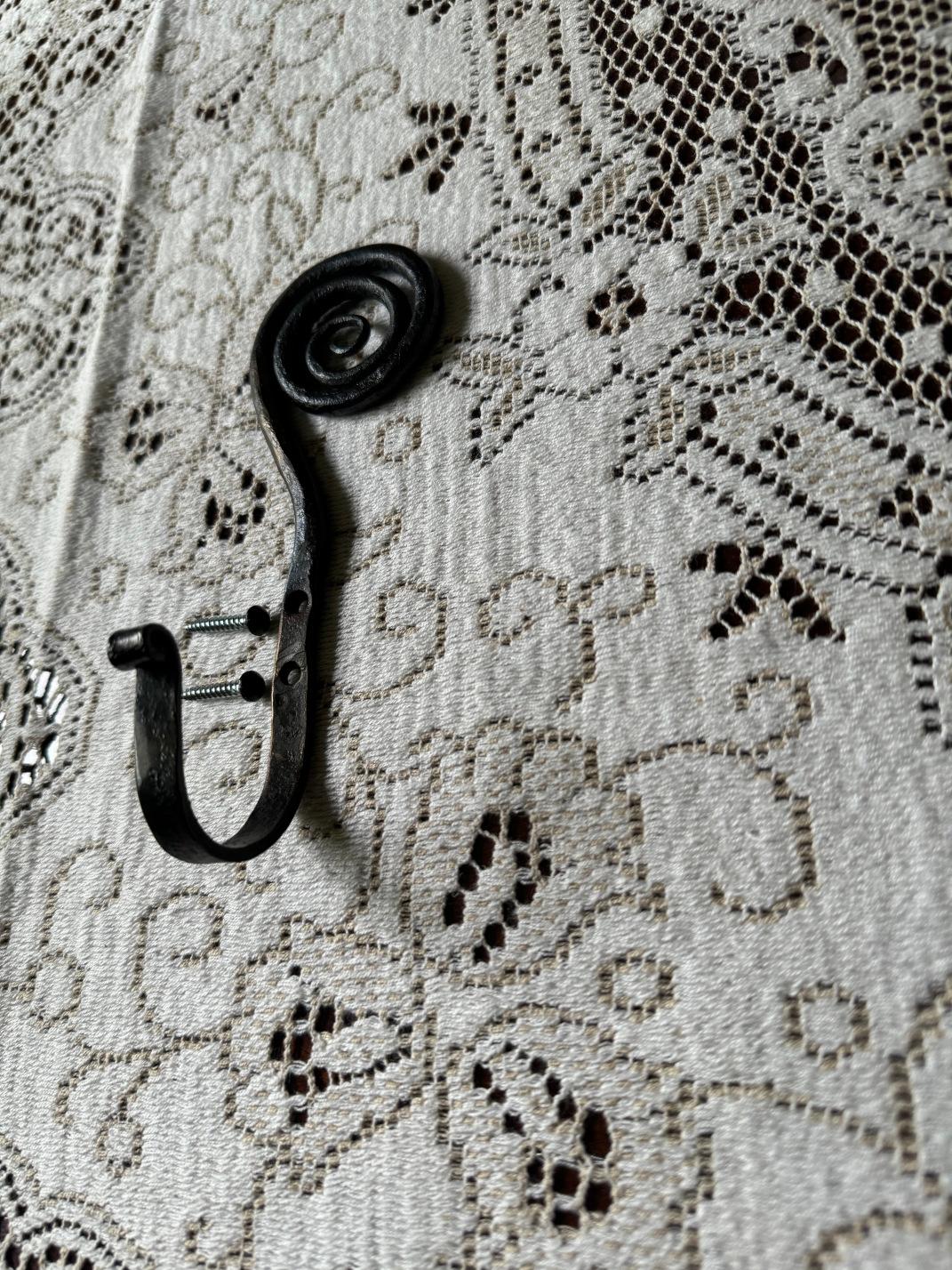
Yesterday, I took your advice and made a stubbier hook, and I think it looks better. Is this close to what you suggested?

-
Me either. One has to be both very good at it and a wise business person to make a living doing so. I am neither. But I love moving steel and learning new ways to make things. I have been doing this off and on since 2016, but the early effort was more brute force and ignorance than art. These days, I'm trying to make things smaller and better looking. Here's what I managed to do in the past couple of months. There are some duplicates, and I gave some away. - Paul

-
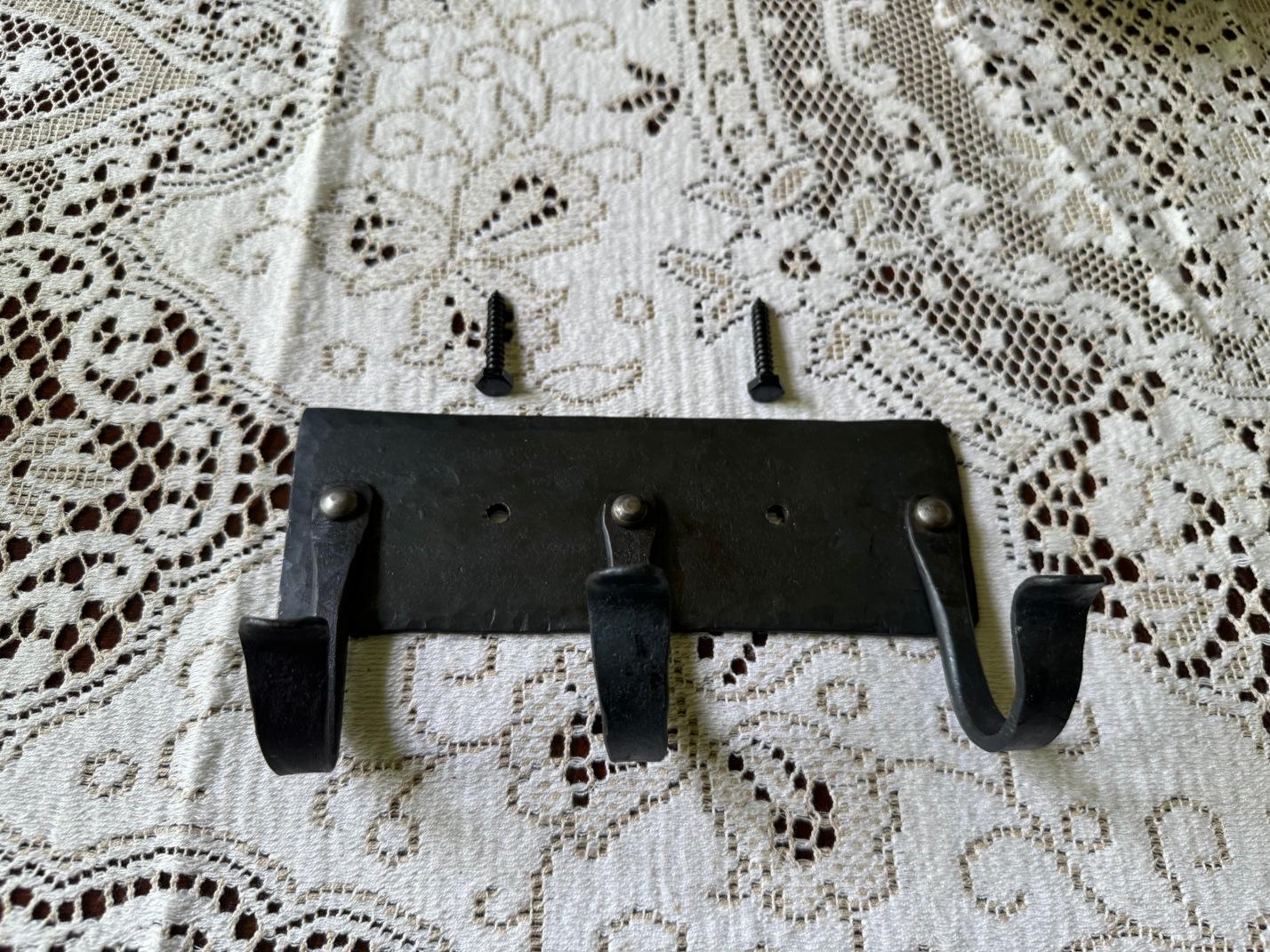
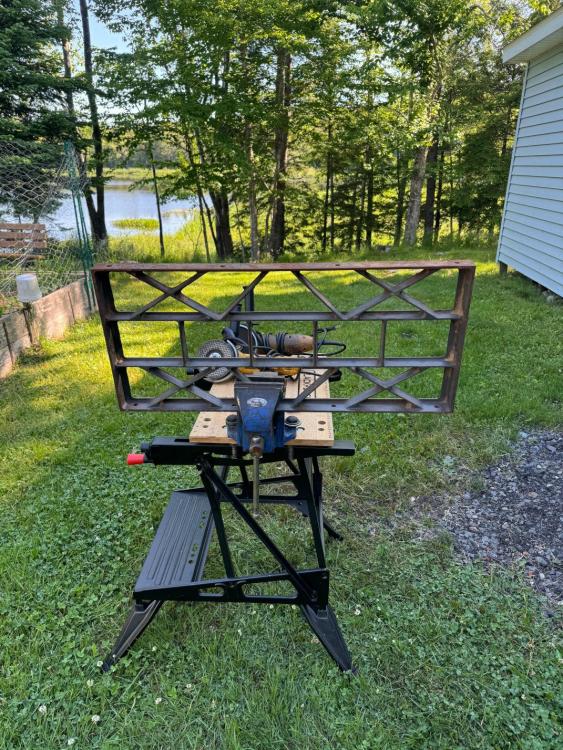
A neighbour gave me some "steel" he salvaged from an old table saw. I was suspicious of the metal; I thought it was cast. I cut a piece off and made it into a back plate for a three-item coat hook. It's a joy to work hot, but when I tried to rivet it - CRACK! Looking at the coarse grain, I see why. I took a piece of mild steel and finished the project, and it's OK. The question I have for the gurus is, what do I do with this table saw mystery metal? I think it's cast iron, but I don't know how to tell. Whatever it is, it works well when hot, drills nicely, etc. Is the best guess, looking at the photos, that it is cast iron? I have no idea how old it is, but I'm pretty sure it's not from the 21st century. - Paul


-
Wow, JHCC! How long have you been blacksmithing? Talent like this does not occur in a few months. Great work. I took a screenshot of your design. As I get better, I will try to replicate your work. I'm off to make something . . . It's 8:40 AM here, and I don't want to waste the cooler temps in the AM. - Paul
-
Thanks, GrazyGoatLady. I appreciate the feedback. I read your post about the sweat getting in your eyes and the temperature being 90 F. It's only 75 F or so here, but it'll be 85-90 F on Wednesday and Thursday. This is our first heat wave of the year. I don't know how you folks stand it. Hopefully, it's not humid. We get a lot of humidity being close to the ocean, and if that's the case, there'll be no blacksmithing here near the end of the week. - Paul
-
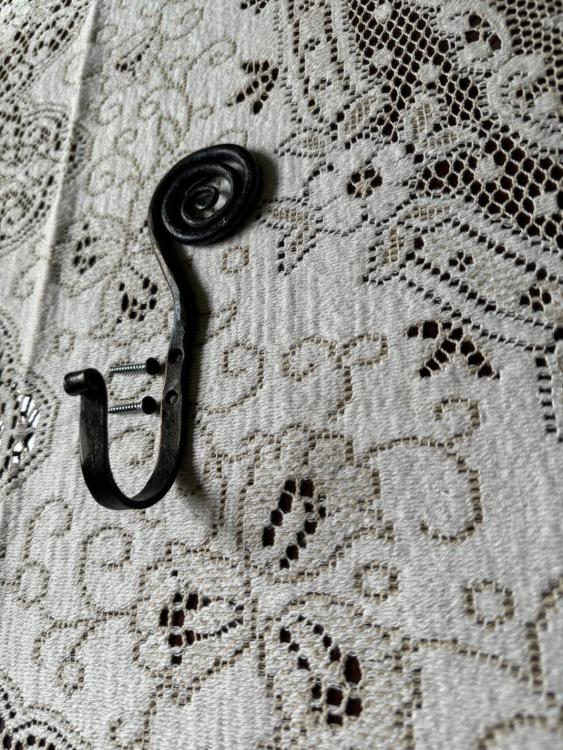
Thanks for the idea, JHCC. I did just that yesterday after reading your suggestion. It might have been OK as it was, but Murphy's Law suggests it would have broken off when I needed it the most. I appreciate the feedback from those with the experience and wisdom I lack! :-) This is a bit "top-heavy" looking, but it's my first attempt at scrolling. I think the next one will be better. Practice makes perfect (or at least better than the last time.) - Paul
-
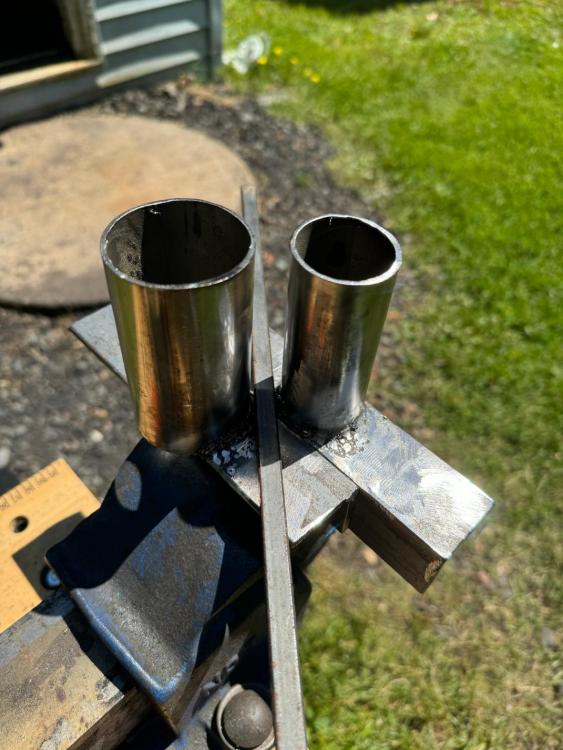
Beautiful work, JHCC. I was lucky enough to visit the Azores 12 years ago, and I bought those style tiles for my amateur radio call sign VE1DX. Now I have an idea how to display them. I made a "universal" bending jig today. Unfortunately, all I could find was tubing, not thick-walled pipe. It'll do for small things, but I need something stronger long-term. - Paul
-
At age 7 or 8, I started making "horseshoes" out of copper wire using the side draft of my grandparents' wood stove. I had an old claw hammer and I don't remember what I used as an anvil. Likely a flat rock. I remember sitting on the kitchen floor doing this. I was inspired by Quint Asper (Burt Reynolds) on Gunsmoke. - Paul
-
Yes, a lot of rebuilding occurred, including replacing the whole heel. The 230 weight stamp is undoubtedly inaccurate because I'd estimate 15-20% of the anvil has been restored. Someone welded a small horseshoe underneath and back of the hardy hole. It rings nicely. After the restoration, the hardy hole looks to have been cut with a torch. Whoever rebuilt it knew their stuff, and they likely had a Hay-Budden in hard shape to work with. Either way, it's a great anvil. I made a jig to go in the hardy hole that contains a pritchel hole, so it's fully functional. Even with all the rebuilding, I appreciate the legacy and often wonder what stories this anvil could tell if she could talk. - Paul
-
Eight years ago, I bought a Hay-Budden anvil on a local swap shop for "junk weight." The seller was not a blacksmith and only wanted $1 a pound. I grabbed it for $325 CDN. After realizing what brand it was, I read A1?55 as the serial number. I think that dates it to 1918. I weighed it with bathroom scales, and it was 316 pounds. Someone who seems to know their stuff redid the top years ago and didn't put a pritchel hole back in. I lightly cleaned the top with a wood sander using 160 and then 220 grit emery paper to get rid of the surface rust. This thing is a beauty and has served me well. It's stamped 230, and a master blacksmith told me this was the weight in the British hundredweight system. If my math is correct, that's 308 pounds. I think this makes sense with the 316 pounds on the bathroom scales and accounts for the resurfacing work. However, I would have thought a US company out of Brooklyn would use pounds, not the British system. All this preamble to as if anyone knows what Hay-Budden used for the weight stamp. - Paul