SubterraneanFireForge
Members
-
Joined
-
Last visited
Everything posted by SubterraneanFireForge
-
Thanks for the information Gorge. I’m always surprised at how fast people respond on this forum. Having a lo carbon practice piece and a high carbon take 2 sounds like a good idea. i recently acquired a car springs that I’m assuming would be good for a second shot. the yellow blade/ blue spine temper is a good point I’ll definitely try to temper it like that. Thanks again!
-
Hi I’m not sure if topic should be in cold working or quenching and tempering so if this is in the wrong place please say so. I’m forging a sickle out of rebar this particular piece seems to have some carbon if I make a piece thin, quenched it in cold salty water and give it a bonk it will snap. im thinking about work-hardening it my question is would u work harden and quenched and sneak a piece, the same proses as with carbon high carbon steel? minus the normalization? Or world u just forge it into a black heat and call it done? Any general advice about sickles is also welcome! Thanks!
-
If you hang it or hammer with it, it makes me think of my grandfather’s tools that he left behind. I didn’t get much of a chance to meet him before he passed but many of his tools are in working or nearly working condition. I can connect with him tho we are worlds apart by using his tools. This is part of the reason it’s important to buy and make good tools because the tools you use will be the tools your children use and maybe your grandchildren if you are lucky. That’s a beautiful hammer that’s what I want mine to look like when I pass.
-
SubterraneanFireForge replied to DevanMcDavitt's topic in Spears, Arrows, Pole arms, Mace/hammer etc.Hi Gorge, I just flatten out a round making sure that it has an even width like a little rectangle. I don’t use any glue or pin as long as my sockets are around a inch long I don’t have a problem I’ve even stuck them in a vise to see if I could pull the head of and I can’t. its really important that the head fits the inside of the socket with no dead space. happy forging!
-
Sorry I missed that and sorry to hear that.
-
Evfreek the coal that you were using in the other shop is probably bituminous coal, it burns hot and fast a gives off tons of sulfur especially when igniting. What do you normally use as fuel?
-
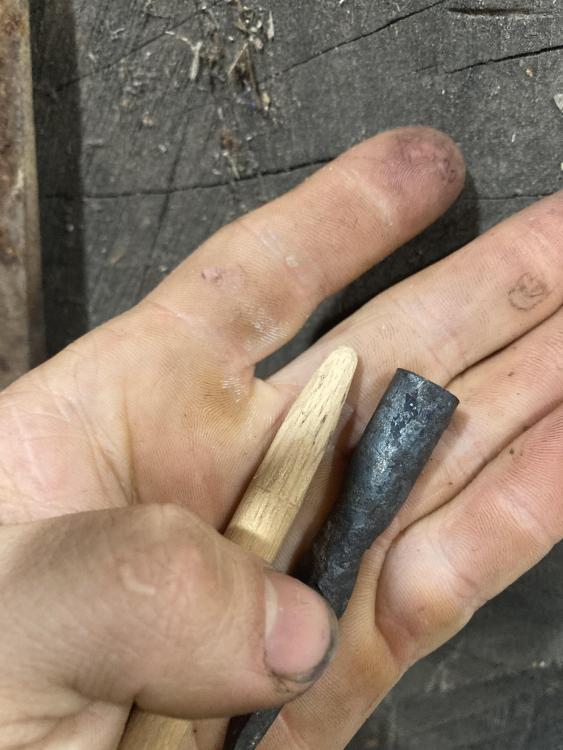
SubterraneanFireForge replied to DevanMcDavitt's topic in Spears, Arrows, Pole arms, Mace/hammer etc.I’ve had much more success attaching more cylindrical than conical shaped sockets. when I want to mount a head I just carve of some of the end of the arrow shaft with a pocket knife till it looks like the inside of the socket I’ll lightly place the socket on a couple times to make sure I’m on the right track. Then shove the head on and tap the back end off the arrow with a rubber mallet I attached my heads before cutting nocks from this reason. Then once the arrow is fully assembled I’ll lightly shoot it head on into a stump. Realized after I wrote this, that this post is old. Devan I hope u have had luck with your arrowheads and can fully enjoy the wonderful control and luxury of forging your one heads!
-
Sorry — this is long: I live in the city and work in my stair landing between the yard and bacement. Not xxxxxx xxx the neighbors with a lot of noise is a big part of the equation to continue make things. I have a small gas forge and cast Harbor Freight anvil and recently acquired a large metal wedge I’ve been using as a spike anvil. CAST ANVIL My cast anvil is securely fastened to a stump atop flat metal slabs and is wrapped in an old climbing rope with bits of short scrap metal intertwined in it to weigh it down. I’m going to get a thick chain to replace the rope. I’ve also heard of people placing a sheet of silicone between the stump and anvil but I’m worried about losing rebound. Should I be? Has anyone tried this? I’ve also heard of people using large magnets. Does this do anything? THE FORGE The sound of the forge itself is something I couldn’t find a lot of information on addressing. Would a higher quality forge or more insulation do a better job insulating the sound as well as the heat? Is there some way to muffle the rumble or make it travel less far? SPIKE ANVIL The spike anvil, while having beautiful sharp edges, rings like a bell and I’m not sure what to do about it apart from wrapping it in chain or the rope from the other anvil. It’s currently about a quarter of its length into a stump. Would hammering it more deeply into a stump make it quieter? INSULATION? Is there some sort of insulation I could line the walls of my little forge zone to stop the sound from traveling? If anyone has any advice or suggestions for noise cancellation I’d love to hear them. Thank you and happy holidays!
-
George after what u said I took some bolts and nails I had gotten from a demolished building and sawed and snapped them and they looked like wood!! I had wrought iron right under my nose! Sorry if this is redundant but will quenching in oil ad carbon to construction grade steel mild steel or wrought iron? Thanks for all the feedback.
-
Wow so many replies! Thanks! it seems like waiting to stumble across a better piece of steel is the way to go. Just curious for others projects can you ad notice able amounts of carbon to rebar by case harden or oil hardening it? that’s a generous offer Billybones I live in New York home of tons of rebar.
-
Hi I’m new to this forum and pretty new to blacksmithing as well. a crossbow is something I wanted to make sense I started forging. I was wondering how rebar would work for this application. I Know a leaf spring or other spring steel would work better but right now I have rebar and Im probably going to try it anyway and at least make a wall hanger or a crossbow shaped piece of steel. if anyone has advice on quenching ,tempering, annealing demotions ,forging, grinding ect I’d appreciate it.
-
it’s beautiful! Did u forge in or grind the taper? and what was the length and thickness and draw weight I’ve never made a steel crossbow but I’ve made a couple yew ones and string stretch has been an issue. u can tell if the string is if you’re brace hight decreases. whats the string made of?