Bob Ouellette
Members
-
Joined
-
Last visited
Everything posted by Bob Ouellette
-
I second that you should use at least 1/2" stock and work hot. As for a bending fork, you can make a very simple fork by bending a piece of 1/2" or larger round in a U and clamping that in the vice. It's a lot less work and just as effective.
-
I recommend the Museum of Natural History. It's been a while since I've been there, but I used to go a lot as a kid. The best part is that it's free I also recommend visiting Great Falls, though I've never seen it from the VA side of the river, it's impressive.
-
Swedish pattern hammers are nice, I like nice square faced hammers though.
-
I hardened the face first, so when I hardened the peen, there was enough heat transfer to temper the face. I tempered the peen only a bit as I wanted it to bee pretty hard still.
-
It was forged, then ground and finished off with a file. I guess leaving forged or filed for school kinda left its mark on me I did the face and peen one at a time in a coal forge. Heated up just about 5/8" back and quenched in water. Finnr, I can't say that it's a period handle, just what I prefer.
-
It's about 850 grams forged from an 18 wheeler axle or drive shaft. It was punched and drifted then hammered over the horn to get the shape how I wanted it. It's loosely based on the hammers from "The Masterm
-
I hope I'm not too late to jump in on the discussion. First I would like to say that you should probably use a lighter hammer. The biggest mistake some beginners make is to get too heavy of a hammer. About 2 pounds or so is a good weight. I recommend using a long handle, so that when you put the hammer head in the crook of your elbow, the handle extends to your finger tips. A longer handle will increase the velocity and the power of the swing. It will save your arm in the long run. The heavier weight of other hammers gets you twice. #1: You have to lift more weight, then #2: It doesn't rebound as much. Another advantage of a longer handle is that you can keep you hand father away from the hot metal. I guess some people like the short, Hofi hammer with a heavy head, but from my experience, the longer lighter hammer is really easier to use and hits just as hard with less effort. As far as head pattern goes, I like the old Viking/Medieval style. It's fairly similar to an American pattern, which is not too far from the German style. I think that it's all about the look you're going for. Of course, some hammer faces are a little further from the centerline of the handle than others, but each hammer takes a bit of getting used to before they all function the same.
-
Wow, that is terrible...
-
I wish I had a picture of the die we made for it. If I could get to school, I'd get one.
-
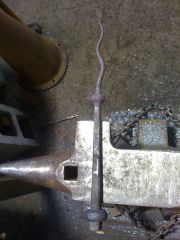
Thanks everyone. I really liked working on it (despite all the times when I thought my brain was going to explode). Mark, the beaded piece in the center (if that's what you're talking about) is made from 2 different sized collars welded onto the parent bar. The larger collar was 1/2" sq welded onto a 3/4" sq bar. The bar was then drawn down to 1/2" sq over 7 inches. A 3/8" sq collar was welded at 7" in a die. Heavy chamfers were forged onto the bar between the two collars. Then the flame was tapered, rounded and squiggled. Finally, the 1/2" round tenon was forged on it. Gerald, all of the joinery is mortice and tenon, half-lap, collars or forge welds. If you're interested in the school, call them up and talk to them. There may be scholarships available ;)
-
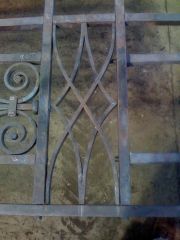
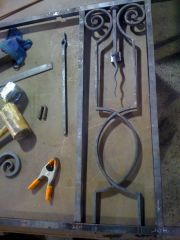
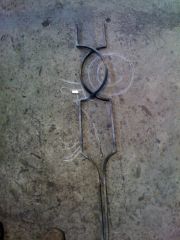
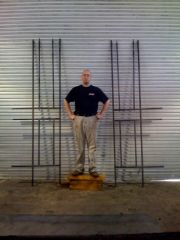
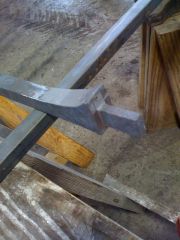
There's a picture of both of the side panel frames. The short, horizontal bars are half lapped into the extreme outer vertical bars and the tenons on the end of the horizontal bars fit into mortices in the extreme inner vertical bars. I hope that helps.
-
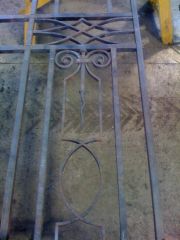
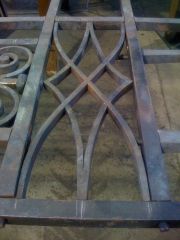
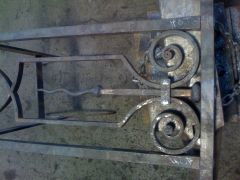
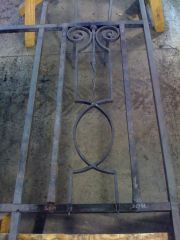
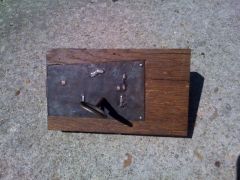
This is as far as I've gotten working one of the side panels for the gate we've designed during the BS 202 at the American College of the Building Arts. I've managed to get the bottom panel and lock plate of the side panel I was working on finished. The second year students next year will finish it.I've been fairly lucky when it comes to smithing. Only a few little scale burns on my hands and some stuff coming out of the fire and landing on my lips. It looks pretty funny when you see it happen, but don't know what's going on. The worst burn I got came from hot brass directly out of an M-16 hitting me in the neck then falling down my shirt, burning my chest and tender belly all the way down to my belt. I think you can still see a scar on my neck and a little bit of one on my chest.Thanks y'all. I'll try to work on a blue print when I make my next one. It'll be full of step by step pictures. I'll include the making of the key, which is just as, if not harder than the lock itself.Hi y'all. This is a plate stock lock I made a few weeks ago. Just now getting pictures. It took a week's worth of class to get the key cleaned up, the lock plate layed out and everything cut out and put together. I've also documented one of my professor's locks and started on a new key for my next project. Rubbings are an excellent way to get a quick and easy documentation and sometimes show something you can't readily see.
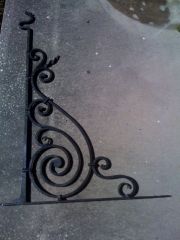
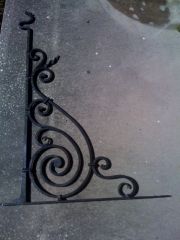
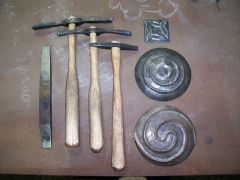 A few projects with the three hammers and one stake.
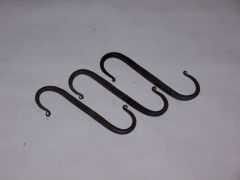 3 matching S-hooks forged from 1/2" stock.