Julianb
Members
-
Joined
-
Last visited
Everything posted by Julianb
-
No!
-
I cannot make out anything on that picture, I'm sorry! I can see the "No 1" stamp and a bit above it the "2" of the weight stamp. Sometimes, Krägeloh stamped on "Krägeloh Schalksmühle", but in pretty small letters. It doesn't have to be a Krägeloh at all though!
-
Hello! It could be made by F. W. Krägeloh, they most typically stamped the fire numbers in that style. I've seen it on a very few others though, but forgot any details. The "North German" refers to the pattern, not to the actual geographical place of manufacture. Krägeloh was located in Schalksmühle, western Germany. I'd say it is older than mid-20th century, but Krägeloh still produced forged anvils then. Without a date stamp we'll never know for sure though and they usually didn't do that. Cheers! Julian
-
Same here, around 0° Celcius I refrain from using my leave-spring powerhammer. I'm more concerned about the ram fracturing though!
-
The square holes in modern (industrialization and onwards) anvils were mostly done by drilling and then squaring with a vertical shaper.
-
They are somewhat hyped. Not that they're bad anvils, but nothing out of this world either. The information in that old thread, that Frosty linked, is not accurate though: - PFP did drop forge anvils, the smaller ones in one piece and from 50kg upwards they were made of two pieces, welded together at the waist. I'm not up to date on how they do it today, since the brand underwent some changes with this Ridgid stuff... - The hardy holes were drilled through and then squared up, but not all the way through. It is not a bad sign, if you can see the circular part further down. - The raised "PFP" logo on the side is not a sign of casting, although you can date the anvil a little, because they used different stamps at different times. This is earlier, but not earliest, I forgot the exact timeframe. - The grinding marks beneath the horn and heel are the areas in which the flashing from the drop forging process has been ground away. I hope I could help out! Cheers! Julian
-
Hello! I have no real idea about anvil prices in the US, other than them being incredible compared to Germany. So from that perspective I'd never spend that much money on such a worn down anvil, but if you do not really have alternatives and really need one... This one will be 25-30kg, personally I find those a little bit too small to do real work on it. Just as an assessment from afar, just because it's a PFP, it doesn't mean it is worth that price... Cheers! Julian
-
That they're currently not in use doesn't mean they will be at any point though, honestly. Stake plates are not that common as anvils around here and I do not like the typical pattern of them. The stake anvils are going to be set in nicer display stumps, when I get around to it. The sheet metal stakes will be set in an old oak beam. I seriously expanded my available space, at some point I'll finally post some pictures in another workshop thread (when I get around to it...) Cheers!
-
Hello! Not just today, but I finally finished an anvil shelf to properly store those not in use at the moment. Cheers! Julian


-
Well, it might also be an inadequate choice of translation from my side. I guess you could also describe the meaning of term as "protrusion" or "extension". The same for the side shelf, for which the German term could also be translated with something like "anvil extension". Thank you for looking into the French translation, Larks!
-
Well, my Firminy catalogue doesn't list this pattern, so no luck there. Various German manufacturers call this kind of hardy hole "halfround attachment" or "hole attachment". I also found another term for the Eselsrücken, which is "Reckrücken". This translates to "back for drawing out", further supporting the theory that it is meant for drawing out pieces. Cheers!
-
They also forged those patterns, although in France itself anvils were cast more often. I'll have a closer look in my catalogues after I return from work, but I think the term for this kind of hardy hole design would more likely be "swallows nest", as the "swallows tail" often refers to the shape of those tool slots in the face. But I don't speak french, will have a look into it later. Cheers!
-
You're welcome, I'm glad to actually be able to help someone out with all that niche-knowledge. Maybe at somepoint I'll be even available to provide some written work, but it'll be a few years until that's print ready. Here's a quick snapshot of my anvil with an Eselsrücken, I need to drag it out of its corner at some point, as you can barely guess the upwards curve in the horn. It's something like a "French pattern with one horn, donkey's back and attached hole on the master's side".

-
Ah, now we've posted at the same time. Those anvils with the four legs are often referred to as French patterns, but historical manufacturers actually list them as Italian patterns.
-
Hello, this kind of transition between the face and the horn is called an "Eselsrücken" in German, a "donkey's back". It is found in the so called French or Luxembourg patterns, although they're also available without it. I've got one tucked away in a corner, will go and take a picture later. Cheers! Julian
-
You are absolutely correct about that!
-
It is not as common, but not unique either. I've come across several examples over the years, but they are most definitely rarer than other patterns.
-
Hello! This pattern is called "Schweizer mit 1 Horn, Voramboss und geschlossenem Stauchfuß", which translates to "Swiss with one horn, side shelf and closed upsetting foot", the "closed" not in a way of locked, but meaning something like "cohesive/one piece". The kind of breast often found on swiss pattern anvils is called "half breast", because, well, it's half the size of a full breasted model. You are absolutely correct with the Holthaus stamp. Cheers! Julian
-
Nit Noloten is not the name of the manufacturer. It is just a phrase, meaning something like "Don't let up!".
-
Hello! It seems very similar to this one, without the circle: Probably made by the same manufacturer, just at a different time. Those markings tend to vary from time to time. Which maker that actually is, is unclear at this point though. Cheers! Julian

-
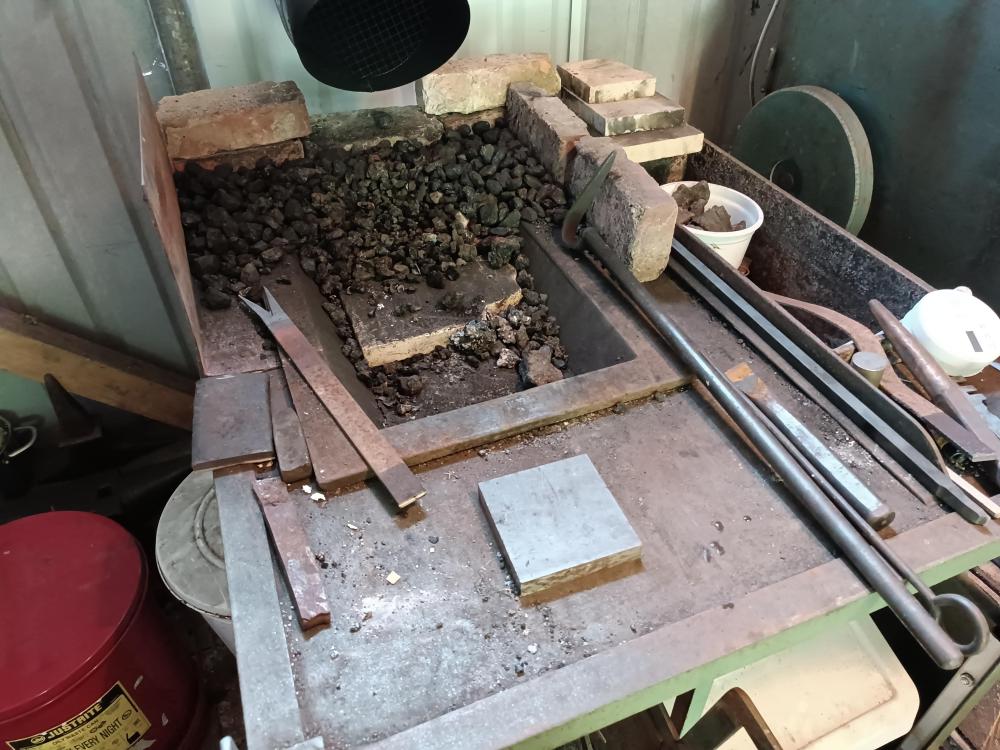
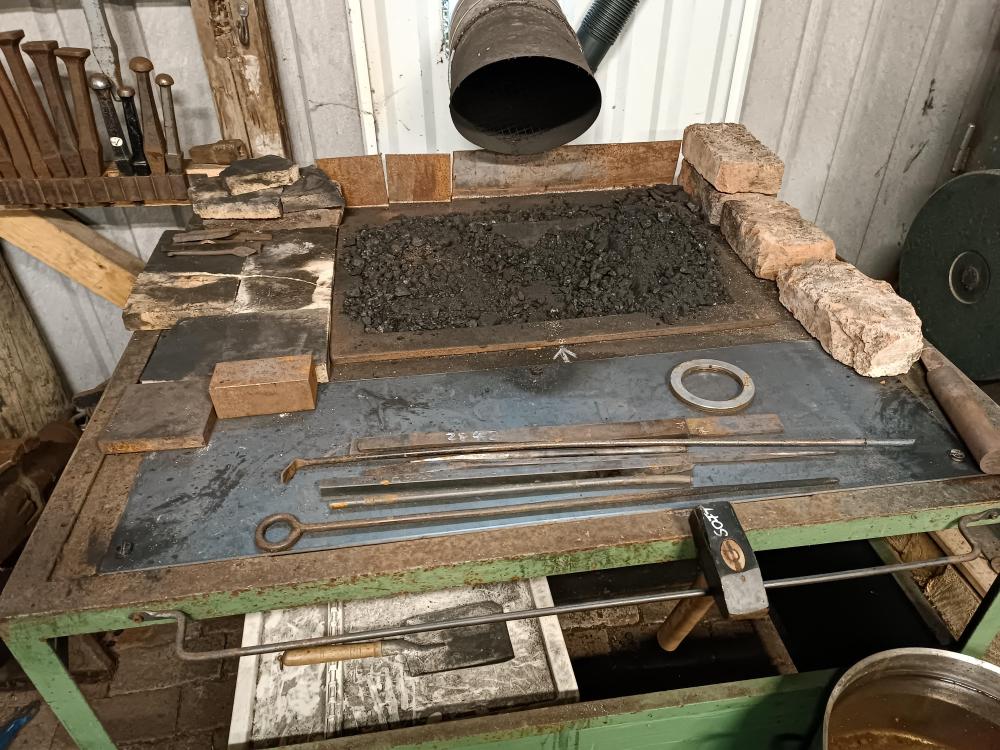
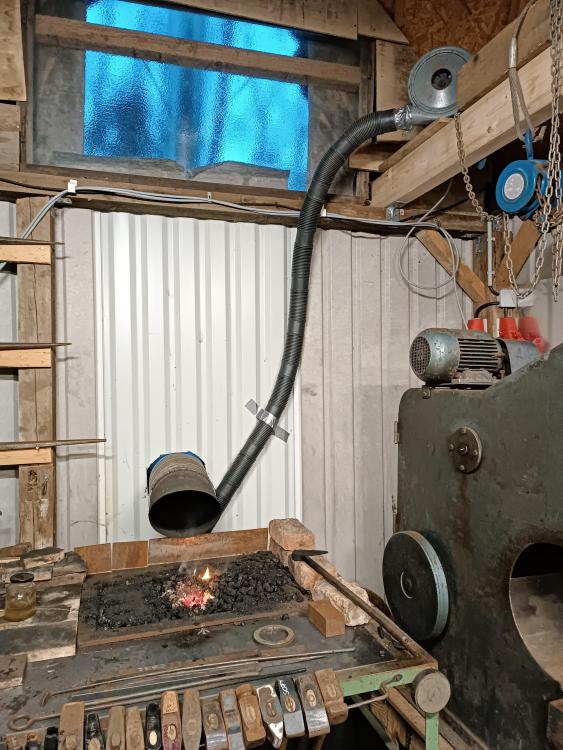
Hello! I didn't create much recently, but reorganized a lot in the shop. This week, I updated the fire to better fit the layout of the forge. At first, it wasn't really practical to have the table reach as far into the room and at the same time have so little space to warm up longer pieces. So I turned it lengthwise, but then the water trough got in the way. As I didn't really need that on there anyway, I bolted down a 6mm plate over the opening, to create more useable space. I didn't weld it in place, to be able to flawlessly reverse the process, if need be. I also moved the blower up onto a beam, it was bolted to the table before. Before: After: Cheers! Julian
-
Sadly, I couldn't find the sculpture anymore, it has been given away. But I've got another interesting thing, the model of a large bronze sculpture depicting a blacksmith and his apprentice. The sculpture is standing on an old marketplace, in the same place there's been a sculpture of a weapons smith, until its destruction in 1944. The original can be found here: https://solingen.de/inhalt/verzeichnis/artWork/19 Cheers!


-
This is amazing, thank you for sharing and testing! I'll be sure to try that out. I've recently bought 5 litres of Evaporust, but at the price of 50€ for that, I'll be happy for an alternative to be able to soak whole anvils in... Cheers!
-
I think I have at least one of those lying around. I'll dig it up.
-
This has so much historical value, I'd agree not to use them and conserve and document them instead.