

AnBello
Members
-
Joined
-
Last visited
Everything posted by AnBello
-
As less than a beginer, I can only talk about what I have seen in this forum, and my own thoughts. As I see it, you have 2 options to start: Learn forging/general blacksmithing, then move on to forge blades. This way, you'll probbably make most of your tools, and get a nice set of skills (hammer control and a lot others). Once you move on to making blades, you'll be quite profficient in forging, so you can focus only on the blade-specific processes (heat treating, grinding, sharpening, handles, etc). I'd recommend this if you want to be a blacksmith with bladesmithing skills. Learn how to make blades (by stock removal), then move on to forge blades. This way shows its rewards faster as it won't take you too long till you have your first sharp knife. You start by learning grinding, heat treating, sharpening, handles, etc. and then you move on to forging, where you focus on general blacksmithing skills and the like. This would be if you want to be a bladesmith with blacksmithing skills. In the end, you will probably get enough profficiency in both aspects if your ultimate goal is to make knifes/blades. This is just how you start. DO NOT try to do both since the begining, it will be too hard and has gotten a lot of people frustrated. EDIT: Just to avoid being misunderstood, I'm not saying that one way is better or "more blacksmith-y" than the other. Both are equally valid, it just depends on your likes and what you plan to do.
-
Since I'm a native Spanish speaker, I'll do my best here: -Front (lower photo, with the blacksmith): Welding iron and steels. Made in Spain (in the little white box) 10 light sheets/plates "Laffitte" (the brand) (The same is repeated in the lower edge) -Sides: Gridded sheets. Registered brand and model. -Back (the first photo, with the anvil): Welding 2 pieces of Iron or Steel A piece of sheet between the parts to be welded Temperatures: Pale white for Iron Orange-yellow for steel -Sides: Society of welding powders and sheets, Tarragona (a city in Spain, also the name of this particular company) (PS: Is it "gridded" when something is marked/divided in squares?)
-
I don't personally have any authority on the subject, but I though it would be useful to post these words, said by Steve Sells, who was quoting Glenn. Names big enough to warrant some attention. I'm sorry if this is out of place, but I'm just sating that I stand with the crowd of "first try until it works, and then modify/experiment".
-
I have personally seen that exact same effect in an old, small hammer. It was used (and abused) to hit stone, bricks, cold metal and anything you can think of for a small house hammer. I can't take pictures, because just last week I grinded it to have a more even surface, but it looked exactly like that, as if a VERY thin layer got "separated/delaminated" from the rest. Taking into account that it was a hammer and not an anvil, and showed the same effect, I would say that it is not exclusive to anvils, so anvil construction should be a bit less relevant for this subject. Also, as this is a very small cross peen hammer (2cm square face, 9cm total metal length, I would gess about 8oz), I doubt case hardening or differential hardening was applied (I might be wrong). So, my guess would be that this effect is related to the striking nature of the work involved, the same as in an anvil. Probably work hardening? Of course, that's just speculation. I'm sorry for being long winded, it's in my nature.
-
Bookmarking this page, hoping for more people to comment on "unusual" beginers techniques that I can use! It's been a very hard year for me (and it still is), but as soon as I get the resources (including time), I'll be sure to come back here!
-
The thing that impresses me the most is that this behaviour is usually "expected" to an extent from teenagers - boys in their 20s. But, according to his words, this was a well grown up man. Or maybe just an "old boy", but still, one would expect that age and experience helped him listen a bit more... By all means, I'm not against trying things, but I think you should always have enough knowledge and experience in the "regular" way, before experimenting with something new. That way you have more chances of success, and a lot less chances of blowing yourself up.
-
"Remember: Experience is a hard teacher because she gives the test first, the lesson afterward. If you fail the test chances are you won't be around for the lesson." Woody
-
DSW: Thank you for your input. I didn't know that about air brakes, and I could have done something risky. About the 3 round tanks I'm talking about, 2 of them don't appear on the pictures, but are exactly like the ones in the 3rd picture. They are located in the center of the truck, you can barely see them in the first picture. These ones: I'm not considering selling it as a whole mainly because of all the regulations there are for vehicles here. It's not illegal to destroy it (unless the owner has some way of claiming it), but it IS illegal to try to use it, unless you have all the corresponding papers (which are surely long lost). I will check if I can work out the numbers on the license plate, but there's no hope of it being still useful as a vehicle (even if it runs). I'm seriously considering the pros and cons of taking it appart. But so far, the best "deal" I got was to give it away for free (they can keep it if they take it somewhere else), or just take it to the side of the road and "Inform the town that there is an abandoned truck in front of my house", so that they take care of it. I'm not sure how to explain it, but basically: We've bought a "vacant" lot almost next to our house. In this place, we found the truck and a half-demolished house (house project actually, only the walls were built and then partially demolished), so the place is half-filled with rubble and plants/small trees growing in there. So there will be a lot of cleaning to do, and it's somewhat a mid-term project (2-5 years). No hurry to get it clean, and all the broken bricks and concrete will be about as much work as the truck. The owners of the lot have nothing to do with the truck nor the building, they just lent it to someone else for a long time. I see that there are some issues I hadn't considered, and I'll need to think a bit more before actually starting, but so far it still seems to be the best idea for me. I could try to sell parts of the engine/transmission, but most other parts seem to be far too rusty and old to be used in a vehicle. If I finally decide to carry on, I will most likely start with the rear leaf springs, and the 3 air tanks. If I wanted to take apart the leaf springs, Which part of the process is the most dangerous one? What is the step when I need to stop and say "If I'm not careful, this spring will hurt me"? Do I just cut the U bolts, or do I first find something (strong bricks or something) to put under the structure of the truck to keep it from falling? Do I take the wheels first, or just go straight to the springs?

-
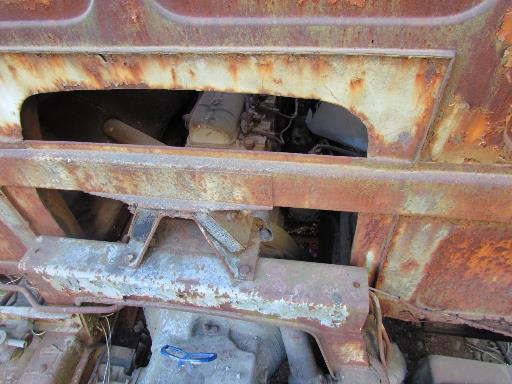
Well, after some unexpected circumstances, you could say that I ended up with an abandoned truck at my "side-yard". It seems to have been there for about 10 years, maybe. It is kind of a god-send, given that I'm starting up in this craft. It seems that there is a LOT of usable materials, of different quality and composition, and some parts that might be useful as they are, even if they are not good as forge material. I know that I can (at least) use leaf springs, axles, and maybe some other parts. I see some tanks that can be useful as a gas-forge, and quenching-tank. I know almost nothing about cars, and even less about trucks, so I'm standing here, asking for your help today. I want to take all usable part from this vehicle, but I have no idea how to do it SAFELY. I really wouldn't like a leaf spring to jump full-force into my face, a tire blowing up, or the whole truck falling on me. Most likely I won't be able to use any electric tool, since there is no electricity in this particular space yet, or anywhere close. Here are some small photos: (More High resolution pictures in this link: http://imgur.com/a/v9pIW#0 ) This is the old truck A lot of leaf-spring metal 4 of these stacks, one for each wheel (safety goggles for scale) Future gas forge/quenching tank (there are 3 of these tanks, oil tanks I believe?) BIG heavy chunk of metal. Probably useful, right? No idea what this is, but it seems to be aluminium. It left these marks when I hit it with a very small hammer. What's that? Could it be...? Yep. It is. The engine is still there. Useful? This is all, sorry for all the pictures. As I said, I'm quite lost as to how to go around with this. I have never really done any kind of "real work", but I want to do this. I believe it will be a great experience, and I will learn a lot from this. But, I don't want to break a bone, lose a finger, or worse. So, can you please help? PS: More pictures, high quality: http://imgur.com/a/v9pIW#0




-
From the point of view of a newbie here, all I can say is that I think that you "old folks" are right. Don't take it as a "Ok, you're right" kind of thing. I mean it in a deep, meaningful way. You Are Right, about what you've been talking in this thread. This place is SO filled with knowledge and advice that I can't imagine how I would do it without this site. I'm new to this. Haven't even started, actually. I have been lurking this forum since December, and I only posted for the first time last week, when I felt I was kind of ready to actually begin. I'll be asking for help soon, because I lack a lot of skills and knowledge, not only those related to this craft, but also anything not related to PCs. Thanks to the people who posted in my introduction thread (especially Frosty), I have set a starting point to improve my skills, and I will be slowly walking up that path to more complicated projects, little by little. But in my time reading this, I've come across so many "young people" asking the same questions, that even I felt embarassed. Just by reading a couple of stickies, those questions got answered 2 or 3 times, with varying amounts of detail. And they can't say they "aren't familiar with how a forum works". No offense, but they (gamers and hardcore internet citizens) probably know about forums even better than all of you, so they know what a "Sticky" means and how to find it. I don't want to make myself sound superior to other people my age. I'm stubborn, I tend to think "I know it all". Mainly when someone tells me "That won't work", I tend to say "Ok, I believe you, but I still want to try it". I just hope that even though I'm as stubborn as anyone my age, I can still take my hat off in front of you all, ask for a glimpse of your knowledge, and know how to be grateful for it. Because thanks to this forum (actually, Thanks to the people in this forum), blacksmithing is within my reach. It's real, something that I can actually learn and do. PS: So, tomorrow I'll be making my first 50 kg Titanium+Tungsten sword and quenching it in snow, tell me how to do it! D:<
-
Right now I'm cheking a lot of posts in the "Gas Forge" section. I'm looking for a viable design that I can make for now. I'm not sure what would be best for me yet, but I'm checking different designs and what their making prices&time would be. Once I decide on the forge, I'll look into the burner. I chose gas because here real coal is hard to get by, we only have charcoal. And charcoal is quite expensive, because it is of very high demand because of our "asado" (local kind of BBQ). Gas, on the other hand, is a lot cheaper, especially with 10kg propane bottles that are government subsidized, and therefore quite cheap. Also, it seems to be quite cleaner, right? I hadn't thought I could use my "anvil" vertically. That's opens up a lot of possibilities. Thank you! I will try to ask if someone knows somebody who is or used to be a blacksmith. I'll get in touch with any related shop I can think of. Maybe even asking local forge material suppliers could help. Thanks for the tip. PS: Just to clarify: This "mud oven" is not intended to cook mud. It's intended to cook food inside of an oven that is made from mud (nowadays, mud+refractory powders mixed), like this one or this modern one. It is usually heated by charcoal and wood, but some people prefer to use gas. Once it's hot you turn it off/remove the leftover coal (paper should catch fire as soon as it enters, with the burners off), and then add the meat to be cooked with the leftover heat. In the second one you can actually see a burner similar to mine. I will probably use my burner to build one of these, if I can't use it for metal working.
-
About the burner, yes, I believe it is prepared in that way, given its design objective. I guess it will work for heating metal, but will consume a lot more gas than a better burner would, right? I think I'll have to test it. And if it isn't useful, at least it can make quite a good mud oven for a nice big "bbq". I'll ask in more detail in the "Gas Forges" section, I hope I can get more info on that, then.
-
Well, wasn't expecting to have so many replies in so little time. Thanks for the warm welcome! Where I live I haven't been able to get in touch with anyone in this branch of work, but I'm still trying. It doesn't seem to be very common here. And it's also very hard to buy "known" steel, at least for someone unfamiliar with the market. Frosty, thanks for the advice. I'll try to do what you explained. I think I can even do that in my spare time in-week, and build my skills with that. I'll see what soft metal I can get my hands on. Probably copper, or maybe aluminum. Once I feel a bit comfortable with the hammer I'll move to hot metals. Luckily, I have come across several elements that will be of use for when I start working with steel (apart from a whole set of PPE I got from work). So far I have a piece of about 60cm (2ft, sorry, I'm only familiar with metric system) of railroad track that I plan to use as an anvil. I also have a nice gas burner that came from a mud oven (it looks like this), and a good hammer (though it's a bit small). I still have to build a forge, though. And I also have a whole abandoned truck in my backyard to scrap from, so I can get quite a big assortment of steel to start with. Thanks everyone, and I will be asking questions around the forum from now on.
-
Hello, everyone on this forum I'm Andres, from Far Far Away (Argentina, actually). I've always been interested in this kind of work, but it was just a "platonic" kind of interest, until I've finally decided to get started with this, and here I am, getting the parts for my first temporary forge and anvil. I have never really done any kind of hand work, I'm just good with PCs and electronics, so it'll be quite an ordeal. But I've been reading quite a lot, so I hope it's not as tough as it seems. I'm gonna be starting with the very basics, just learning to work metal itself (heating it, hammering it, shaping it, heat-treating it), and slowly I will move into knife-making, which is my real target. I'm quite busy (work all day, University all night, free some weekends), so I will try to read all I can during the week, since I'll only be able to practice on the weekends. I hope to get some good advice, and eventually be able to give my own, but since I'm just starting I'll be asking a lot of quesions around here, so please bear with me.


