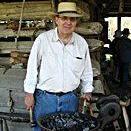
November 27, 200817 yr Author This hammer was made by Michael McCarthy. Is this what could be called a Colonial Pattern?
November 27, 200817 yr Doesn't look like the old spanish colonial ones from here in the USA You might want to look through something on Williamsburg to see what they are using.
November 27, 200817 yr Author Thomas, I did exactly that before I posted this. I did not see anything like this hammer. Michael's shop was entirely hand powered, no electricty anywhere, and he forged this entirely by hand. He said the group at the museum made their own charcoal and smelted their own iron. I don't think this is steeled wrought, though. This is one of the hammers that had been stolen from me in the burglary I posted about several weeks ago. I am really glad to get it back. I couldn't remember where I saw the term "colonial pattern hammer". It is right here in the auction section. It is one of Jymm Hoffman's hammers. Looks similar. Edited November 27, 200817 yr by Quenchcrack
November 27, 200817 yr I would say it would be okay, maybe even work for earlier periods better. One of the common parts I see of earlier hammers, cross peen is in line with the bottom of the hammer. Many variations after that.
November 28, 200817 yr Checkout Blacksmith Guild of VA Colonial Blacksmith Rendezvous pg.7 Blacksmith Guild of Viriginia - Gallery Their are several hammers in one picture. What better than Williamsburg Smith's. Travis
November 29, 200817 yr I think you are asking the wrong question. You are asking if there is a colonial pattern hammer. The question should be what do colonial era hammers look like. Based on the specialties and specific jobs they had a range of hammers. Since the colonies were being colonized the origin of the colony/colonist can make a difference also. that being said. here are some williamsburg and monticello photos williamsburg silversmith shop (some great hammer photos)Williamsburg Silversmith - a set on Flickr Probably what you are really looking for is in these 2 photos Williamsburg blacksmith shop (not so great on hammers it was honeymoon and my wife and I had a deal about not spending all day at the blacksmith shop)Williamsburg Blacksmith - a set on Flickr Monticello early american nail heading setup and clockjack picturesMonticello 2008 - a set on Flickr Edited November 29, 200817 yr by solvarr
November 30, 200817 yr Author I do not want to know what ALL colonial hammers looked like; I just wanted to know if there was a typical pattern that could be representative of the Colonial Era. But thank you for your references. I went to Williamsburg and was also facinated with the Blacksmith and the Gunsmith even before I began smithing. My son just wanted to go on the roller coasters at Bush Gardens.
November 30, 200817 yr I beleive that the style of hammer used was dependent on the country of origin for the smith, or his master. it's conjecture
November 30, 200817 yr The ones I make, use and am having reproduced are based on an example found in Dunbar's Camp, the guy that was in charge after General Braddock was wounded then died, plus other 18th. century examples BRPA - Dunbar's Camp . So that is why I put the label "Colonial Pattern" on it. Yes there were lots of styles, but as mentioned, most early cross peens seem to have one thing in common, the peen is on line with the bottom of the hammer not the center as is most modern peens. Yes, there were some regional and of course personal variations. As pointed out, there are hammers for other trades that vary greatly. There are a couple of pattern books that have been reproduced that show these. My hammer is for blacksmiths, not silversmiths, coppersmiths, coopers, carpenters, etc, unless they want to do some serious forging. Without digging up a lot of research, you will see the basic pattern from the early 19th. century (that is 1800's) and earlier. One can even see this basic design throughout Europe. The English did import German and French ironworks in the 16th. and 17th. centuries. So there is probably less distinction in patterns than there is today. But many people today want a label and they want sound bite answers. So I made a flyer up, prior to posting it on IForge's Tailgating area as "Jymm's Colonial Pattern Hammer", not THE Colonial Pattern. As I am reluctant to broadcast something this basic as "MY" design, I choose to leave my name off the posting in the Tailgating section. Now, if you want a top notch, excellent 2 pound forging hammer that is made in a style that is appropriate to use for historic demonstrations. Look at the hammer I have posted in the Tailgating section "Colonial Pattern" Hammer - Blacksmithing Classifieds. There are 3 left and I do not know when I will be getting more. Everyone that uses these with my handles fall in love with them. I use one like this every day, I am a full time smith. One of my helpers uses one of these everyday. He stopped using other hammers after he started using this one. Other students have also made the switch and refuse to use any other hammer for basic forging. When I have reproduced tools for historic demo's, and get it right, I normally find out why some things should not be changed.
December 1, 200817 yr Author Well, Jymms "Colonial Pattern Hammer" is a darned nice one and I would dearly love to have one. I really like the one I have and the other dozen varieties or so I already own so I will probably not be getting one soon. But I thank everyone for the input and guidance.
Join the conversation
You can post now and register later. If you have an account, sign in now to post with your account.